Networking
Professional Networking: What It Is and a Weekly Routine
12 min read
Key takeaways
- Professional networking is meeting people and staying in touch over time. A contact you never write to is just a name.
- The strongest evidence is about weak ties. In a study of more than 20 million LinkedIn users, looser ties helped people change jobs more than close ones. The study measured job moves only.
- Networking is not a fast channel. A Federal Reserve Bank of St. Louis analysis found that people who used their networks found jobs at a slower rate than the average job seeker.
- A small weekly routine beats a big push. Try three sessions of about 20 minutes, one list of people, and three numbers to review each month.
Short answer: Professional networking is getting to know and staying in touch with people who can share advice, information and openings, and who can count on you for the same. It works through many small, honest conversations over time, not one big push. Start with one list of people, one weekly routine and one way to follow up.
In this article
What is professional networking, and what is it not?
Does professional networking actually work?
Which way in is right for you?
How much time does it take, and what should a week look like?
How do you know it is working?
FAQ
Do this today
What is professional networking, and what is it not?
It is Sunday night. You have a job offer to think through, or a question about moving into a new field, and you scroll your contacts for the right person to ask. Some of the names belong to people you have not written to in two years. The gap between the people you know and the people you actually stay in touch with is the gap professional networking is meant to close.
Novoresume defines it as building and maintaining professional contacts, ideally to the benefit of both sides, through advice, referrals and opportunities. The word that matters is maintaining. Uniqode's guide sorts networks into four kinds: operational (people inside your organization who keep daily work running), personal (people outside it you can turn to when you are stuck), strategic (people tied to your long-term goals) and nodal (well-connected people who open access to other circles). You probably have people in each group already. Writing them down is the first step, and our guide to building a professional network from zero shows how.
It helps to say what networking is not. It is not collecting connection requests, sending one message to a hundred people, or asking a stranger for a job in your first message. We recommend none of that, and we skip any tool that sends messages in bulk. Every message should be written by you, to one person.
Does professional networking actually work?
Mostly yes, with limits. Here is what each piece of evidence measured, and where it stops.
- Weak ties. In 1973, sociologist Mark Granovetter asked people who had found jobs through personal contacts how often they saw the contact who helped them. According to a summary on AcaWiki, 56% saw that person occasionally and 28% rarely. The group was people who found jobs through contacts, so it cannot tell you how many job seekers get work that way.
- A test on LinkedIn. Scientific American reports a study of more than 20 million LinkedIn users over five years. LinkedIn varied its People You May Know suggestions at random, so some users saw more weak ties and others more strong ones. Weak ties helped people get new jobs, and the most useful ones shared roughly 10 mutual connections. The study measured job moves on one platform, and strong ties still gave people the support to keep searching.
- What workers say. A MyPerfectResume survey of 1,000 U.S. workers, reported by HR Dive in 2025, found that 54% said they got hired through a personal or professional connection. The article does not give the sampling method, so treat it as a rough signal.
- A caution. A Federal Reserve Bank of St. Louis analysis of Current Population Survey data found that contacting employers directly had the highest job-finding rate in the first month of unemployment, 46%, and that people who used their networks found jobs at a slower rate than the average job seeker. It looked at people who were already unemployed and searching.
Here is our reading, not a finding of any one source: networking pays off most when you get to know people before you need them, and it is slow. It is a habit, not a shortcut. If you need a job this month, apply and keep networking in parallel.
Which way in is right for you?
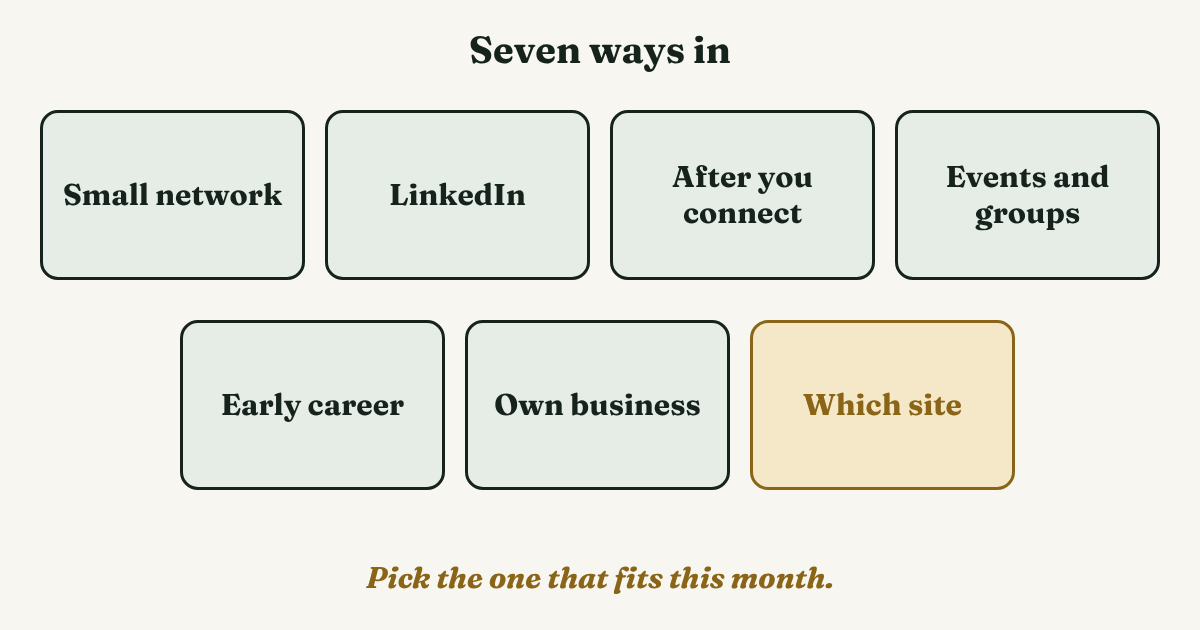
People come to networking from different places, so we sorted our guides into ten starting points. Pick the one that matches your situation this month, read that guide, and leave the rest until you need them.
I have a small network and want to grow it
Start with building a professional network: 5 steps from zero, which covers who to add, how often to reach out and how to keep people. Before you pick any app, the strategy tool guide shows how to plan first and choose a tool second.
I want LinkedIn to work like a network
LinkedIn professional network: 4 steps explains who to add and what to do after they accept. If you are new to the site, begin with the 7-day LinkedIn start plan. To be found by more people, see how to get more LinkedIn followers and how to use LinkedIn for professional growth.
I do not know what to write after we connect
The LinkedIn follow-up message guide has four templates and says when to send them. Then pick the case that fits: after someone accepts your request, to a recruiter, or a professional first message to someone you know little.
I want to go to events and groups
Professional networking events: pick, prepare, follow up covers choosing a room and, most of all, what you do afterward. If you are leaving a career fair, add the follow-up message after a career fair.
I am early in my career
Networking tips for young professionals gives 7 ways to start when your work history is short and your list is small.
I run my own business
Networking events for entrepreneurs helps you pick by goal. For founders on LinkedIn, see how founders grow on LinkedIn and how to write LinkedIn outreach for founders.
I am not sure which site to use
Professional networking sites: pick by job, not by rank sorts sites by the job each one does and gives a two-week test.
I want more people to accept my requests
LinkedIn connection request: note or no note, then what? shows when a note helps and what to send the day someone accepts.
I sell on LinkedIn
LinkedIn for sales: a simple weekly routine helps you pick 25 people, write one useful message and follow up with a date.
I need to find the right person
How to find people on LinkedIn starts with what you know: a name, a company, a school or an event.
How much time does it take, and what should a week look like?
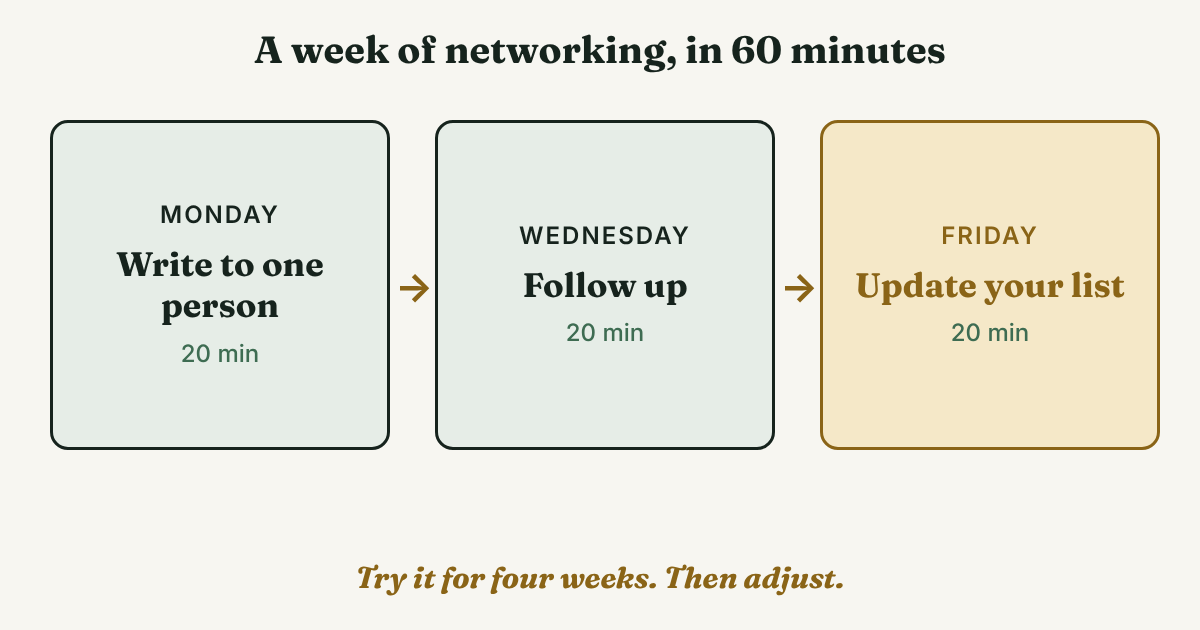
We found no source that says how much time networking needs, so what follows is our suggestion, not a finding. Try it for four weeks, then change it. Three sessions of about 20 minutes a week:
- Monday: write to one person. Pick one name from your list and write to that person in your own words. The professional LinkedIn message guide has a frame if you want one.
- Wednesday: follow up. Reply to anyone who answered you. Then write to one person you talked to recently with something useful: an answer, a link or a thank-you.
- Friday: update your list. For each person you talked to, write one line: where, what you talked about and the next step. Then choose three names for next week.
Here is the line to copy for each person on your list: [Name], [where we connected], [one detail they mentioned], next step: [what I will do].
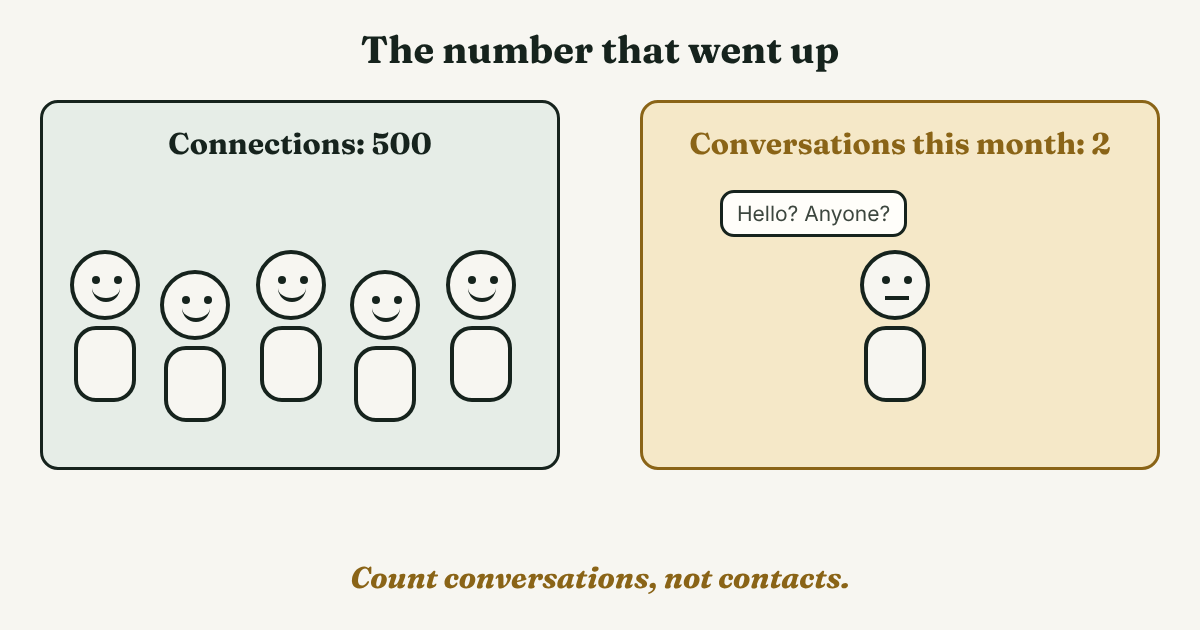
The common mistake is counting contacts instead of conversations. Daniel (an example, not a real person) is a product manager who adds people until he reaches 500 connections in a month. When he checks, he has talked to two of them. The number he can see went up. The number that matters did not. A smaller list that you write to, one person at a time, does more than a long list you never open.
The list needs a home. A notes app or a spreadsheet works. Full disclosure: we make GrowthSeeded, a simple follow-up tracker for LinkedIn. It does not find people, write messages or send them. You write a note after each conversation, and a due-today view shows who is waiting for a follow-up. The next step comes from what happened, such as an accepted connection or a reply, not from a fixed date. The Free plan is $0 for 5 active people at a time, and up to 20 when friends join through invites (checked October 2026, and plans change).
How do you know it is working?
Skip follower counts. Once a month, count three things: people you wrote to, real conversations (a two-way exchange, not a like) and next steps agreed (a call booked, an introduction offered, a question answered). If the first number is high and the second is low, change your opening message. If the second is high and the third is low, change how you follow up. For the LinkedIn side, see how to use data for LinkedIn growth.
Then run the Sunday night test from the start of this guide. Could you ask three people for advice tomorrow, and would they answer? That is the gap, measured.
FAQ
What is professional networking?
It is getting to know and staying in touch with people who can share advice, information and openings, and who can count on you for the same. Staying in touch matters as much as meeting them.
Is LinkedIn a professional networking site?
Yes. LinkedIn describes itself on its about page as "the world's largest professional network" with more than 1 billion members in more than 200 countries and territories. That is LinkedIn's own claim. Whether it fits you depends on whether your people are there and answer you. Our guide to professional networking sites covers the other kinds.
What is a weak tie?
It is an acquaintance rather than a close friend or family member. Granovetter argued that weak ties link otherwise separate groups, which is why they can carry news of openings that your close circle has not heard.
How often should I reach out?
We found no source for a right number. Our suggestion is the routine above: one new message and one follow-up a week, then adjust to what you can keep up for a year, not a month.
Does networking help if I already have a job?
It can. A New York Fed analysis found that employed workers who were not searching received about one-fourth of all job offers, and the authors link this to informal contacts. The data were self-reported survey answers, so read it as a pattern, not proof.
Do this today
- Write down 10 people you could ask for advice tomorrow.
- Next to each name, write the last time you talked.
- Write one message, in your own words, to the person you talked to longest ago.
Ten names is a small list on purpose. Once you have them, add each person to GrowthSeeded with a note on where you left off, and the due-today view will show who is waiting. You send every message yourself, and it never sends anything or touches LinkedIn.
Sources
- Professional Networking | What Is It & Why it Matters, Novoresume, checked 2026
- A guide to professional networking, Uniqode, checked 2026
- The strength of weak ties (summary of Granovetter's 1973 paper), AcaWiki, checked 2026
- A Massive LinkedIn Study Reveals Who Actually Helps You Get That Job, Scientific American, checked 2026 (reports a study published in Science)
- Half of workers say they got a job through a connection, HR Dive, 2025
- Job Searching: Some Methods Yield Better Results than Others, Federal Reserve Bank of St. Louis, 2014
- How Do People Find Jobs?, Liberty Street Economics, Federal Reserve Bank of New York, 2017
- About LinkedIn, LinkedIn, checked 2026
About the author
Anisur Rahman Fagun is a marketing and content strategist with more than 9 years of experience in SEO, content, paid advertising and brand growth. He holds a master's degree in mass communication and journalism, and has led content and SEO strategy, built editorial teams and worked with product, design and sales teams. He also builds simple tools that turn marketing data into clear decisions. He writes the GrowthSeeded blog, which shares practical ways to follow up and stay in touch with people on LinkedIn.
Related reading
- Building a Professional Network: 5 Steps From Zero
- LinkedIn Professional Network: 4 Steps to Make It Work
- LinkedIn Follow-Up Message: 4 Templates and When to Send
- Professional Networking Events: Pick, Prepare, Follow Up
- Networking Tips for Young Professionals: 7 Ways to Start
- Professional Networking Strategy Tool: Plan, Then Pick