Networking
Professional Networking Sites: Pick by Job, Not by Rank
10 min read
Key takeaways
- A professional networking site is a place where people with work in common can find each other and talk. Choose by the job you need done, not by member count.
- Size is not fit. LinkedIn says it has more than 1 billion members, yet in a 2023 Pew survey 53% of U.S. adults with a bachelor's degree used it, against 10% of those with a high school degree or less.
- Four kinds of site cover most needs: a large network, event pages, interest communities and craft sites. Most people need one main site and one small second one.
- Test any site for two weeks with three numbers: people you added, real conversations and next steps agreed. Keep the people you want to stay in touch with in a list of your own.
Short answer: A professional networking site is an online place where people with work in common find each other and talk. Pick by the job you need done: a large network to be found, event pages to meet locally, a community to talk shop. Use one main site, add one small one, and test each for two weeks.
In this article
What is a professional networking site, and which kinds are there?
How do you pick the right site?
What does a big network do well, and where does it stop?
How do you test a site in two weeks?
What do you do with the people you find?
FAQ
Do this today
What is a professional networking site, and which kinds are there?
You search for professional networking sites and get a list of ten names: LinkedIn, a job board, an events page, a portfolio site. The list tells you what exists, not which one to open on Monday. This guide gives you a way to choose and a short test. If you already know you want LinkedIn, our guide to using LinkedIn as a working network goes deeper on that one.
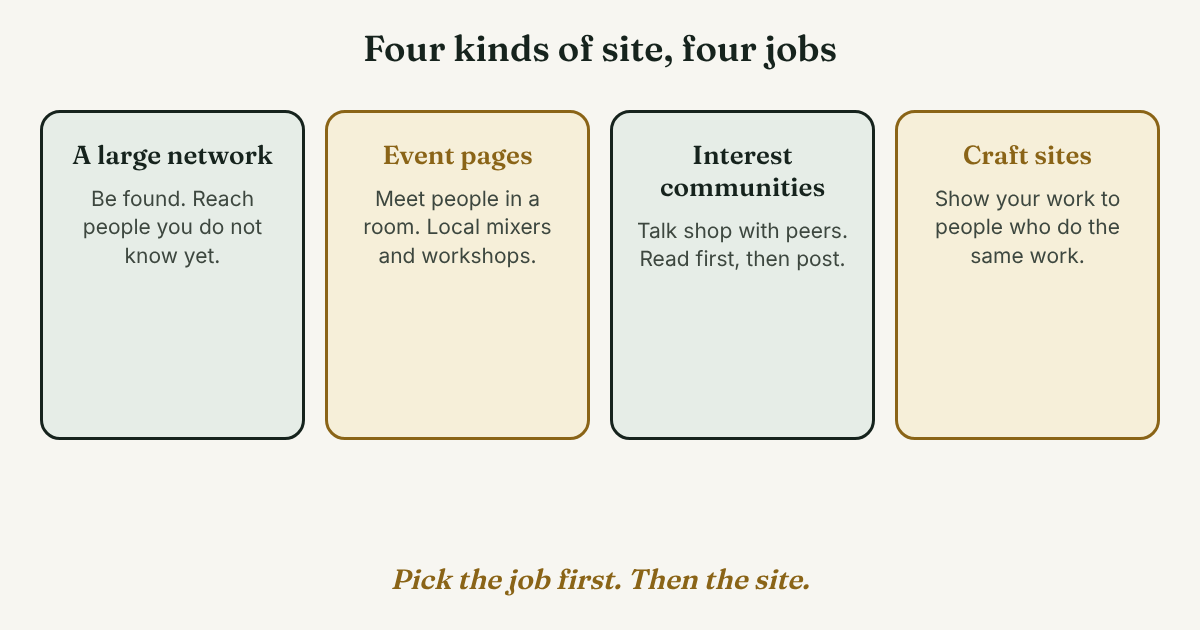
Shopify's 2025 guide describes these sites as online platforms for building professional contacts, matching job seekers with openings and staying in touch with colleagues. That covers a lot of ground. A plainer way to sort them is by the job each one does. Four kinds cover most of the lists we read:
- A large network. LinkedIn is the example. Its about page calls it "the world's largest professional network" and says it has more than 1 billion members in more than 200 countries and territories. The job: be findable, and reach people you do not know yet.
- Event and meetup pages. Cake's list describes Meetup as a source of free local events such as mixers and workshops, and Eventbrite as a source of local business events by category, though many are paid. The job: meet people in a room.
- Interest communities. The same list describes Reddit communities for specific careers, which are anonymous, and Facebook Groups by city or industry, where profiles are not anonymous, so you can learn about members before you meet them. Career.io adds Slack communities built around an interest. The job: talk shop with peers.
- Craft sites. Shopify's guide lists GitHub, whose Discussions feature supports developers, and Dribbble, a directory and job board where designers get peer feedback. The job: show your work to people who do the same work.
Job boards such as Indeed and Glassdoor also appear on these lists. In our reading, they are where you find an opening, not where a connection grows. Chambers of commerce and associations belong in our guide to professional networking events.
How do you pick the right site?
Shopify's advice is to join several platforms. That is how people end up with seven logins and no conversations. Here is a smaller path.
Step 1: Name one job
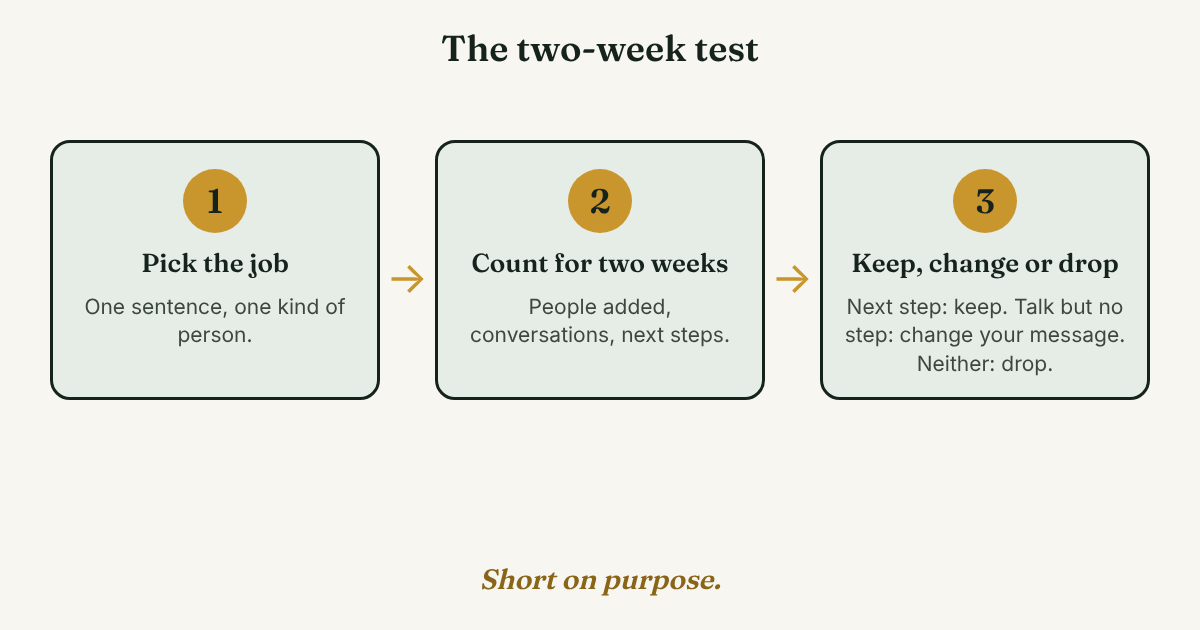
Finish this sentence: This month I want to [be found by / meet / talk with / show my work to] [kind of person]. One job, one kind of person. If you cannot finish it, no site will help yet.
Step 2: Ask three questions about each site
- Are my people here? Do not rely on member counts. The Pew Research Center surveyed 5,733 U.S. adults from May to September 2023. It found that 40% of adults aged 30 to 49 used LinkedIn, against 12% of those 65 and older, and 53% of adults with at least a bachelor's degree against 10% of those with a high school degree or less. That covers all U.S. adults, not your field, so check directly: search for your job title and for five people you want to talk to.
- Can I see how people talk before I join? Read a week of posts. Look for real answers, not only announcements.
- How much time will it take? Shopify's guide says to estimate the time commitment, from setting preferences to steady posting. Write a number before you start. Ours is 20 minutes a day, a suggestion, not a finding.
Step 3: Choose one main site and one small one
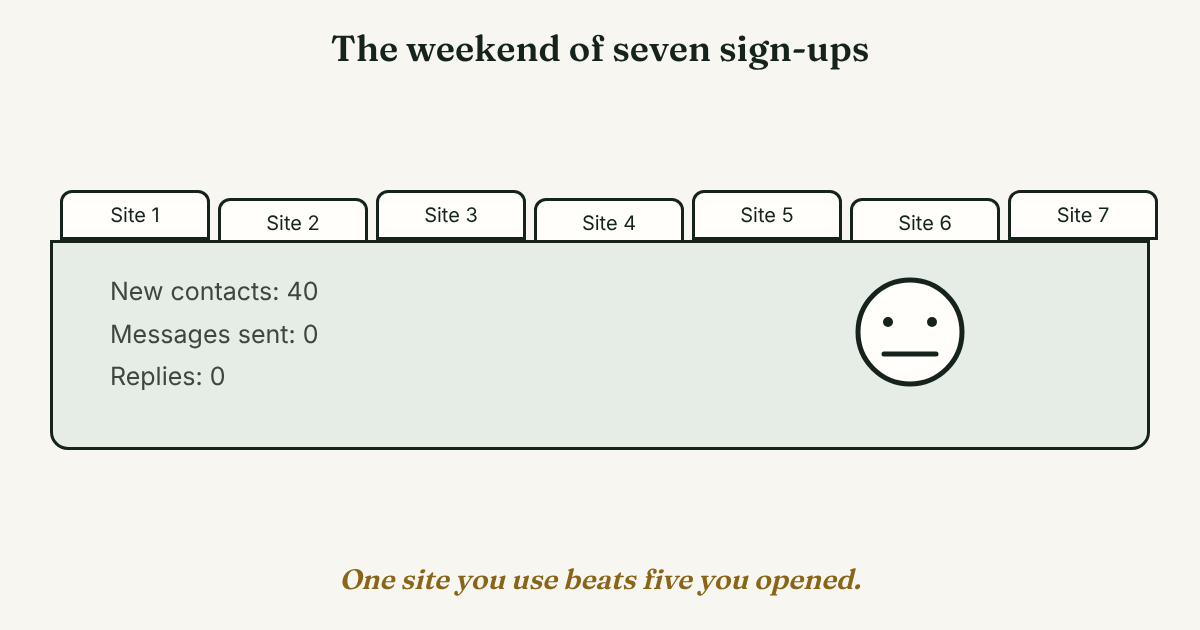
The common mistake is joining everything in one weekend. Maya (an example, not a real person) is a designer who signs up for five sites on Saturday. By Friday she has 40 new contacts and has talked to none. Her job was portfolio feedback from other designers. One craft site and one community would have done it.
What does a big network do well, and where does it stop?
If LinkedIn is your main site, know what the research supports. MIT News reported a study of about 20 million LinkedIn users in a randomized experiment from 2015 to 2019. LinkedIn changed its "People You May Know" suggestions so that some users saw more weak ties and others more strong ties. Weaker ties led to more job transmissions on average. Moderately weak ties, with about 10 mutual connections, were the most useful.
The study measured job applications and jobs found through LinkedIn. It did not test other goals or other sites. So it supports one claim: a wide, loose network has real use when you look for work. For the basics, see our guide to using LinkedIn for beginners.
How do you test a site in two weeks?
We found no source for how long a site takes to pay off. So test it yourself, in two weeks, with numbers you can count.
Step 4: Count three things
- People added. People you chose and wrote to yourself, one at a time.
- Real conversations. A two-way exchange. Likes and views do not count.
- Next steps agreed. A call booked, an introduction offered, or a reply with a question.
Write one line per site at the end of each week:
[Site], week [1 or 2]: [number] people added, [number] conversations, [number] next steps.
Our rule of thumb, not a finding: keep the site if you have at least one next step after two weeks. If you have conversations but no next steps, change how you open and follow up before you drop it. Our guide to the follow-up message has wording to start from. If you have neither, move the time to another site.
One warning from the lists. Cake's roundup includes a tool that supports mass messaging. We skip any tool that sends messages in bulk. Every message should be written by you, to one person.
What do you do with the people you find?
A site is where you find people. Your follow-ups live somewhere you control. When a good conversation happens, move that person into a list of your own: name, where you met, one detail and the next step. A list of your own does not depend on any site. Our guide to building a professional network covers how often to reach out, and the strategy tool guide shows how to plan before you pick a tool.
Full disclosure: we make GrowthSeeded, a simple follow-up tracker for LinkedIn. It does not find sites or people, write messages or send them. It keeps a list of the people you talked to with a note after each conversation, and a due-today view shows who is waiting for a follow-up. The next step comes from what happened, such as an accepted connection or a reply, not from a fixed date. The Free plan is $0 for 5 active people at a time, and up to 20 when friends join through invites (checked October 2026, and plans change). A notes app or a spreadsheet works too.
FAQ
What is a professional networking site?
It is an online place where people with work in common can find each other, talk and keep in touch. The kinds differ in what they are for: a large network, event pages, interest communities or craft sites.
Is LinkedIn a professional networking site?
Yes. LinkedIn calls itself "the world's largest professional network" on its about page. Whether it fits you depends on whether your people are there and answer you.
Is LinkedIn the world's largest professional network?
That is LinkedIn's own claim, and we found no independent count to check it against. Its pages differ too: the about page says more than 1 billion members, and the newsroom page shows 1.3 billion with no date.
Is LinkedIn no longer a professional networking site?
We found no source that says so, and LinkedIn still describes itself as one. People who say it mean the feed, not the site. That is a view, not a fact. Test it for yourself: are the people you want to reach there, and do they reply?
Do I need more than one site?
Most people do better with one main site and one small second one. Career.io notes you can join many free to compare. Our suggestion is to compare two at a time, not seven.
Are paid plans worth it?
We did not test paid plans, so we cannot say. Check the price on the site's own page, since prices change, and run the two-week test on the free version first.
Do this today
- Finish the sentence: This month I want to [be found by / meet / talk with / show my work to] [kind of person].
- Pick one site and search for your job title and five people you want to talk to. Note how many are there and active.
- Write the start date, the end date two weeks later, and the three numbers in a note.
The people who reply in your first week are the ones worth keeping. Add three of them to GrowthSeeded with one line on where you met and what you promised. The due-today view then shows who is waiting for your message. You send every message yourself, and it never sends anything or touches LinkedIn.
Sources
- About LinkedIn, LinkedIn, checked 2026
- About us (LinkedIn newsroom), LinkedIn, checked 2026
- Americans' Social Media Use, Pew Research Center, 2024 (survey of May to September 2023)
- The power of weak ties in gaining new employment, MIT News, 2022
- Professional networking sites, Shopify, 2025
- 10 Best Professional Networking Sites To Expand Your Professional Network, Cake, checked 2026
- Professional social network alternatives for LinkedIn, Career.io, checked 2026
About the author
Anisur Rahman Fagun is a marketing and content strategist with more than 9 years of experience in SEO, content, paid advertising and brand growth. He holds a master's degree in mass communication and journalism, and has led content and SEO strategy, built editorial teams and worked with product, design and sales teams. He also builds simple tools that turn marketing data into clear decisions. He writes the GrowthSeeded blog, which shares practical ways to follow up and stay in touch with people on LinkedIn.