Networking
Building a Professional Network: 5 Steps From Zero
10 min read
Key takeaways
- A professional network is the set of people who know what you do and think of you when something comes up. It is not a follower count.
- Start with people who already know you. Most people have more contacts than they think.
- Add a few new people from places you share, such as a school, a job or a group. Write to one person at a time.
- Keep a simple rhythm, and note what you talked about, so each message after the first is easy to write.
Short answer: To build a professional network, start with people who already know you, add a few new people from places you share, such as a school, a job or a group, and write to one at a time. Then keep in touch on a simple rhythm. Steady, specific contact matters more than a long list.
In this article
What is a professional network?
Who is already in your network?
Who should you add next?
How do you write to someone new?
How often should you reach out?
How do you keep track of it all?
FAQ
Do this today
What is a professional network?
You may have heard that you need to "build your network." It sounds like a project with a big list and a lot of events. It is closer to a habit: a small group of people who know what you do, and who would think of you if they heard of something useful.
The Muse says the value of networking comes less from how many people you contact and more from "how many people know to keep you in mind for opportunities they hear about." We find that a useful way to look at it. The goal is not to collect names. The goal is to be known, by a few people, for something specific.
This guide is for you if you are starting from zero or from a small base. It covers who to add, how to write the first message, and how often to reach out. If you want to go deeper on one part, we link to a guide for it as we go.
Who is already in your network?
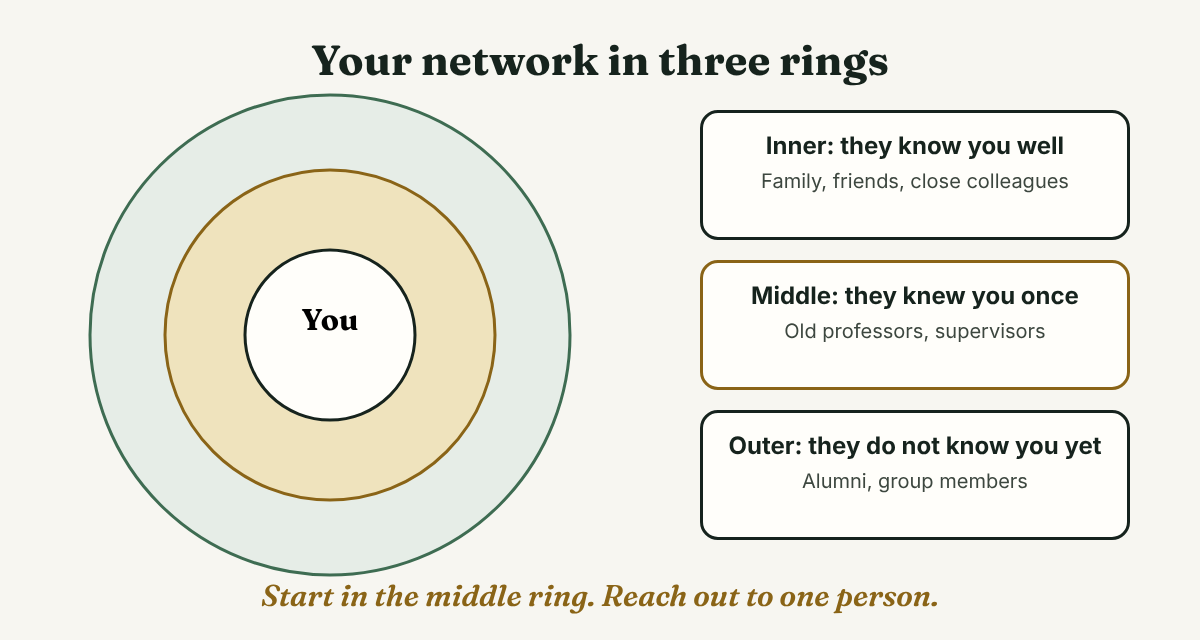
Start with the people you already have. Montana State University's career services says your network may already include professors, classmates, family members, coaches, supervisors and mentors, and tells you to begin with people you already know and pick one you could reach out to now.
Step 1: Write down 10 names
Open a note and list ten people you could write to today. Do not judge them yet. Dana (an example, not a real person) lists a former professor, two old coworkers, a cousin who works in finance, a teammate from a volunteer group, and five classmates.
The Muse suggests treating your closest people differently from the rest. Friends and family already know your strengths, so tell them specifically what you are looking for, such as introductions or contacts in a field that interests you. For former professors, past coworkers and old supervisors, start with an update on how you have been, and then invite them for coffee, which you pay for.
Who should you add next?
A list of people you know is a base, not a network. The next step is to add a few people you do not know yet, in places where you already share something.
Step 2: Add 3 people from a shared place
Pick one place where you have something in common: your school's alumni list, a former employer, a club, a group you belong to. The Muse suggests searching your school's alumni database for people in your field or at companies you admire, then asking for an informational interview. If you share a background, say so, and say that you found them through the database.
Why not stick to close friends? A large study suggests that people further from you can matter more than you would expect. MIT News describes an experiment run on about 20 million LinkedIn users from 2015 to 2019. On average, weaker ties were more useful than stronger ones for changing jobs. The effect was strongest in digital industries, and the study covered LinkedIn only, so it does not prove the same result for every field or goal. Our reading: it is a reason to say yes to a few new names, not a reason to ignore the people you know well.
If your LinkedIn profile is not ready, start with our 7-day plan for LinkedIn beginners. If you are early in your career, our hub for young professionals has seven ways to start.
How do you write to someone new?
Step 3: Write to one person, in four short parts
Montana State says an outreach message should introduce you, share your interests, explain why you are reaching out, and make a specific request. Keep the request small. A question the person can answer in a sentence is easier to say yes to than a call.
Here is a template. Change every part in [brackets], and write each message to one person.
Hello [Name], I am [your role or school]. I found you through [shared place]. I am working toward [one goal], and your move from [A] to [B] caught my attention. Could I ask you one question about [topic]? Thank you, [Your first name]
Two of our guides cover the wording in more detail: how to write a professional LinkedIn message and what to send after someone accepts your request.
Montana State also says to send a thank-you within 24 to 48 hours of a conversation. A short thanks, with one detail you remember, is enough.
We never recommend sending one message to many people. Every message should be written by you, one at a time. A network is made of separate conversations.
How often should you reach out?
Step 4: Set a rhythm you can keep
The sources we read agree on the idea, but not on a number. Yale School of Management's career office suggests casual coffee chats or virtual meetups "every few months," and sharing small updates in between: a milestone, industry news that relates to an earlier talk, or an event invite. It also says that liking or commenting on a contact's posts keeps you visible "without being intrusive."
ASU's W. P. Carey career center asked alumni how they stay in touch. One advises you to "set a cadence to reach out and engage 1:1 for a coffee catch-up or video chat." Another mixes coffee chats with quick texts or LinkedIn messages, so that you are "engaged but not exhausted."
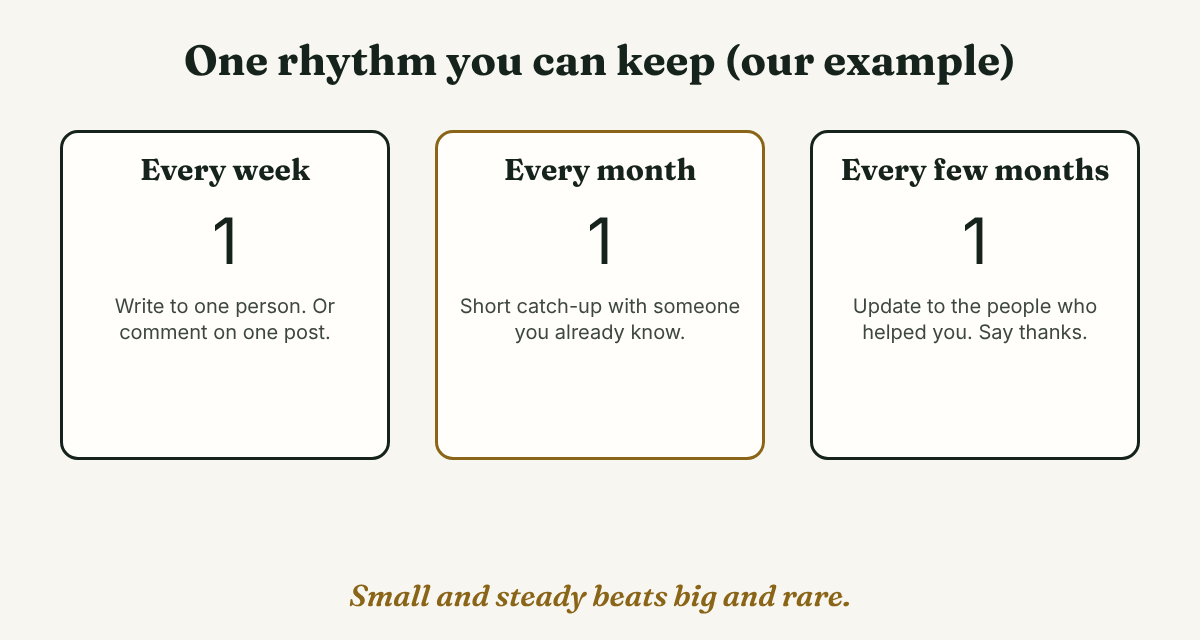
The rhythm in the picture is our example, not a number from a study. Pick amounts that you can keep for a year. If you can only do one message a week, that is 52 conversations started.
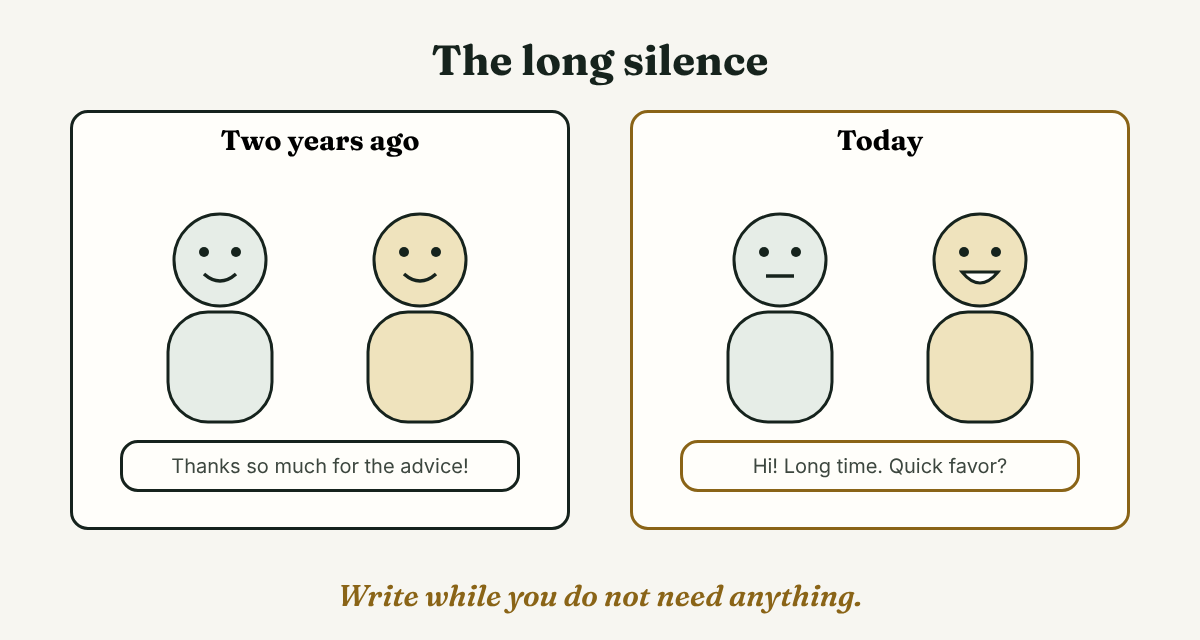
One more point from Yale: write before you need something. Reaching out before a new job or an application means the contact hears from you when you are not asking for help.
How do you keep track of it all?
Step 5: Write one note after every conversation
After each talk, write two lines: what you discussed and what you will do next. It takes a minute. In three months, you will not remember that a contact was moving to a new team or that you promised to send an article. Those details make the next message specific, and specific messages get answered.
If you want to plan the whole system first, read our guide to planning your networking before you pick a tool. A paper list or a spreadsheet works for a start.
Full disclosure: we make GrowthSeeded, a simple follow-up tracker for LinkedIn. It does not write messages, send them or touch LinkedIn. You send every message yourself, and it never sends anything. What it does is keep track: a due-today view shows who to follow up with, you write a note after each conversation, and the next step comes from what happened, such as an accepted connection or a reply, not from a fixed date. A paper list can do a version of this. A tracker helps most when the list grows past what you can hold in your head.
Prices, checked October 26, 2026: Free is $0 for 5 active people at a time (up to 20 when friends join through invites), Pro is $15 a month or $150 a year, and Max is $29 a month. Prices change, so check the pricing page before you decide.
FAQ
What is a professional network?
It is the group of people who know you and your work, and who may think of you when an opportunity comes up. It includes close contacts and distant ones.
How do you build a professional network from nothing?
Start with people who already know you: classmates, former professors, coworkers, family and friends. Then add a few people from a shared place, such as an alumni list. Write to one person at a time, and keep in touch.
How many people do you need in your network?
None of the sources we opened gives a number. Montana State says networking is about genuine connections, not collecting contacts. A better first goal is ten names on a list and one message a week.
How often should you contact people in your network?
There is no fixed rule. Yale suggests a coffee chat or call every few months, with small updates in between. Pick a rhythm you can keep.
Do you need LinkedIn to build a network?
No. Alumni lists, groups, coworkers and in-person events all work. LinkedIn is useful for keeping in touch with many people in one place. The alumni who spoke to W. P. Carey also stress getting together in person.
Is it all right to write to someone you do not know?
Yes, if you are specific and respectful. Say how you found them, why you are writing, and ask one small question. Do not ask for a job in the first message.
Do this today
- Write down ten people you could write to this week. Include one former professor or supervisor.
- Write one message with the template above and send it to one person, not to a group.
- Write two lines after your next conversation: what you talked about and what you will do next.
Building a network is slow, and the slow part is remembering. In GrowthSeeded you can add those ten names, write a note after each talk, and see who is due for a follow-up. You send every message yourself, and it never sends anything or touches LinkedIn. The Free plan covers 5 active people at a time, which is enough to start with your first few conversations.
Sources
- Build Your Network, Montana State University Career Services, checked 2026
- The Network You Forgot You Had, The Muse, updated 2020
- Keeping Networking Connections Warm, Yale School of Management Career Development, 2024
- W. P. Carey Alumni Share Ways to Maintain Your Network, Arizona State University W. P. Carey Career Services Center, 2023
- The power of weak ties in gaining new employment, MIT News, 2022
About the author
Anisur Rahman Fagun is a marketing and content strategist with more than 9 years of experience in SEO, content, paid advertising and brand growth. He holds a master's degree in mass communication and journalism, and has led content and SEO strategy, built editorial teams and worked with product, design and sales teams. He also builds simple tools that turn marketing data into clear decisions. He writes the GrowthSeeded blog, which shares practical ways to follow up and stay in touch with people on LinkedIn.
Related reading
- LinkedIn Follow-Up Message: 4 Templates and When to Send
- Professional Networking Strategy Tool: Plan, Then Pick
- How to Use LinkedIn for Beginners: A 7-Day Start Plan
- Professional Networking: What It Is and a Weekly Routine
- Networking for Career Advancement: 3 Asks and a Monthly Plan
- Mapping Your Professional Network: 4 Steps on One Page