Networking
LinkedIn Follow-Up Message After Connecting: 4 Examples
Updated: October 23, 2026 · 10 min read
Key takeaways
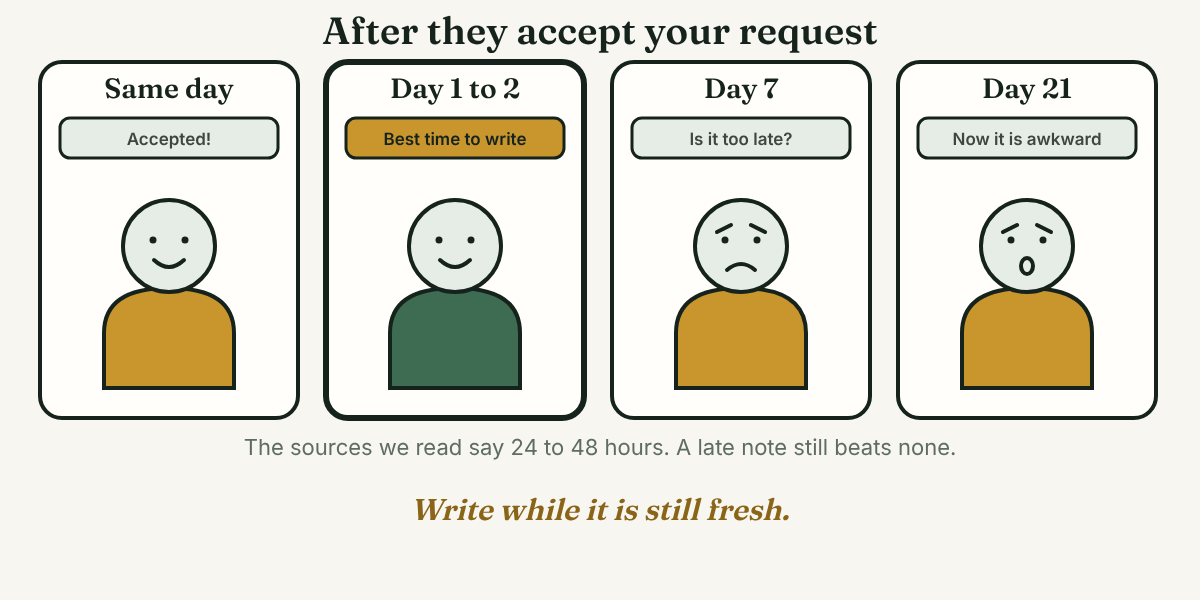
- The best time for a first note is the day or two after someone accepts your request. Skylead, Dripify and Sendspark all give 24 to 48 hours, and none of them shows a measured LinkedIn result for it.
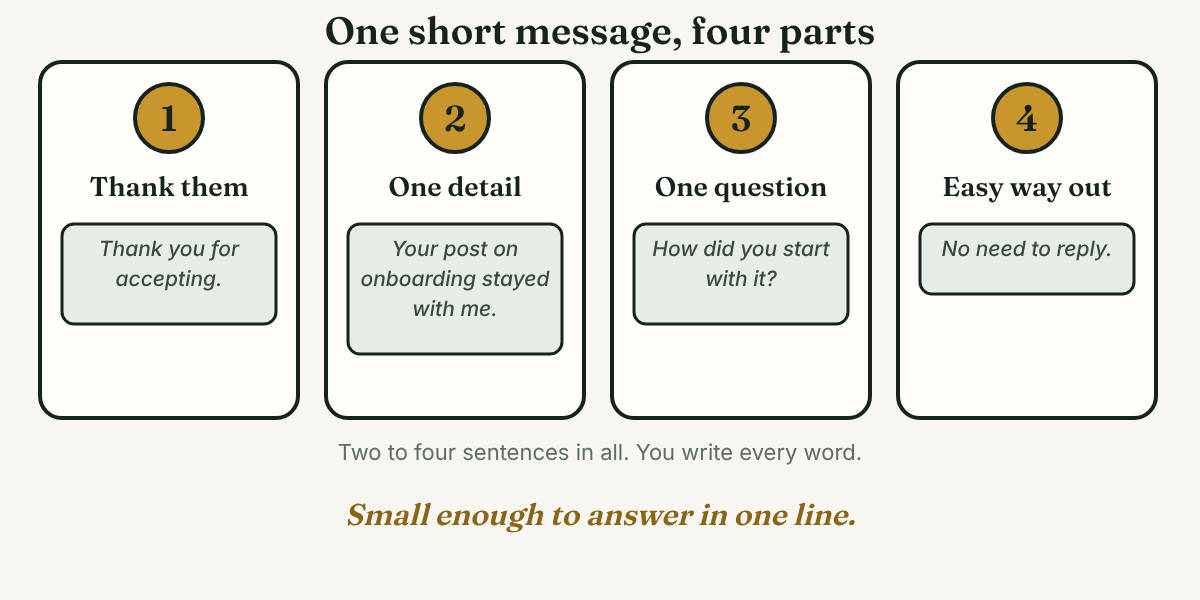
- Keep it to two to four sentences: thank the person, name one specific detail from their profile or posts, and ask one small question.
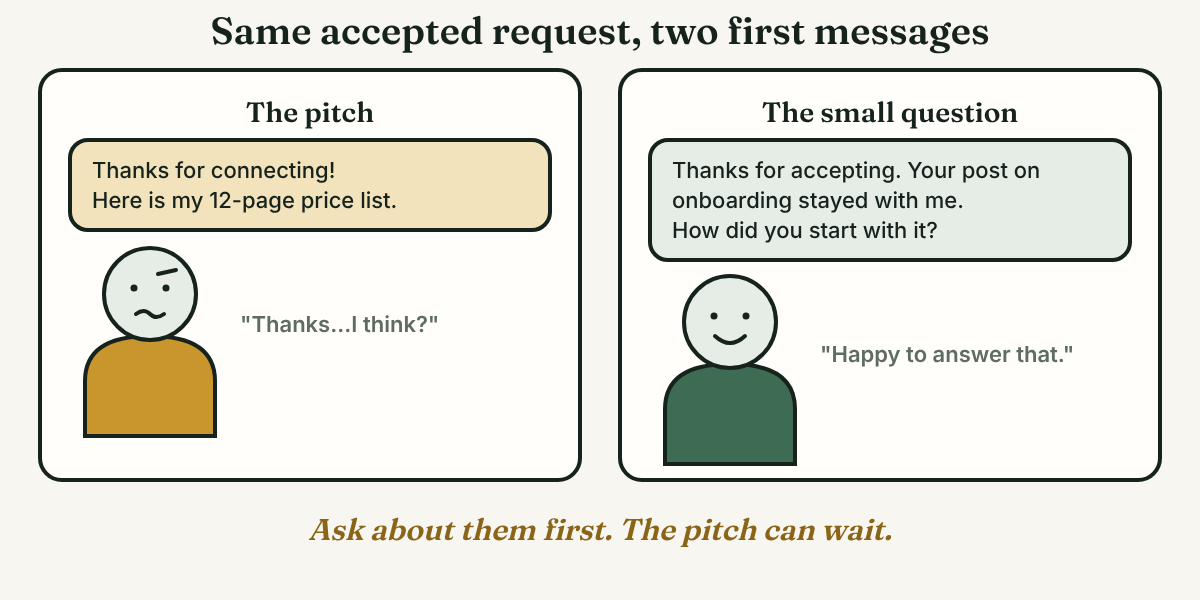
- Do not pitch, and do not ask for a job or a call yet. The sources we read agree that a sales message right after a connection can cost you the goodwill you just earned.
- You write every message yourself, to one person at a time. Skip tools that send it for you.
Short answer: After someone accepts your LinkedIn request, send one short message within a day or two. Thank them, mention one specific detail from their profile or posts, and ask one small question that is easy to answer. Do not pitch. Write it yourself, to that one person, and wait for their reply.
In this article
- Why does the first message after a connection matter?
- When should you send a follow-up message after connecting?
- What should the message include?
- What are four examples you can edit?
- What should you skip?
- Where does a tracker fit?
- FAQ
- Do this today
Why does the first message after a connection matter?
Someone just said yes to your request. That is the one moment when you have a reason to write and your name is fresh. Say nothing, and you are a name in a list. Send a pitch, and you are a stranger with a sales message.
Two sources describe a late first message. Skylead, a LinkedIn automation vendor, says that waiting weeks can make the message feel "random and transactional." Dripify, which also sells LinkedIn automation, says that a message sent three weeks later can seem "random and out of place." Both are opinions from companies that sell outreach software, with no data shown.
This post covers the first message after an accepted request. If your message has already gone unanswered, our guide to the LinkedIn follow-up message covers that case.
When should you send a follow-up message after connecting?
Three sources give the same window. Skylead says to write "within 24-48 hours of the connection being accepted." Dripify says "within 24 to 48 hours after connecting." Sendspark, a video outreach vendor, also says 24 to 48 hours.
Career offices set a tighter rule, for a different situation. After a conversation, Boston University's Center for Career Development says to send a thank-you note within 24 hours. Dartmouth's Center for Career Design says the same, and adds that "it is much better to send a late response than none at all." Those pages are about email after a real conversation, not LinkedIn.
Netsmartz, in a company blog post, goes faster. Its sample sequence sends a first note one hour after connecting, then more at 8 hours, 3 days and 4 days. We do not recommend that pace. Four messages in four days is a lot for someone you have not talked to yet.
Our suggestion is the next day or the day after. That is our reading of the sources, not a measured result. If it has been weeks, write anyway and say so in one plain line. Dartmouth's advice about late thank-you notes points that way.
What should the message include?
Step 1: Thank them in one short line
Start with thanks, then move on. Skylead warns against the bare "Hi, thanks for connecting," because it gives the person nothing to answer. It also lists "Looking forward to networking" and "Let's connect and grow together" as clichés to drop.
Step 2: Pick one specific detail
Dripify says to personalize with something specific from the person's profile, their activity or a mutual connection. Skylead says to make the message about them, and to refer to their work or a recent post rather than your own background. Choose one detail you can state in a few words, such as a project, a post or a shared group. Three details read like a research file.
Step 3: Ask one small question
Dripify advises an open-ended question that invites a reply, not a question that gets "yes" or "thanks." We would add: make it small. "How did you start working on [topic]?" is easier to answer than "Can you tell me about your career?"
Step 4: Keep it short and leave a door open
Skylead says two to four sentences. Sendspark says about 50 to 75 words and warns that messages over about 100 words get lower reply rates, a claim it does not source. Dripify says to end with a no-pressure next step. One sentence that says a short answer is fine does that job.
What are four examples you can edit?
Change every part in [brackets], and write each message for one person.
1. You sent no note with your request
Maya (an example, not a real person) is a student. She sent a plain request to a speaker whose post about hiring interns she had read. After the request is accepted, she writes:
Hi [Name], thank you for accepting. I read your post about [topic], and the point about [one detail] changed how I think about [subject]. One question: [a small, specific question]?
2. You talked in person or at an event
Skylead's event template recalls the event and the topic. Add one thing you did since, so the note has a reason to exist:
Hi [Name], it was good to talk at [event] about [topic]. You mentioned [detail], so I looked up [thing]. Here is the link in case it helps: [link]. No need to reply.
3. You share a person or a group
Dripify has templates for a mutual connection and for a shared LinkedIn group. Name the link between you, then ask about their experience, not about a favor:
Hi [Name], thanks for connecting. We both know [mutual name] / are in [group]. I saw that you [detail]. How did you first get into [topic]?
4. You are new in the field and want nothing yet
Dartmouth's guide says networking follow-ups should not directly ask for a job. This note asks for nothing, and still gives the person a reason to remember you:
Hi [Name], thanks for accepting. I am just starting out in [field], and your work on [topic] is the kind I hope to do. If you ever have one tip for someone at the start, I would be glad to hear it. Thank you either way.
If the person answers, write back soon and say what you did with their reply. Boston University's career page says to tell a contact when you act on their advice. A request for a call or a longer chat belongs in that second message, after they have written back once.
What should you skip?
Skip these:
- A pitch. Skylead says "nothing kills trust faster than pitching in your first message." Dripify says not to mention your product, expertise, company or achievements in a first message. Netsmartz says people on LinkedIn are usually not in shopping mode, so a list of products and features lands badly.
- A bare "thanks for connecting." It is polite and empty. Add the detail and the question.
- Tools that send it for you. Skylead and Dripify both sell automation for first messages. We do not recommend automation, bots or auto-messaging. A first message works because one person chose to write to another.
- The same message to many people. If you could paste it to ten people, it is not about the one in front of you.
Where does a tracker fit?
Full disclosure: we make GrowthSeeded, a LinkedIn relationship tracker. It does not write messages, send them or touch LinkedIn, so it cannot tell you what to say. What it can do is protect the window in this post. You add the person and write a short note about why you wanted to talk to them, and the due-today view shows them when it is time to write. Its next step follows what happened, such as an accepted request or a reply, instead of a date on a calendar.
Prices, checked October 23, 2026: Free is $0 for 5 active people at a time (up to 20 when friends join through invites), Pro is $15 a month or $150 a year, and Max is $29 a month. They change.
If you connect with a few people a month, a notes app or a spreadsheet works fine. A tracker helps more as the list grows.
FAQ
How soon should you message after someone accepts your LinkedIn request?
Within a day or two. Skylead, Dripify and Sendspark all say 24 to 48 hours, though none of them tested it on LinkedIn. If you are late, write anyway and keep it plain.
What should you say in a first message after connecting?
Thank them, mention one specific detail from their profile or posts, and ask one small question. Two to four sentences is enough. Do not pitch or ask for a job.
Do you have to send a message after someone accepts?
No source we read says you must. A short note gives the person a reason to answer. If you have nothing specific to say, wait until you do instead of sending a generic line.
Can you ask for a call in the first message?
Netsmartz suggests moving to a call quickly. Dripify says to avoid pushy calls to action, and Dartmouth says not to ask directly for a job in a networking follow-up. We suggest waiting for a first reply, then asking for a short call in your second message.
What if they never reply?
Silence often means busy. Wait about a week and send one short follow-up with a new reason to write, as in our follow-up message guide. After a second note, stop.
Do this today
- Open the connections you accepted or had accepted this week and pick one person you have not written to.
- Find one specific detail on their profile or in a recent post, and write one small question about it.
- Write the note in your own words, two to four sentences, and send it to that one person.
The hard part of this routine is the day after, when you are busy and the 24 to 48 hours slip by. GrowthSeeded keeps each new connection in a due-today view, next to your own note about why you wanted to talk to them, so the specific detail is in front of you when you start writing. You write every message, and it never sends anything or touches LinkedIn. Free costs $0 if you track up to 5 people at once.
Sources
- Thank you for connecting on LinkedIn [+12 templates], Skylead, 2025
- LinkedIn First Message Examples and Templates, Dripify, 2025
- LinkedIn Follow-Up Messages: Templates, Timing, and Tactics That Get Replies, Sendspark, 2026
- Beyond the Connection: How to Follow Up After Connecting on LinkedIn, Netsmartz, 2023
- Networking: Follow Up, Boston University Center for Career Development, 2025
- Interview and Networking Follow-Up, Dartmouth Center for Career Design, 2023
About the author
Anisur Rahman Fagun is a marketing and content strategist with more than 9 years of experience in SEO, content, paid advertising and brand growth. He holds a master's degree in mass communication and journalism, and has led content and SEO strategy, built editorial teams and worked with product, design and sales teams. He also builds simple tools that turn marketing data into clear decisions. He writes the GrowthSeeded blog, which shares practical ways to build professional relationships on LinkedIn.