Networking
How to Write LinkedIn Outreach for Founders: 4 Parts
Updated: October 22, 2026 · 10 min read
- A founder's first message works when it is about the other person's work, not your product. Every guide we read says to lead with their world.
- Use four parts: one real point about them, one sentence about you, one small ask, and an easy way to say no.
- The sources disagree on connection notes and on length, and nearly all of them sell outreach tools. Test your own version on a small group.
- Write every message yourself, one person at a time. Skip bots, mass messages and copied templates.
Short answer: To write LinkedIn outreach as a founder, open with something real about the other person's work, say in one sentence why you are writing, ask for one small reply instead of a call, and make it easy to say no. Keep it short enough to read in about 20 seconds, and write each message yourself.
In this article
- Why does a founder's message need its own shape?
- What are the four parts of a founder's message?
- Should a connection request have a note?
- What should you do after you send it?
- What should founders skip?
- Where does a tracker fit?
- FAQ
- Do this today
Why does a founder's message need its own shape?
When a founder writes, the reader hears from the person who built the thing. That is worth keeping, and it is easy to lose. Fuzzy AI, a company that sells outreach software, wrote in March 2026 that founders lose their edge when they sound like a generic sales rep. It also claims founder messages get two to three times the replies of rep messages, but it names no data, so we left that number out.
EarlyCustomers, which sells a lead-finding tool, says the same thing in fewer words in its 2026 guide: lead with their world, not yours. Both companies have a product to sell, so read them as advice, not measurements.
For a sense of what recipients already get, Expandi, a LinkedIn automation vendor, reported on 13.2 million connection requests sent from 13,302 accounts on its platform between May 2025 and April 2026. About 28.5% were accepted, and 10.4% of messages got a reply. These are tool users' campaigns, so they show a crowded inbox, not a target for careful one-to-one messages.
What are the four parts of a founder's message?
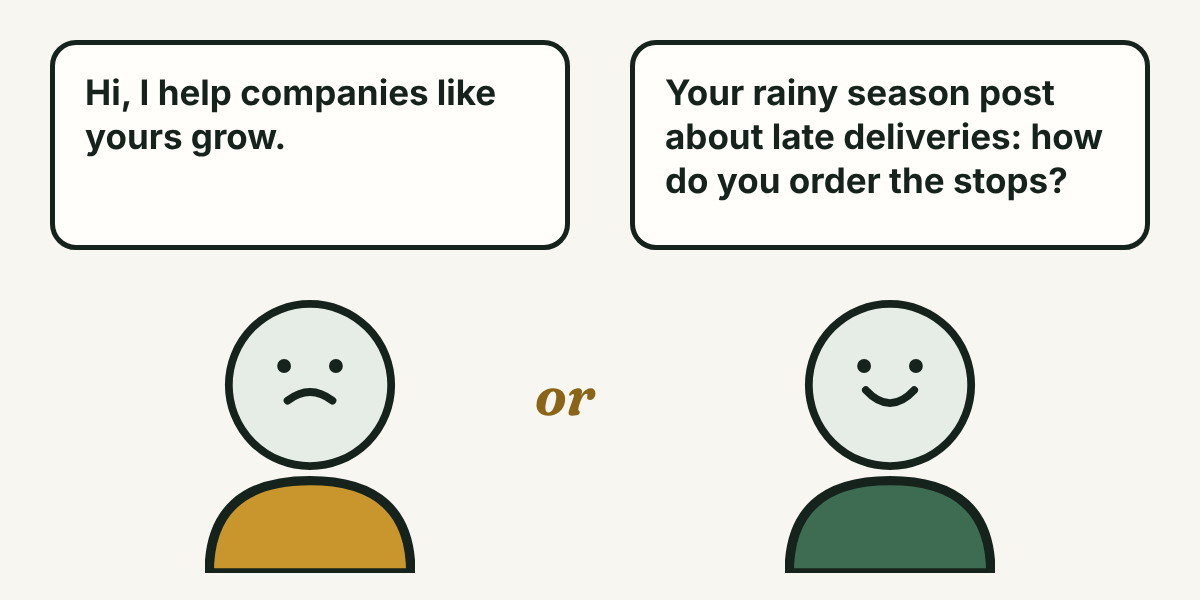
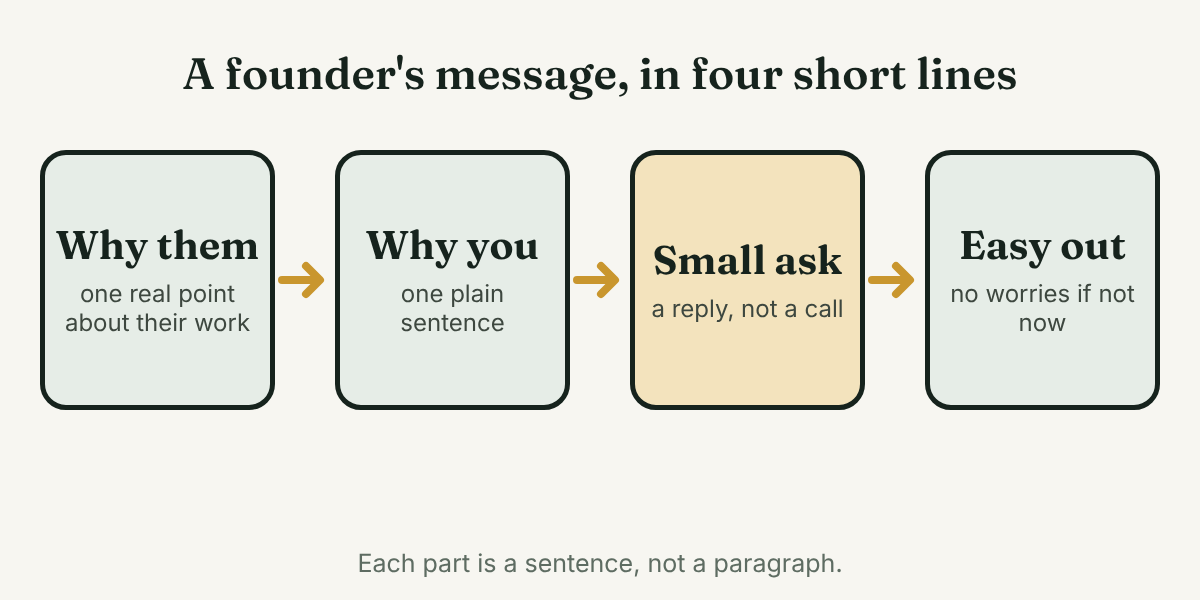
The guides use different names for the parts. PhantomBuster, which sells automation, calls its version HEART: hook, empathy, authority, request, thanks. We shortened it to four parts that fit in a few lines. Here is an example. Daniel (an example, not a real person) makes a tool that helps small farms plan delivery routes. He wants to talk to Priya (an example, not a real person), who runs a farm box delivery service and posted about late deliveries in the rainy season.
Part 1: Start with one real thing about them
Read a post or profile and pick one specific point, something you could only say after reading it. "I loved your post" is not a point.
Daniel writes: I read your post about late deliveries in the rainy season. The part about drivers guessing the order of stops stayed with me.
Part 2: Say who you are in one plain sentence
One sentence, no slogan: what you make and for whom. Do not list features.
Daniel writes: I build a small tool that helps farms plan delivery routes.
Part 3: Make one small ask
Ask for a short reply, not a call. EarlyCustomers advises one tiny ask, and Y Combinator's Michael Seibel, writing about emails to investors in 2019, said not to ask for a meeting right away. His advice was for investors, so we use it only for the idea: the first ask should be easy to say yes to.
Best is a question you cannot answer yourself. Daniel writes: How do you decide the order of stops today?
Part 4: Give an easy way out
A line that says no reply is fine takes pressure off the reader. Daniel ends with: No worries if it is not a good week. It costs one sentence and it is polite.
Here are the parts as templates. Fill them in for one person, then write the message again for the next one.
Connection note: Hi [Name], I read your post about [topic]. The part about [their point] stayed with me. I would like to connect.
First message after they accept: Hi [Name], thanks for connecting. I build [one plain sentence]. About your post on [topic]: [your question]? No worries if it is not a good week.
Should a connection request have a note?
The sources disagree. ReactIn, an outreach vendor, says in a November 2025 post on more than 80,000 requests that requests without a note were accepted 55% to 68% of the time and requests with a note 28% to 45% of the time. EarlyCustomers says the opposite: about 25% for blank requests and 60% to 70% for personalized ones, with no source for the figures.
Neither is a clean test. ReactIn's is an internal study of automation campaigns, and its product defaults to no-note invites. EarlyCustomers gives no method. Trust neither number.
One finding in ReactIn's data fits both views: it reports that a generic note was accepted less often (28% to 35%) than a personalized one (45% to 60%). If you have a real point about the person, write it. If you do not, a short, honest request is better than a note that could go to anyone.
Length. The guides say different things: Fuzzy AI says keep connection requests under 300 characters and follow-ups under 100 words, PhantomBuster suggests 180 to 220 characters for a note, and EarlyCustomers says a first message should take about 20 seconds to read. Several of them give 300 characters as the limit for a note. We could not open LinkedIn's help pages, so check the counter in the box on your screen.
Because the data is mixed, try both: about ten requests with a real note and ten without, over two weeks. Twenty requests prove little, but they tell you how your own group responds.
What should you do after you send it?
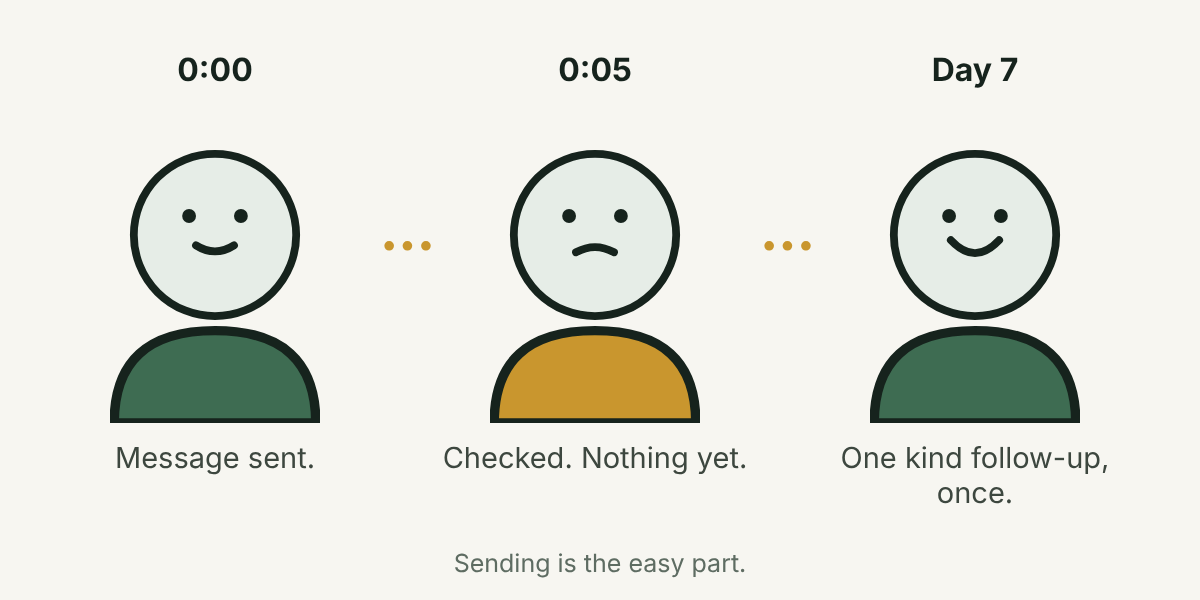
Do three things. First, write down the date, what you sent, and the point you picked. Second, if the person accepts and does not reply, wait. Third, send one follow-up that adds something new, such as a link they might use.
The guides vary on timing. Fuzzy AI spaces steps three to five days apart, and EarlyCustomers suggests days 3, 7 and 14. Seibel warns against sending several follow-ups quickly. Our suggestion, not a measured result: one follow-up about a week later, then stop. If the person replies later, write back.
Follow-up template: Hi [Name], one more thought on [topic]: [something new you noticed or a short link]. If it is not useful, no need to reply.
To bring people to you before you write, see How Founders Grow on LinkedIn covers comments and posts.
What should founders skip?
Skip these:
- Tools that send for you. Several of the guides above come from vendors of automation. We do not recommend bots, auto-messaging or mass messaging, and we have not checked how LinkedIn treats them, so check its rules yourself. A founder's message is worth reading because a person wrote it.
- One message copied to many people. If a message could go to 500 people, it will read like it did. Use the templates as a frame and write each one again.
- A pitch in the request. Fuzzy AI and EarlyCustomers both say to keep the product out of the first message. You can explain what you build once they reply.
- Big numbers with no source. Fuzzy AI's two to three times claim and EarlyCustomers' 27% reply rate for messages that mention a post come with no data. We left them out.
Where does a tracker fit?
Full disclosure: we make GrowthSeeded, a LinkedIn relationship tracker. It does not write messages, find people or touch LinkedIn. It helps after you send: you add each person you wrote to, write a note after each conversation, and a due-today view shows who to follow up with. The next step comes from what happened, such as an accepted connection or a reply, not from a fixed date. You write every message, and it never sends anything.
Free is $0 for 5 active people at a time, and up to 20 when friends join through invites. Pro is $15 a month or $150 a year. Max is $29 a month. We checked these on October 22, 2026, and they change.
A different kind of tool fits better if your main need is to find people or to draft messages. We have not tested tools for that, so we cannot say which fits you.
FAQ
How long should a founder's LinkedIn message be?
Short enough to read in about 20 seconds, which EarlyCustomers puts at four to six sentences. For a connection note, the guides we read suggest between 120 and 300 characters and do not agree on one number.
Should I add a note to a connection request?
Only if you have a real point about the person. Vendor data points both ways, and none of it is a clean test, so try both on a small group and see which gets better replies from your own people.
How many follow-ups should I send?
The guides range from three follow-ups over two weeks to a gap of three to five days between steps. We suggest one, about a week later, with something new in it, and then stop. If the person answers later, write back.
Can I use a template?
Yes, as a frame. Keep the four parts, and write each message for one person. Never send the same message to many people.
Do this today
- Pick one person you would like to talk to this week and write down one specific point from their post or profile.
- Write the four parts as four short lines: your point about them, who you are, one small question, and an easy way out. Join them into one message you could read aloud in 20 seconds.
- Send it to that person only. Then write the date, what you sent, and the day you will follow up once.
Outreach does not end when you press send. The part founders forget is what happens after: who answered, who is waiting, who needs one more line. Add each person you write to GrowthSeeded with a short note on what you said, and the due-today view shows when to write back. The Free plan holds 5 active people at a time, you write every message, and it never sends anything or touches LinkedIn.
Sources
- LinkedIn Outreach Founder Guide: Templates That Get Replies, Fuzzy AI, 2026
- LinkedIn Outreach Guide for Founders & SaaS Teams, EarlyCustomers, 2026
- High-Response LinkedIn Outreach Messages: The HEART Framework, PhantomBuster, 2025, updated 2026
- LinkedIn Connection Request With or Without Note: 80K+ Data, ReactIn, 2025
- LinkedIn Outreach Benchmarks 2026: 13.2M Data Points, Expandi, 2026
- How to Cold Email Investors, Y Combinator, 2019
About the author
Anisur Rahman Fagun is a marketing and content strategist with more than 9 years of experience in SEO, content, paid advertising and brand growth. He holds a master's degree in mass communication and journalism, and has led content and SEO strategy, built editorial teams and worked with product, design and sales teams. He also builds simple tools that turn marketing data into clear decisions. He writes the GrowthSeeded blog, which shares practical ways to build professional relationships on LinkedIn.