Networking
How Founders Grow on LinkedIn: 5 Steps to Start
Updated: October 22, 2026 · 10 min read
- Founders usually grow on LinkedIn in two ways at once: an audience that reads their posts and a small group of people they talk to. Most advice covers only the first.
- In one 2026 dataset, founder and executive accounts earned about twice the median impressions of company pages. The company page sample was only 3 pages, so read it as a hint.
- Pick a rhythm you can keep. The sources we opened range from one post a week to five, and none proves one number is right for you.
- Reach is uneven: a few posts get most of the views. Comments, replies and follow-ups are what turn views into conversations.
- Write every comment and message yourself, one person at a time. Skip bots, mass messages and bought lists.
Short answer: Founders grow on LinkedIn by choosing one group to be known by, posting at a rhythm they can keep, commenting on that group's posts, writing to people who respond one at a time, and tracking conversations, not only views. Expect months, not weeks.
In this article
- Why do founders grow on LinkedIn through a personal profile?
- How do founders grow on LinkedIn, step by step?
- How long does it take founders to grow on LinkedIn?
- What should founders skip?
- Where does a tracker fit?
- FAQ
- Do this today
Why do founders grow on LinkedIn through a personal profile?
A company page and a founder profile do different jobs. Koka Sexton, who writes about founder-led growth, says in a September 2026 article that buyers research founders before they talk to sales, so a founder's profile works as the top of the funnel. That is an argument from experience, not a measurement.
There is some data. RevBoss, a company that sells LinkedIn services to founders, published benchmarks on 1,202 posts from 33 profiles at 28 B2B companies, from January to August 2026. Founder and executive accounts had a median of 520 impressions per post. Company pages had 244. The study says the company page sample was 3 pages and 80 posts, and the accounts belong to RevBoss's own clients. It shows a pattern in one group. It is not a rule for every founder.
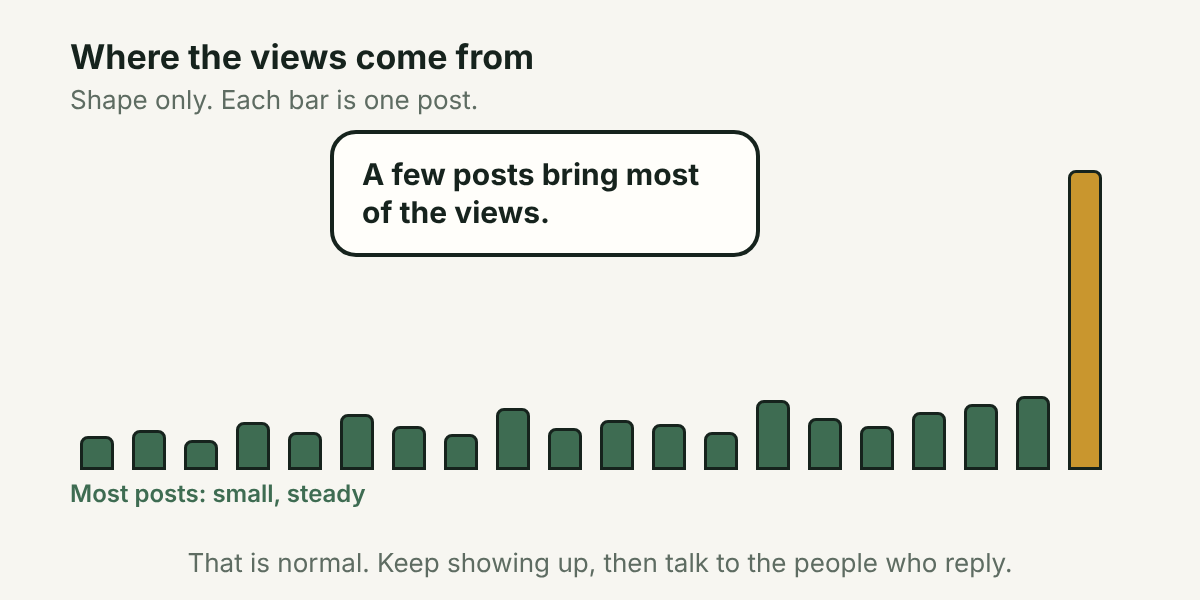
The same study shows how uneven reach is. The median post earned 502 impressions, and the top 5% of posts drove 66% of all impressions. A quiet week does not mean you are failing.
How do founders grow on LinkedIn, step by step?
Use these five steps. They need a profile, about an hour a week and no tools. Here is an example. Maya (an example, not a real person) runs a three-person software company and has one free hour a week for LinkedIn. She follows each step below.
Step 1: Choose who you want to be known by
Growth without a target turns into posting for everyone. Write one sentence:
I want [kind of person] to know that I [do one specific thing], so they think of me when [a moment they face].
Maya writes: I want small clinic owners to know that I build scheduling software, so they think of me when bookings get messy. Now she knows whose posts to read and what to post about. RevBoss found that a median of 28% of founders' existing connections matched their ideal customer profile, in a range from 6% to 51%. If your network is far from your group, Step 4 matters even more.
Step 2: Set a rhythm you can keep for 90 days
The sources do not agree. Lilach Bullock, in a 2026 article for B2B founders, posts once a week on a fixed day and time, and says it takes her 2 to 3 hours a week. Sexton suggests 3 to 5 posts a week. Otto, a vendor of tools for freelancers, says LinkedIn does not need a constant barrage of posts. RevBoss found that accounts above its median of 1.7 posts a week added about 737 followers in six months, against 373 for accounts below it. It calls that finding directional, not causal, and it covers only 22 accounts.
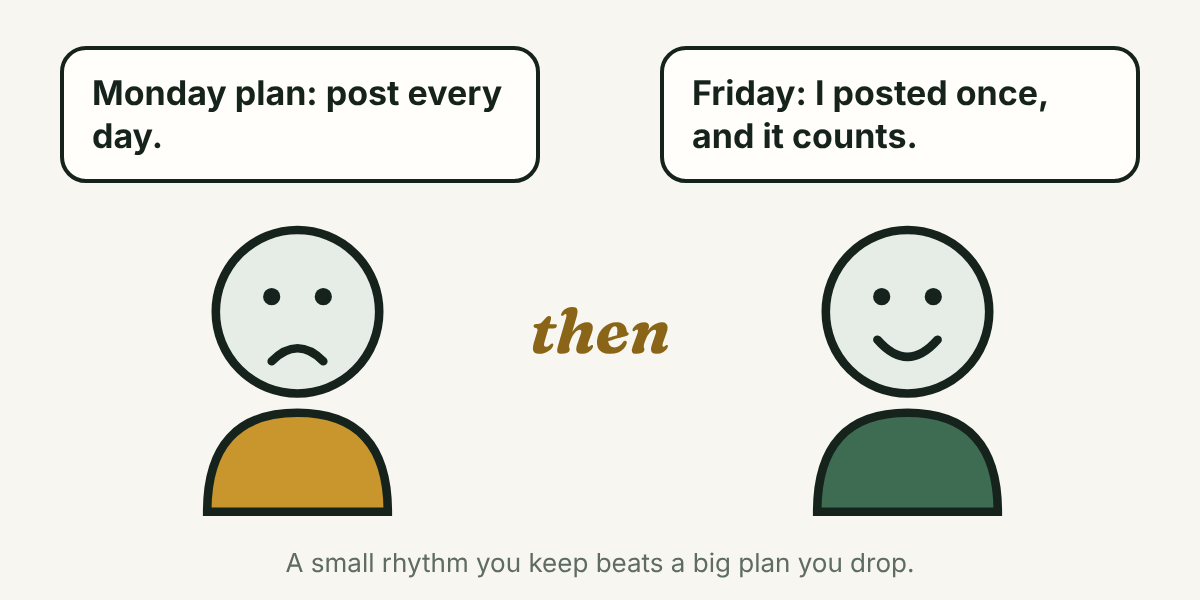
So choose the rhythm you will actually keep. One post a week, every week, beats five posts in week one and none after that.
Build each post around one real thing from your work. Bullock builds hers around one client problem, the result, and one common mistake. A customer question or a number you track works too. End with a question people can answer.
Step 3: Comment where your group already talks
Bullock spends about 15 minutes after each post leaving two-sentence comments on five to ten people in her market, and says to spend about four weeks only commenting before you start posting. Sexton lists engaging with target buyers' posts as its own stage, before any outreach.
A useful comment adds one fact or one question the author can answer. "Great post" adds nothing. Write each comment yourself, and skip any tool that comments for you.
Step 4: Write to the people who respond, one at a time
Posts and comments create small signals: someone replies to a comment, likes a post or visits your profile. Sexton calls the next stage context-based outreach, which means a message that refers to the specific post. A simple version:
Hi [Name], you commented on my post about [topic]. You said [their point]. I have one question about it: [your question].
Write it for that person only. Never copy one message to many people.
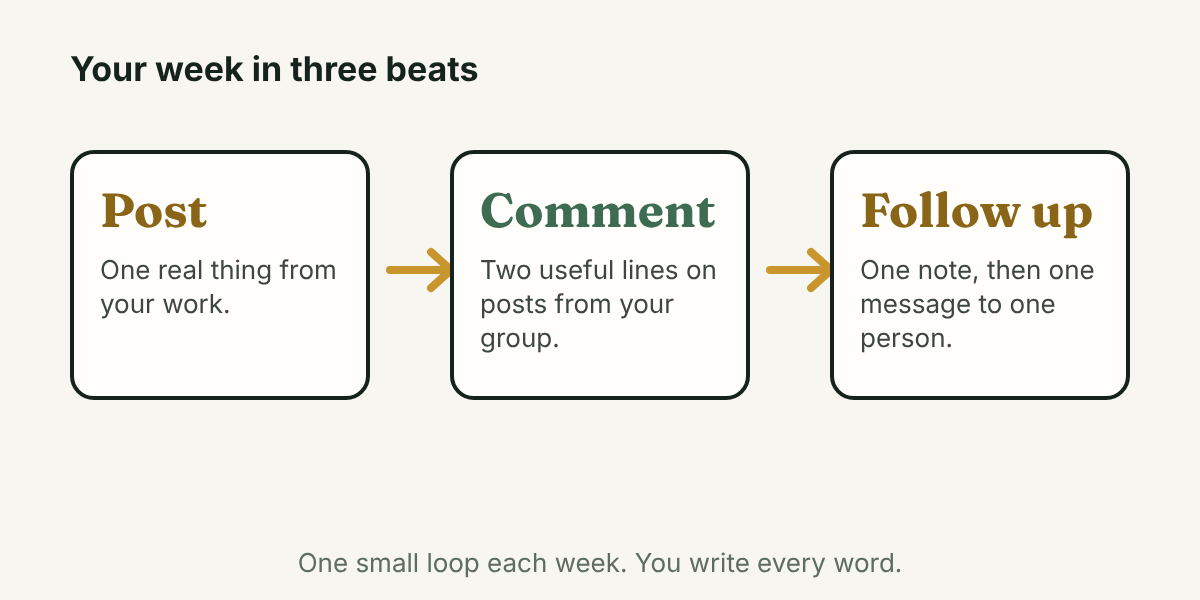
For a sense of scale, RevBoss reports a 21.4% reply rate on follow-up messages (809 replies on 3,774 messages) and 15.0% acceptance on connection invites. Both come from its clients' campaigns, so treat them as one vendor's data, not what you will get.
Step 5: Track people and conversations, not only views
Both Sexton and Bullock say to watch profile views, direct messages and meaningful comments instead of impressions alone. Sexton's sample funnel runs from impressions to meetings, but its figures are the author's own illustration, so do not use them as targets.
Once a week, write down who replied, who visited your profile, and what you will say next. A short note after each conversation is enough.
How long does it take founders to grow on LinkedIn?
The sources give different timelines. Bullock writes that it took about six months to move the needle, about nine months to get meaningful inbound, and a year to win a client directly from a post. That is one person's account. Sexton's example plan shows engagement growing in about 30 days, conversations in weeks 4 to 6, and pipeline in months 2 to 3. It is an example, not a measurement.
Plan for a slow start. Judge your first 90 days by whether you kept the rhythm and had real conversations, not by follower count. No one can promise you a result, and we do not.
What should founders skip?
Skip these:
- Automation and mass messages. Tools that post, comment or message for you remove the one thing that makes a founder's profile worth reading: a person wrote it. We do not recommend them.
- Big multipliers with no clear source. Sexton's article says personal profiles get 5 to 8 times the engagement of company pages, and also 8 times, and names no source for the 8 times figure. An Ordinal article reports 561% more reach and credits a 2025 synthesis of other people's data. We left those numbers out.
- Handing off the thinking. Ordinal, which sells a post approval tool, suggests a weekly 20-minute voice note so the founder supplies the ideas and someone else drafts. That may save time, and we have not tested it. Its test is a good one: if anyone else on the team could have written the post, it is too generic. Comments and messages stay yours.
We did not rely on LinkedIn's own pages for this post, so we make no claim about how LinkedIn treats any tool. Check LinkedIn's rules yourself before you use one.
Where does a tracker fit?
Full disclosure: we make GrowthSeeded, a LinkedIn relationship tracker. It does not write posts, grow your audience or touch LinkedIn. It helps with Steps 4 and 5: you add the people who replied or commented, write a note after each conversation, and a due-today view shows who to follow up with. The next step comes from what happened, such as an accepted connection or a reply, not from a fixed date. You write every message, and it never sends anything.
Free is $0 for 5 active people at a time, and up to 20 when friends join through invites. Pro is $15 a month or $150 a year. Max is $29 a month. We checked these on October 22, 2026, and they change.
A different kind of tool fits better if your main need is to plan posts or read how they performed. We have not tested tools for that, so we cannot say which fits you.
FAQ
How do founders grow on LinkedIn?
Choose one group to be known by, post at a rhythm you can keep, comment on that group's posts, write to people who respond one at a time, and track conversations. The sources we read say to expect months, not weeks.
Should a founder post from a personal profile or a company page?
In RevBoss's 2026 data, founder and executive accounts had a median of 520 impressions per post and company pages had 244. The company page sample was only 3 pages, and all accounts belong to the vendor's clients. The data does not say you must pick only one.
How often should a founder post on LinkedIn?
The sources we read range from once a week (Bullock) to 3 to 5 times a week (Sexton). RevBoss's median account posted 1.7 times a week. None of them proves one number is right for you, so pick the rhythm you can keep for 90 days.
How long does it take to see results?
Sources give different timelines, from conversations in weeks 4 to 6 in one example plan to about six months for movement in one author's account. Treat both as examples, not promises.
Do this today
- Write the one sentence from Step 1: who you want to be known by, and for what.
- Leave two useful comments on posts from people in that group. Write each one yourself.
- Pick one real thing from your week, draft one post about it, and choose the day and time you will publish it next week.
When a comment turns into a reply, that person becomes a conversation, and conversations are easy to lose. Add them to GrowthSeeded with one note about what they said, and the due-today view shows when to write back. You write every message, it never sends anything or touches LinkedIn, and the Free plan holds 5 active people at a time.
Sources
- Founder-Led Marketing Benchmarks, RevBoss, 2026
- Founder-Led Growth on LinkedIn, Koka Sexton, 2026
- How to Grow on LinkedIn as a B2B Founder in 2026: The Unsexy Truth About Consistency, Lilach Bullock, 2026
- How to Grow on LinkedIn Without Posting Daily, Otto, 2026
- Founder-Led Content, Ordinal, checked 2026
About the author
Anisur Rahman Fagun is a marketing and content strategist with more than 9 years of experience in SEO, content, paid advertising and brand growth. He holds a master's degree in mass communication and journalism, and has led content and SEO strategy, built editorial teams and worked with product, design and sales teams. He also builds simple tools that turn marketing data into clear decisions. He writes the GrowthSeeded blog, which shares practical ways to build professional relationships on LinkedIn.