Networking
Networking for Career Advancement: 3 Asks and a Monthly Plan
11 min read
Key takeaways
- Networking is linked to higher pay and faster pay growth in one three-year study. It shows a link, not proof that networking caused the raises.
- Career networking means three different asks: advice, an introduction or reference, and advocacy. Make them in that order.
- People you have not talked to in years are a good first place to look. In one study they gave more new ideas than current contacts did.
- A month can be four small steps, about an hour a week, and end with one specific ask.
Short answer: Networking helps your career when you ask for the right thing at the right time. Ask for advice first. Ask for an introduction or a reference from people who have seen your work. Ask for advocacy only from people who have seen you deliver. Start with people you already know, and plan about an hour a week.
In this article
Does networking really help a career?
What should you ask people for?
Who should you ask first?
How do you ask without feeling awkward?
How do you earn a reference or a sponsor?
What does a month of career networking look like?
FAQ
Do this today
Does networking really help a career?
Maya (an example, not a real person) has been a marketing coordinator for two years. Her manager likes her work, and she wants a team lead role. But she has never asked anyone outside her team what that step takes, and she does not know who decides. She is not short of skill. She is short of people who know what she can do.
That gap is what career networking fills, and the evidence says it is worth filling, with limits. A longitudinal study by Wolff and Moser followed working people for three consecutive years. Networking was related to salary and to how fast salary grew. It was also related to career satisfaction, but not to how satisfaction changed over time. People reported their own networking, so this is a link, not proof that networking caused the raises.
A Harvard Business Review article by Gino, Kouchaki and Casciaro describes a study of 165 lawyers at a large firm. Success depended on building contacts inside the firm and outside it, and lawyers who avoided networking had fewer billable hours than their peers. Junior people networked less, though they often had the most to gain. That is Maya.
If your network is very small, start with building a professional network from zero, then come back. This guide is about using the network you have to move forward.
What should you ask people for?
Career advancement needs three different things from people, and each one costs the other person more than the one before it. Most networking messages that go unanswered ask for the third thing in the first message.
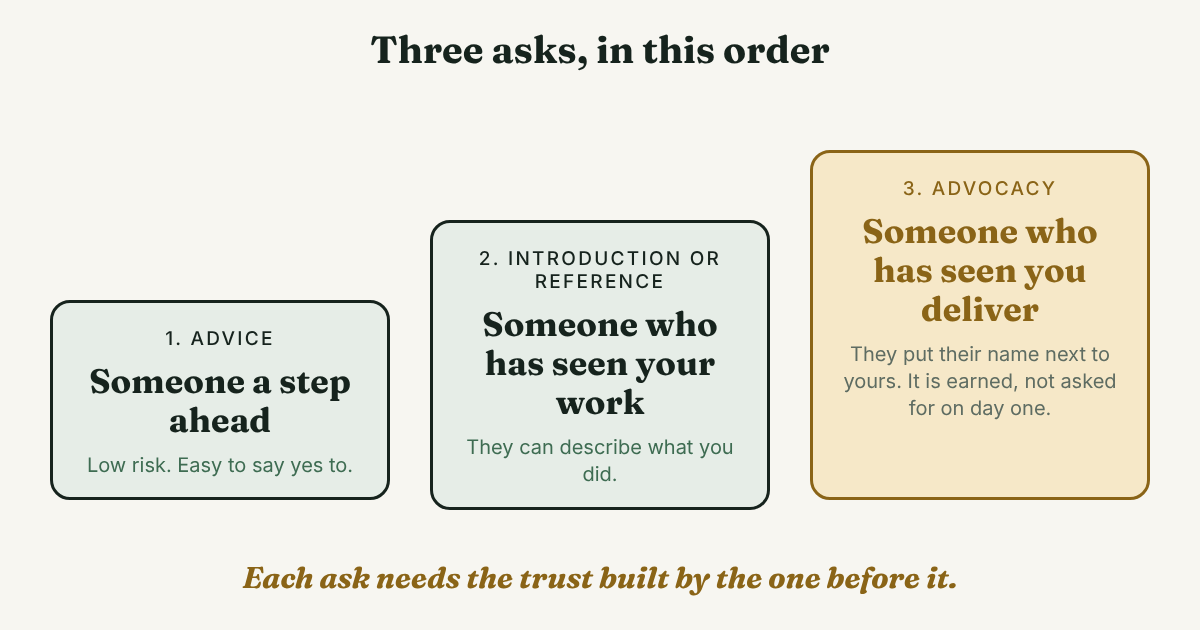
Advice
Ask someone a step or two ahead how they got there and what they would skip. It costs them 15 or 20 minutes, so it is easy to say yes to. For Maya, that is a team lead in another department.
An introduction or a reference
Ask someone who has seen your work to describe it to a third person. A former manager or a project colleague can say what you did in specific terms. A stranger cannot.
Advocacy
This is a sponsor: someone who speaks for you when you are not in the room. In an excerpt from Marissa King's book Social Chemistry, Yale Insights separates a mentor, who gives guidance, from a sponsor, who advocates and uses their own standing on your behalf. It says sponsors are harder to find and must be earned. The excerpt names few of its studies, so we use only the distinction and the advice, not its numbers.
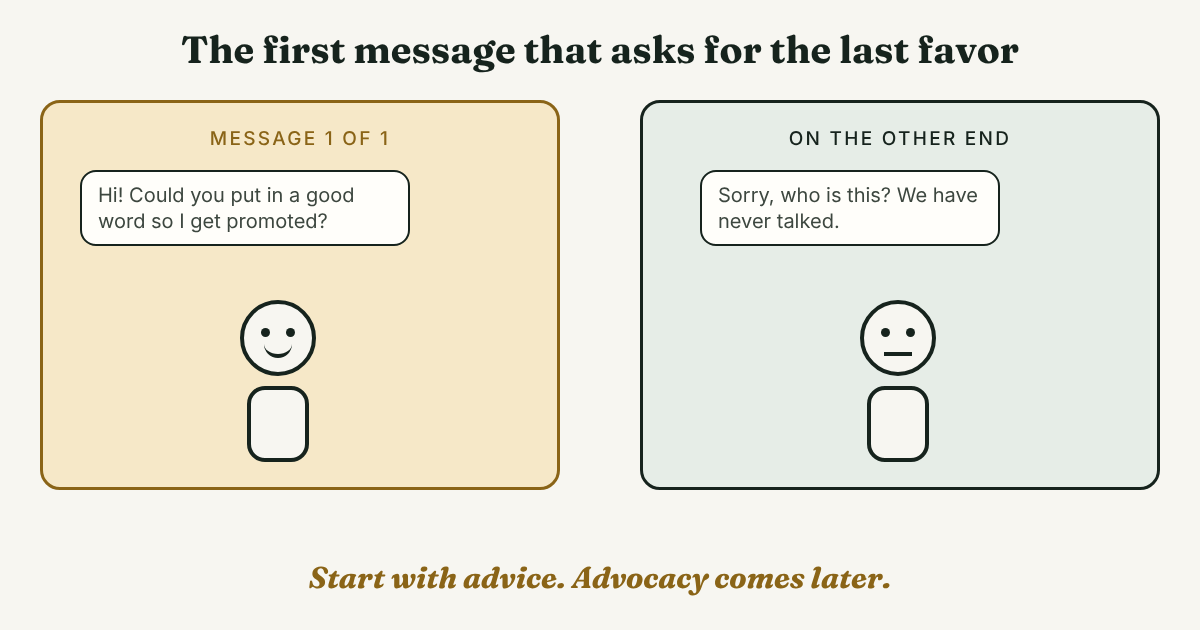
The common mistake is the order. Someone who has never worked with you has nothing to say about you, so a first message asking for a good word gets a polite no or silence. After an advice chat, a visible result and a thank-you, it is a different request.
Who should you ask first?
Start with people you already know, including people you stopped talking to. Researchers call a contact you have not spoken to for at least three years a dormant tie. In a study by Levin, Walter and Murnighan, 129 executive MBA students reconnected with one former close contact and one former acquaintance about a work project, then compared the results with two current contacts each. Old contacts gave more new insights than current ones, and old acquaintances were nearly as useful as old close contacts. The data were self-reports from one group of executives, and the reconnecting was partly a course requirement, so do not expect the same every time.
For Maya, that could be a former teammate who now leads a team at another company. She writes one message, in her own words:
Hi [Name], it has been a while since [the project or team we shared]. I am working toward [role or field], and I remembered you did [specific thing]. Could I ask you two questions about it, by message or on a 15 minute call? No problem if now is busy.
Write each message yourself, to one person at a time. Never send one message to many people, and skip any tool that offers to do it for you.
How do you ask without feeling awkward?
Asking feels riskier than it is. In the Harvard Business Review work, 306 adults who recalled professional networking wrote cleanliness-related words, such as wash and soap, about twice as often as those who recalled social networking, which the authors read as a feeling of discomfort. Their advice: treat it as a chance to learn, build on shared interests, and think about what you can offer.
Flynn and Lake's studies, reported by Stanford Graduate School of Business, found that people overestimated by about 50% how many people they would need to ask, because helpers feel more pressure to say yes than askers expect. The requests were small, such as borrowing a phone, not career favors, so read it as "asking is easier than it feels," not "everyone will say yes."
So make a direct, small, time-limited ask. Portland State University's career center suggests 15 to 20 minutes, a thank-you within 72 hours, and always asking who else you should talk to. Here is a request you can edit:
Hi [Name], I am a [role] at [company or area], and I want to grow toward [target role]. You made that move by [how]. Could I ask you three questions about it on a 15 minute call this week or next? [One sentence about something specific in their work.]
Bring three questions:
- What did you do in your first year in the role that mattered most?
- What would you do differently?
- Who else should I talk to?
After the chat, write a short thank-you. Our guide to LinkedIn follow-up messages has wording and timing. If your profile is thin, fix it first with how to use LinkedIn for professional growth, since people will look you up.
How do you earn a reference or a sponsor?
The step most guides skip is the update. When someone gives you advice, try it, then tell them what happened. It closes the loop and gives them something specific you did. This is our suggestion, not a finding.
Hi [Name], a quick update. After our call I [tried what they suggested], and [what happened]. Thank you again. I will let you know how [the next step] goes.
The same Yale excerpt says to earn a sponsor by delivering results, taking stretch assignments and volunteering for visible work. Send updates like the one above after each result, to the people who helped. Then, when a role opens and someone can speak to your work, make the third ask specific and easy to say yes to:
Hi [Name], I am applying for [role] by [date]. Would you be comfortable sending a short reference, or speaking to [person] about the [project] we worked on? To make it easy, here are three lines on what I did: [line 1], [line 2], [line 3]. No pressure if you would rather not.
What does a month of career networking look like?
We found no source for how much time career networking needs, so treat this as a four-week trial, about an hour a week.
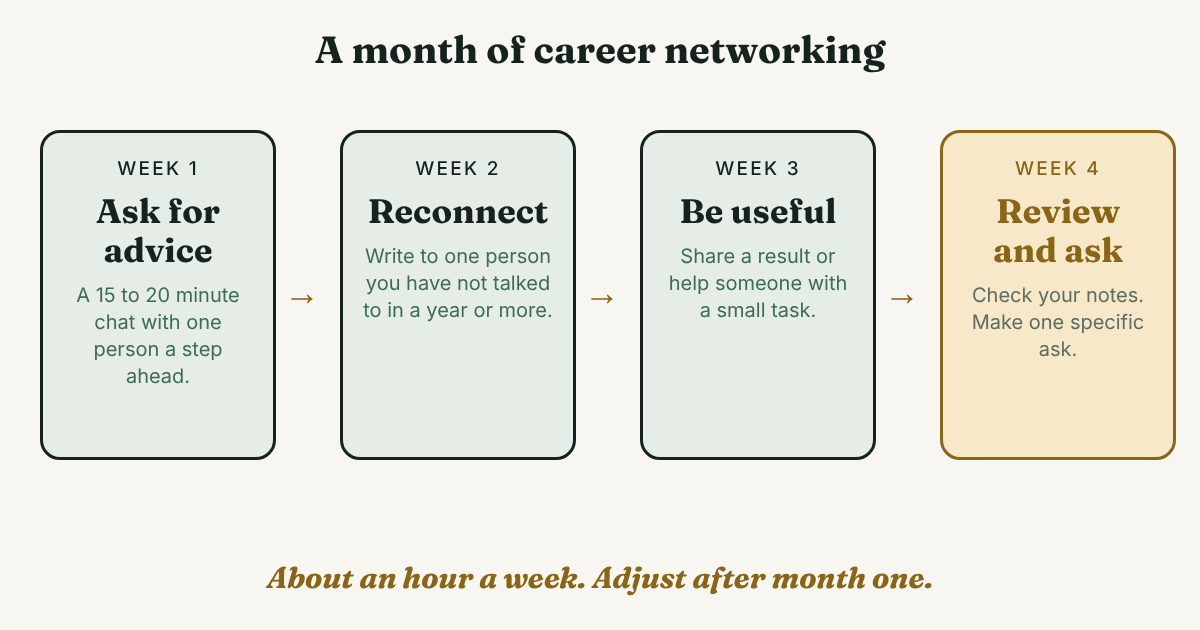
- Week 1: ask for advice. Send the advice request to one person a step ahead of you, and hold the 15 minute chat.
- Week 2: reconnect. Write one dormant tie, using the template above, about something specific.
- Week 3: be useful. Send an update to someone who helped, share a result, or help a colleague with a small task.
- Week 4: review and ask. Read your notes. If someone has seen your work and a role is in view, make one specific ask.
Keep a simple list of who you talked to, what they said, what you promised and the next step. A notes app or spreadsheet works. Full disclosure: we make GrowthSeeded, a simple follow-up tracker for LinkedIn, built for the part people drop. You write a note after each conversation, and a due-today view shows who is waiting for a follow-up. It does not find people or write messages for you.
To see whether the month worked, count three things: conversations held, updates sent and asks made. Do not count connections. For the wider picture, see our guide to professional networking.
FAQ
How does networking help career advancement?
It gives you advice from people who know the next step, introductions to people who decide, and references from people who have seen your work. One three-year study found networking was related to salary and salary growth, though it cannot show that networking caused them.
How often should I network for my career?
We found no source for a right number. Our suggestion is about an hour a week for a month: one advice chat, one reconnection, one update and one review, then adjust.
What is the difference between a mentor and a sponsor?
A mentor gives guidance and support. A sponsor advocates for you and uses their own standing to open doors. Yale Insights says sponsors are harder to find, and that you earn one through results and visible work.
Is it okay to ask someone I barely know for a reference?
It is better to ask someone who has seen your work, because they can describe it. If you barely know a person, ask for advice first and build from there.
Do this today
- Write down three names: one person a step ahead, one who has seen your work, and one you have not talked to in a year.
- Write one advice request, in your own words, to the first person.
- Next to each name, write what you want to ask and the date you will do it.
With three names written, you can add them to GrowthSeeded with the note you just wrote, so the update you promised does not slip. The Free plan is $0 for 5 active people at a time (checked October 2026, and plans change). You send every message yourself, and it never sends anything or touches LinkedIn.
Sources
- Effects of networking on career success: A longitudinal study, Wolff and Moser, Journal of Applied Psychology, 2009 (abstract page, FAU Erlangen-Nürnberg)
- Learn to Love Networking, Gino, Kouchaki and Casciaro, Harvard Business Review, 2016
- Dormant Ties: The Value of Reconnecting, Levin, Walter and Murnighan, Organization Science, 2011
- Francis Flynn: If You Want Something, Ask For It, Stanford Graduate School of Business, summary of a 2008 Journal of Personality and Social Psychology study
- How finding a mentor, or even better a sponsor, can accelerate your career, Yale Insights, 2021 (excerpt from Social Chemistry by Marissa King)
- Informational Interviewing, University Career Center, Portland State University, checked 2026
About the author
Anisur Rahman Fagun is a marketing and content strategist with more than 9 years of experience in SEO, content, paid advertising and brand growth. He holds a master's degree in mass communication and journalism, and has led content and SEO strategy, built editorial teams and worked with product, design and sales teams. He also builds simple tools that turn marketing data into clear decisions. He writes the GrowthSeeded blog, which shares practical ways to follow up and stay in touch with people on LinkedIn.