Networking
LinkedIn Professional Network: 4 Steps to Make It Work
10 min read
Key takeaways
- A LinkedIn professional network is the people who know what you do and would answer if you wrote. The connection count says little about that.
- Add people for a reason: a shared school, employer or group, or a role one or two steps above yours. In a study of about 20 million LinkedIn users, moderately weak ties were the most useful for job moves.
- Write one note that says why you connected, then ask one small question after they accept. Do not ask for a job.
- Sort people into three lists (active, warm, dormant) and give the network 20 minutes a week. Old contacts are worth writing to.
Short answer: A LinkedIn professional network works when you add people for a clear reason, write one specific note after they accept, and keep in touch on a simple rhythm. Start with people who share your school, job or group. Then spend about 20 minutes a week on messages and notes, not on chasing a bigger number.
In this article
What makes a list of connections a working network?
Who should you add to your LinkedIn network?
What should you do after someone accepts?
How do you keep in touch without being annoying?
How do you fit it into 20 minutes a week?
FAQ
Do this today
What makes a list of connections a working network?
Picture a long list of connections. You want to ask one person about a role at their company, but you have not spoken in a year, so the question feels awkward. The list grew with every click. The conversations did not, because nothing happens between "accepted" and the day you need something.
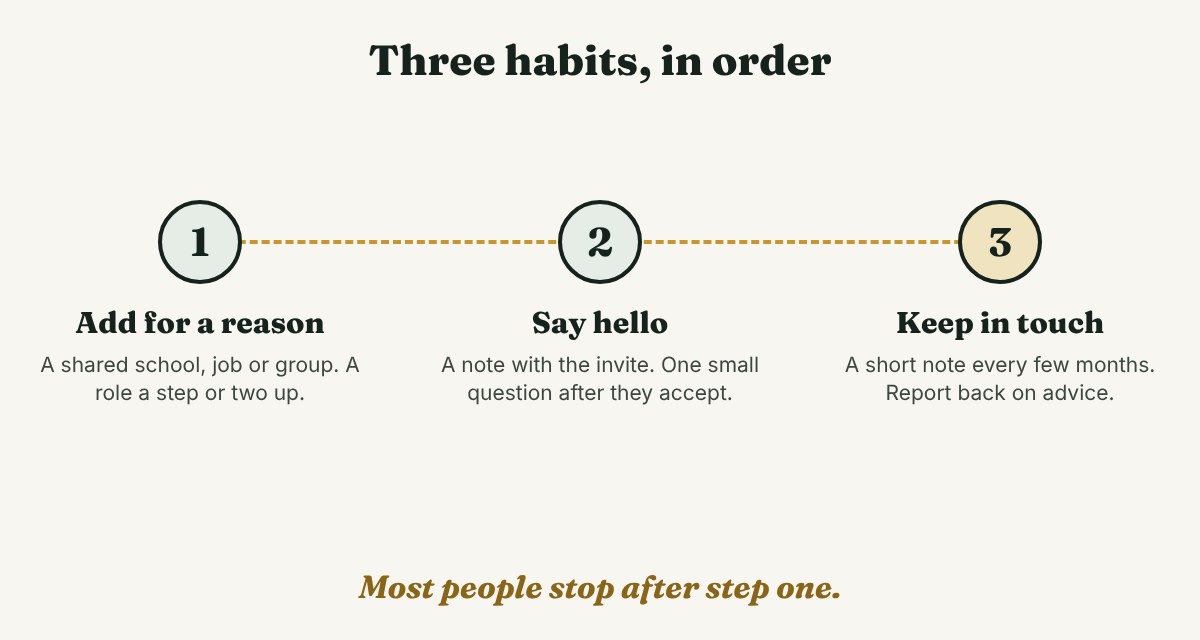
A connection is a button you pressed. A working network is a group of people who would answer you. Getting there takes three habits, in this order: add people for a reason, write after they accept, and keep in touch.
Profile setup is not covered here. If it is not ready, start with our 7-day plan for LinkedIn beginners and come back. For contacts beyond LinkedIn, see how to build a professional network from zero.
Who should you add to your LinkedIn network?
Step 1: Add people you have a reason to write to
Before you press Connect, finish this sentence: "I am adding this person because [reason]." Three starting points from the career offices we read:
- People who share something with you. Georgetown's data science program says to check a company page's People tab for people with your school, employer or organization.
- People one or two steps above you. A career advisor at the University of Denver says not to aim only at CEOs. Find the role one or two steps above yours, because those people can describe the next step more clearly.
- Alumni and people you have talked to. Harvey Mudd College tells students to search alumni by company or class year, and to connect with people they met at talks, career fairs and panels.
Why not add everyone? The people who help most are not always the ones you would guess. MIT News describes a five-year LinkedIn experiment from 2015 to 2019, published in Science, with about 20 million users. When the researchers counted tie strength by mutual connections, the most useful ties for finding jobs were moderately weak ones, and a tie's usefulness dropped once two people had more than about 10 mutual connections. The study measured job moves, not every goal, and covered LinkedIn only.
Our reading: do not skip a stranger with a good reason, and do not rely on close contacts alone. For more on who to add, see how to get more LinkedIn followers and our 5 steps for growing on LinkedIn.
What should you do after someone accepts?
Step 2: Write a note with the invite, then one question after
Connect soon. The Denver advisor says to do it within 24 hours of meeting someone and to say how you met. Georgetown says: "It is unlikely that someone will accept your connection request without further context." Harvey Mudd says to skip the default text and not to ask for a job or a recommendation in the first message.
Here is a short invite note. Change every part in [brackets].
Hi [Name], I saw that we both studied at [school], and I follow your work on [topic]. I am working toward [one goal]. I would like to stay in touch.
When they accept, write back within a day or two (our suggestion, not a study). Ask one question they can answer in a line:
Thank you for connecting, [Name]. I am curious how you moved from [A] to [B]. Is there one thing you wish you had known at the start? A short answer is plenty.
If they reply, ask for a short call. Georgetown suggests about 30 minutes: their career path first, then advice, then any request, because "your chance to ask is at the end of your conversation." After the call, send thanks within 24 hours and name one thing you learned, as Boston University's career office also advises. For more wording, see our examples of what to send after someone connects and our 4-part frame for a professional message.
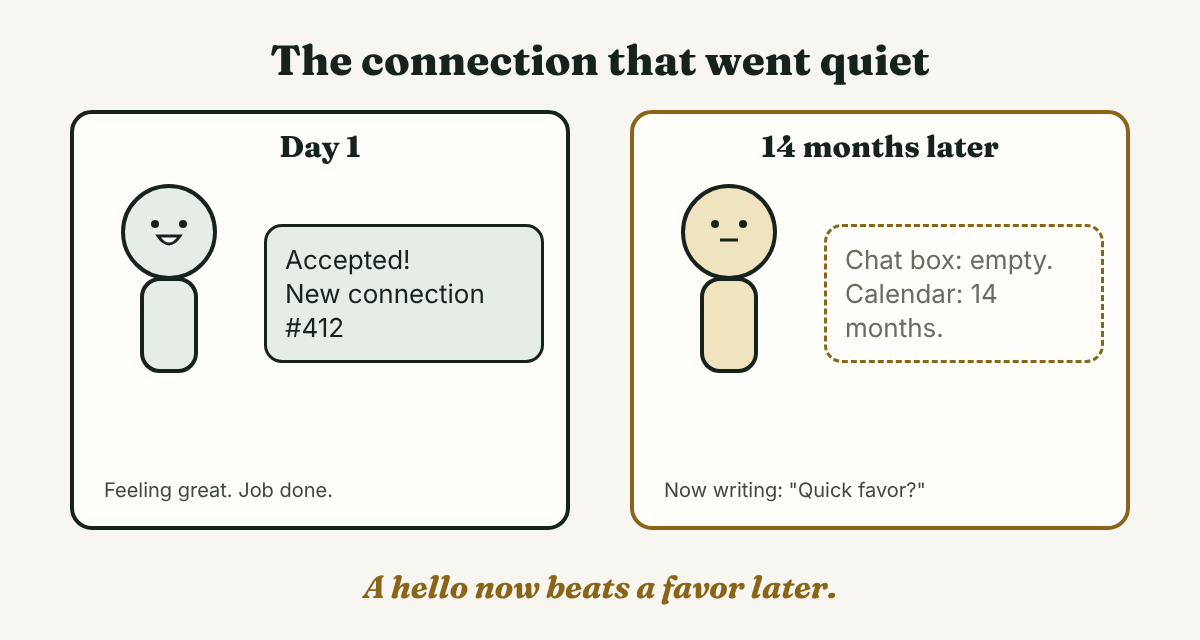
The most common mistake is silence. If you connect and then go quiet, the next message from you is usually a request. Write each message yourself, to one person. We never recommend mass messaging or any tool that sends messages for you.
How do you keep in touch without being annoying?
Step 3: Sort people into three lists
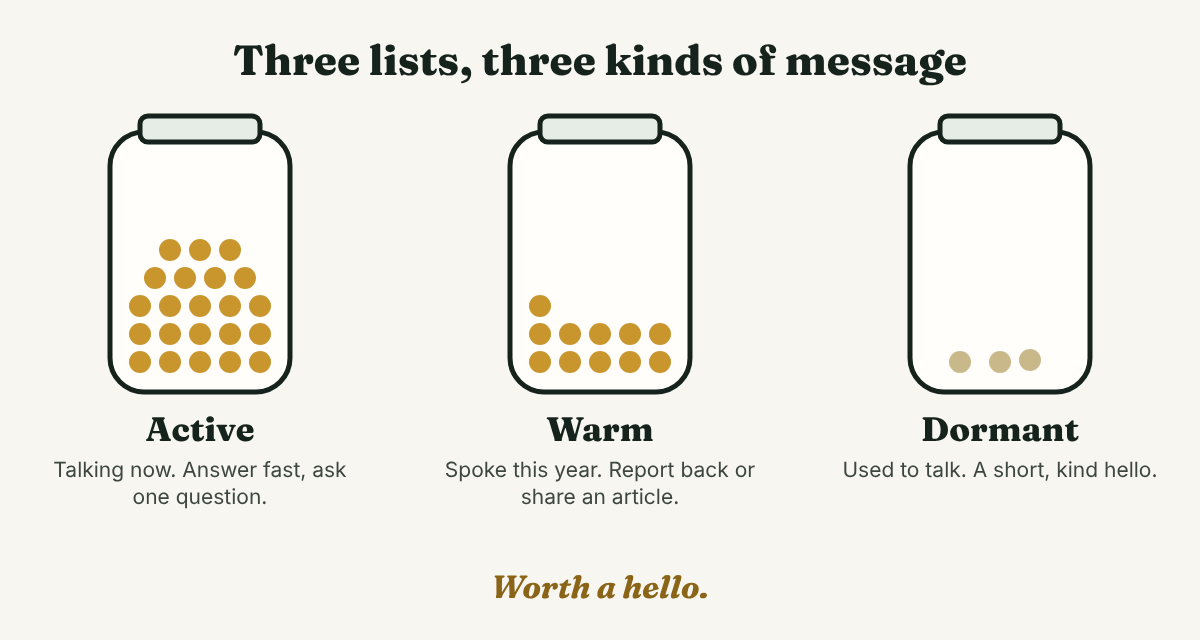
You cannot talk to everyone every month. Put each person into one of three groups. This is our method, not one from a study:
- Active: people you are talking to now, such as someone who just answered your question.
- Warm: people you spoke with in the last year or so.
- Dormant: people you used to talk to and have not heard from in a long time.
Why bother with the dormant list? In a 2011 study in Organization Science, executive MBA students consulted old contacts about an important work project. The authors report that advice from these dormant ties "compared favorably to those of their current ties." The page we read gives no sample size, and the task was a work project, so treat it as a reason to write to an old contact, not a promise.
Then give each list a small move that is not a request. Yale University's Office of Career Strategy suggests sharing an article tied to your last talk, congratulating them on news, or reporting back on what you did with their advice.
Yale School of Management suggests a coffee chat or virtual meetup "every few months," and says liking or commenting on a contact's posts keeps you visible "without being intrusive." Here is a report-back note for a warm contact:
Hi [Name], last time you mentioned [detail]. How did it turn out? I tried your tip about [advice], and [result]. Thank you again.
If someone does not reply, do not push. Harvey Mudd advises one more request after about a month, and then stopping.
How do you fit it into 20 minutes a week?
Step 4: Run the same short loop each week
Here is a loop of about 20 minutes. The times are our example, so change them to what you can keep for a year.
- 5 minutes: answer. Check who accepted your invites and who wrote to you.
- 10 minutes: write two messages. One to a warm contact (a report-back or an article), and one to a dormant contact (a short hello that names the last thing you talked about).
- 5 minutes: write notes. For each conversation this week, write two lines: what you talked about and what happens next.
The notes are the part people skip. In three months you will not remember what you promised a contact. A spreadsheet works for a start, and our guide to the 3 numbers worth tracking shows which counts matter.
Full disclosure: we make GrowthSeeded, a simple follow-up tracker for LinkedIn. It does not write messages, send them or touch LinkedIn. You send every message yourself, and it never sends anything. What it does is keep track: a due-today view shows who to follow up with, you write a note after each conversation, and the next step comes from what happened, such as an accepted connection or a reply, not from a fixed date. A spreadsheet can do a version of this. A tracker helps most when the list outgrows your head.
For templates by situation, see our guide to follow-up messages on LinkedIn.
FAQ
What is a LinkedIn professional network?
It is the group of people on LinkedIn who know you and your work and would answer if you wrote. It includes close and distant contacts. The connection count is only a count.
How many LinkedIn connections do you need?
None of the sources we opened gives a number. A better first goal is ten people you have a reason to write to.
What should you say after someone accepts your request?
Thank them and ask one small question about their work. Do not ask for a job or a referral yet. If you have a call later, make any request at the end of it.
How often should you message your connections?
There is no fixed rule. Yale School of Management suggests a coffee chat or call every few months. Pick a rhythm you can keep.
Is it all right to write to someone you have not spoken to in years?
Yes. A 2011 study of MBA students found that advice from old contacts compared well with advice from current ones. Mention the last thing you talked about, and keep it short.
Do this today
- Pick three people you have a real reason to write to. Write down the reason next to each name.
- Send one invite note or one report-back note from this guide to one person.
- Write two lines after your next conversation: what you talked about and what happens next.
A network fades in the quiet weeks between messages. In GrowthSeeded you can list the people you plan to write to, add a note after each talk, and see who is due for a hello. You send every message yourself, and it never sends anything or touches LinkedIn. The Free plan covers 5 active people at a time, enough to start this loop.
Sources
- The power of weak ties in gaining new employment, MIT News, 2022
- How to Use LinkedIn as a Networking Tool, University of Denver Professional Studies, 2021
- Your Guide to Successful Networking Pt. 2, Georgetown University Data Science and Analytics, 2024
- LinkedIn guide, The Job Search, Harvey Mudd College Career Services, checked 2026
- Networking: Follow Up, Boston University Center for Career Development, 2025
- 10 Ways to Keep a Contact "Warm" (Without Being Awkward), Yale University Office of Career Strategy, 2025
- Keeping Networking Connections Warm, Yale School of Management Career Development, 2024
- Dormant Ties: The Value of Reconnecting, Organization Science (Levin, Walter and Murnighan), 2011
About the author
Anisur Rahman Fagun is a marketing and content strategist with more than 9 years of experience in SEO, content, paid advertising and brand growth. He holds a master's degree in mass communication and journalism, and has led content and SEO strategy, built editorial teams and worked with product, design and sales teams. He also builds simple tools that turn marketing data into clear decisions. He writes the GrowthSeeded blog, which shares practical ways to follow up and stay in touch with people on LinkedIn.
Related reading
- How to Use LinkedIn for Beginners: A 7-Day Start Plan
- How to Use LinkedIn for Professional Growth: 5 Steps
- How to Get More LinkedIn Followers: 6 Steps to Start
- How to Use Data for LinkedIn Growth: 3 Numbers to Track
- Building a Professional Network: 5 Steps From Zero
- LinkedIn Follow-Up Message: 4 Templates and When to Send