Networking
Professional Networking Events: Pick, Prepare, Follow Up
11 min read
Key takeaways
- Pick an event by who will be in the room and who hosts it. A long event list is not a plan.
- Go in with one goal and aim for two or three real conversations, not a full room.
- Write one line about each person right after you talk. A business card without a note is hard to use.
- Send each person a short, personal message within a day or two. That is where most events pay off.
Short answer: Pick events by who will be in the room, set one goal, and plan for two or three real conversations. Write a one-line note after each talk. Then, within a day or two, send each person a short message that mentions what you discussed. The follow-up is where most events pay off.
In this article
Which professional networking events are worth your time?
What should you do before you go?
What should you do in the room?
What should you do after the event?
How do you know if an event was worth it?
Where does a tracker fit?
FAQ
Do this today
Which professional networking events are worth your time?
You signed up for an evening event, and you do not know who will be there. You may have been to one before and left with a few business cards and no plan for them. This guide covers which events to pick, what to do before and during, and the part most guides skip: the days after, when a short talk turns into a contact or fades.
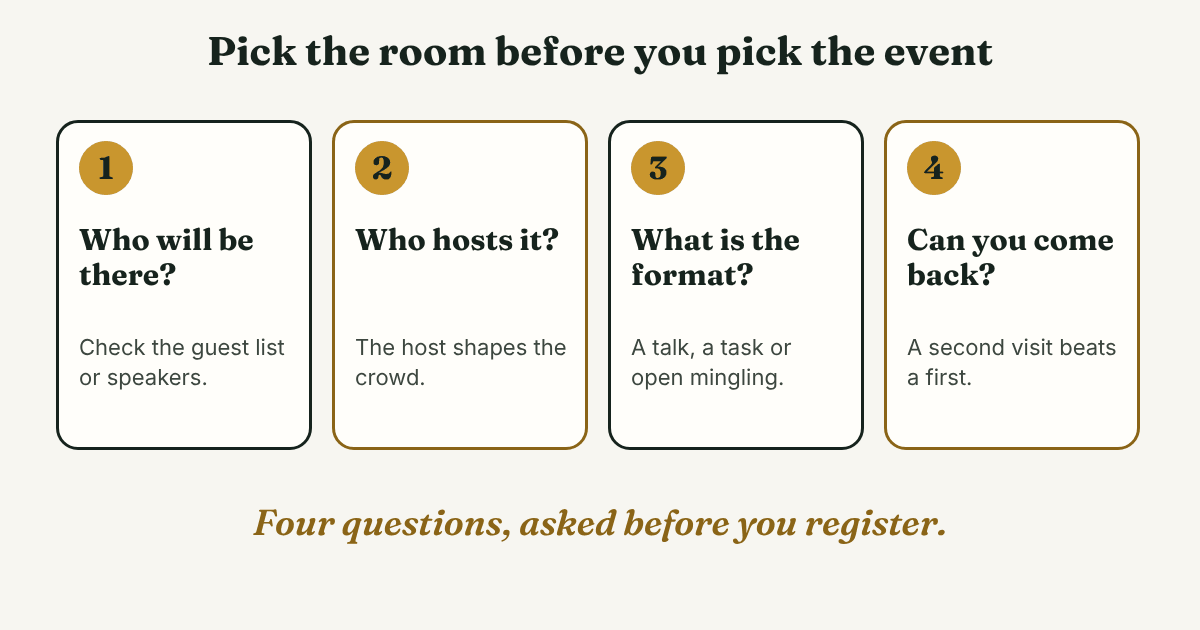
Start with the people you want to talk to, not a list of events. Then ask four questions about each event.
- Who will be there? If there is a guest list or a speaker list, look people up on LinkedIn. The University of Twente suggests checking the guest list to pick out the people or companies you want to talk to. The University of Florida suggests choosing three to five priority organizations, so you know which ones matter most.
- Who hosts it? Entrepreneur, in a piece on picking events, says the host largely decides who comes. Before you register, find out who hosts it and who usually attends.
- What is the format? Some events are structured, with a talk or a group exercise. Others are open mingling. Entrepreneur advises picking the one you will enjoy. A talk gives you something to discuss, which makes the first sentence easier.
- Can you go back? The Entrepreneur writer says it took at least a year of attending the same events before referrals started. That is one person's experience, not a study. Our reading: one event you attend three times is more useful than three events you attend once, because people start to recognize you.
If you are early in your career, our networking tips for young professionals show where to start, and our guide to the follow-up message after a career fair covers that one kind of event in depth. If you run your own business, our guide to networking events for entrepreneurs helps you pick by goal.
What should you do before you go?
Step 1: Set one goal and write your lines
A goal keeps the evening from blurring. Make it small and about people, for example: talk to two people who work in [field]. Georgetown University Law Center advises focusing on a smaller goal, such as two or three good conversations that could lead to a follow-up, instead of working the whole room.
Then prepare three short things. Everything below is a starting point, so change it to sound like you.
- A one-line introduction. The University of Twente says to include more than what you study: add what interests you and what you want next. Try: Hi, I'm [name]. I work on [what], and I came to hear about [topic]. What brought you here?
- Two questions beyond hello. Twente suggests conversation starters that go past "Hi, how are you?" Two to try: What are you working on right now? and How did you get into [field]?
- One thing you can offer. Twente suggests thinking about what you can give, since good connections go both ways. It can be small, such as an article or an introduction.
Update your LinkedIn profile too, because Twente notes that people look at each other's profiles before and after an event. And if crowds tire you, Georgetown suggests a 10 to 20 minute break before and after the event.
What should you do in the room?
Step 2: Have a few real conversations
Arrive early. Georgetown says rooms are quieter before the crowd builds, and standing near the entrance (without blocking it) lets you greet people as they come in one at a time.
Once you are talking, ask one question that builds on their answer. A set of studies reported by the Association for Psychological Science (Huang and others, 2017) found that people who were asked to ask more questions, especially follow-up questions, were rated as more responsive and more likable by their chat partners. The limits: these were 15-minute text chats in a lab with assigned question counts, and the authors warn that too many questions could backfire. A simple follow-up looks like this: You said you moved from [A] to [B]. What made you choose that?
If a conversation felt awkward, take heart. In studies of strangers and of college roommates, people on average liked their partner more than they thought the partner liked them. The authors call it the liking gap. It is an average, not a promise, but your own sense of how it went is probably harsher than theirs.
To leave a conversation without awkwardness, Georgetown gives a polite exit line: I'll let you get to that, but I look forward to speaking with you again soon. Before you walk away, get a card or connect on LinkedIn, as the University of Ottawa's Telfer School suggests, so you know whom to follow up with.
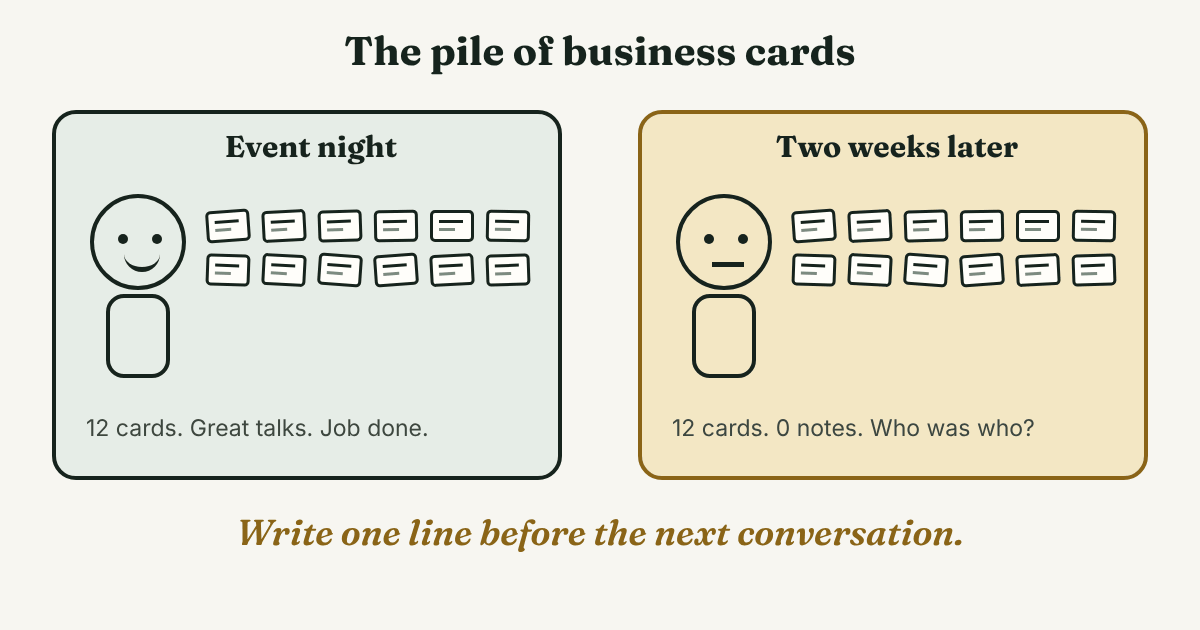
Then do the step most people skip. Before the next conversation, write one line on your phone: the name, one detail they told you, and anything you promised. For example (Dana is an example, not a real person): Dana. Moving from sales to product. Promised the article on [topic]. In two days, that line is what lets you write a message that sounds like you were there.
What should you do after the event?
Step 3: Message each person within a day or two
None of the sources we opened sets a deadline. Georgetown says to contact new connections shortly after the event, and the University of Florida says to send a thank-you note to each recruiter you talked to. Our suggestion: send within a day or two, while they still remember you.
Each message needs three parts: where you talked, one detail from your talk, and one small next step. Here is Dana's note from above turned into a message.
Hi Dana, it was good to talk at [event] about your move from sales to product. Here is the article I mentioned: [link]. I would like to stay in touch.
If you want a short call, add it only after you have given something, and keep it small:
Hi [Name], thank you for the talk at [event]. You said [detail], and I have kept thinking about it. Would you be open to a 15-minute call in the next few weeks? I would like to hear how you [did X].
Write every message yourself, one person at a time. Do not send the same text to everyone you talked to. We never recommend mass messaging or auto-messaging tools. For more wording by situation, see our guide to the LinkedIn follow-up message after connecting and our full guide to follow-up messages.
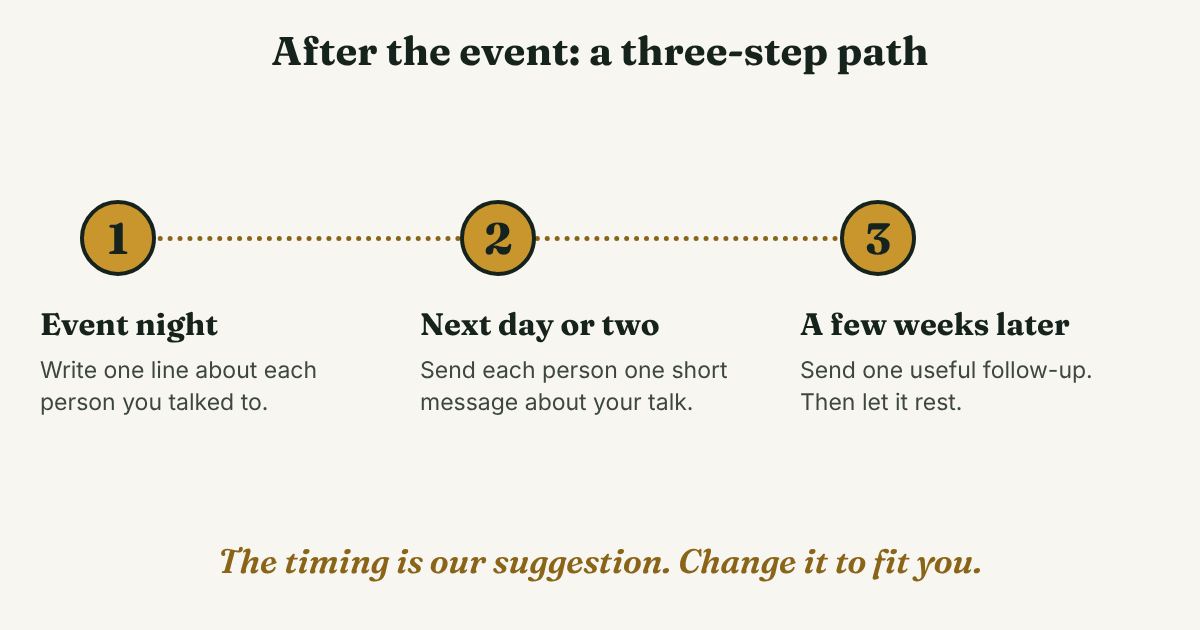
If someone does not reply, do not push. Wait a few weeks, then send one more note that gives something, such as a result from the advice they gave you. After that, let it rest.
How do you know if an event was worth it?
Step 4: Count three things and decide after three visits
After each event, write down three numbers: real conversations, messages sent, and people who wrote back or agreed to talk again. These are our suggestion, not a standard. Many conversations and few messages means the follow-up is the weak spot. Many messages and no replies means the messages, or the room, may be wrong.
Judge an event after about three visits, not one, in line with the Entrepreneur writer's point about the long game. Then keep it, change it or drop it.
If networking events leave you feeling uneasy, you are not alone. A study reported by Kellogg Insight (Casciaro, Gino and Kouchaki, 2014) found signs that networking for professional gain can bring up a feeling of being morally "dirty," and in one law firm, lawyers who felt this way networked less. The article describes no tested fix, and the law firm data cannot show cause. Our reading: a goal about learning and helping, like the one in Step 1, gives you a reason to be there that feels comfortable.
Where does a tracker fit?
Full disclosure: we make GrowthSeeded, a simple follow-up tracker for LinkedIn. It does not find events, write messages or send them. It keeps a list of the people you talked to, with a note after each conversation, and a due-today view shows who is waiting for a follow-up. The next step comes from what happened, such as an accepted connection or a reply, not from a fixed date. A spreadsheet can do the same job if you keep it up. To find events, use association sites and alumni pages instead. For groups that meet again and again, see our guide to professional networking groups.
FAQ
How many professional networking events should you attend?
None of the sources we opened gives a number. The Entrepreneur writer went to about two happy hours a week for several years, which is his own routine. A better start is one event a month that you can follow up on well.
What if you do not know anyone there?
Arrive early, when the room is quieter. If your group hosts, Georgetown suggests taking a small task such as checking in guests, which lets you greet people one at a time.
Are virtual events worth it?
The same steps apply. For virtual career fairs, the University of Florida adds: book appointments early, check your email 24 hours before, and use a quiet space. Our virtual professional networking guide has a 20-minute call plan.
Should you bring business cards?
Bring a few if the event is one where people use them. What matters is leaving with a way to reach the person. The University of Ottawa's Telfer School says to collect cards or connect on LinkedIn at the event, so you know whom to follow up with.
How do you leave a conversation politely?
Say something short and kind, then go. Georgetown's example is: I'll let you get to that, but I look forward to speaking with you again soon. Get a card or a LinkedIn connection first.
Do this today
- Pick one event coming up. Write down the one person or kind of person you want to talk to there.
- Write your one-line introduction and two questions on your phone.
- Open a note on your phone named after the event, so you can add one line after each conversation.
An event gives you names. The weeks after decide whether any of them become contacts. Before your next event, add the people you want to see to GrowthSeeded, and after it, add a line about each talk. The due-today view then shows who is waiting for your message. You send every message yourself, and it never sends anything or touches LinkedIn. The Free plan holds 5 active people at a time.
Sources
- Navigating Career Fairs and Networking Events Guide, University of Florida Career Connections Center, 2023, updated 2026
- 5 Ways to Prepare for a Networking Event, Telfer School of Management Career Centre, University of Ottawa, 2018
- Networking Tips for Introverts, Georgetown University Law Center, 2020
- How to prepare for a network event, University of Twente, 2025
- How to Pick the Right Networking Events to Attend, Entrepreneur, 2021, updated 2025
- Asking Questions Increases Likability, Association for Psychological Science, 2017
- You Probably Made a Better First Impression Than You Think, Association for Psychological Science, 2018
- Networking Is a Dirty Business, Kellogg Insight, 2014
About the author
Anisur Rahman Fagun is a marketing and content strategist with more than 9 years of experience in SEO, content, paid advertising and brand growth. He holds a master's degree in mass communication and journalism, and has led content and SEO strategy, built editorial teams and worked with product, design and sales teams. He also builds simple tools that turn marketing data into clear decisions. He writes the GrowthSeeded blog, which shares practical ways to follow up and stay in touch with people on LinkedIn.
Related reading
- LinkedIn Follow-Up Message After a Career Fair: 4 Examples
- LinkedIn Follow-Up Message After Connecting: 4 Examples
- Networking Tips for Young Professionals: 7 Ways to Start
- Professional Networking: What It Is and a Weekly Routine
- Creative Professionals Networking Group: Bring Your Work
- Professional Networking Groups: Pick One, Then Test It