Networking
Professional Networking Groups: Pick One, Then Test It
12 min read
Key takeaways
- Choose a group by the job you need done: learn your field, get customers, build a local name, or just meet people. Each kind of group does a different job.
- Ask before you pay. Must you attend every meeting? Can someone go in your place? How long is the term, and what does it cost?
- Try three meetings before you commit. After each one, answer four yes or no questions (they are below).
- In a new group, take one small job early, such as greeting people at the door. It gives people a reason to talk to you.
- After each meeting, write one line about every person you talked to, and send a short message to the ones you want to know better.
Short answer: A professional networking group is a set of people from work who meet again and again: an association, a referral group, a chamber, or a free local group. Choose by the job you need done, ask what it expects before you pay, try three meetings, and join the one where people talk to you.
In this article
Which kind of professional networking group fits what you need?
How do you choose between them?
What will a group ask of you in time and money?
How do you test a group in three meetings?
What should you do in your first month?
Why do groups work, and what do we not know?
How do you keep track of the people you meet?
FAQ
Do this today
Which kind of professional networking group fits what you need?
Dana (an example, not a real person) is a freelance bookkeeper. This month she got three invitations: a weekly breakfast where members pass each other customers, a mixer at the local chamber of commerce, and a monthly call from an association for bookkeepers. All three are professional networking groups. They do different jobs, and the wrong one costs a year of dues or many early mornings.
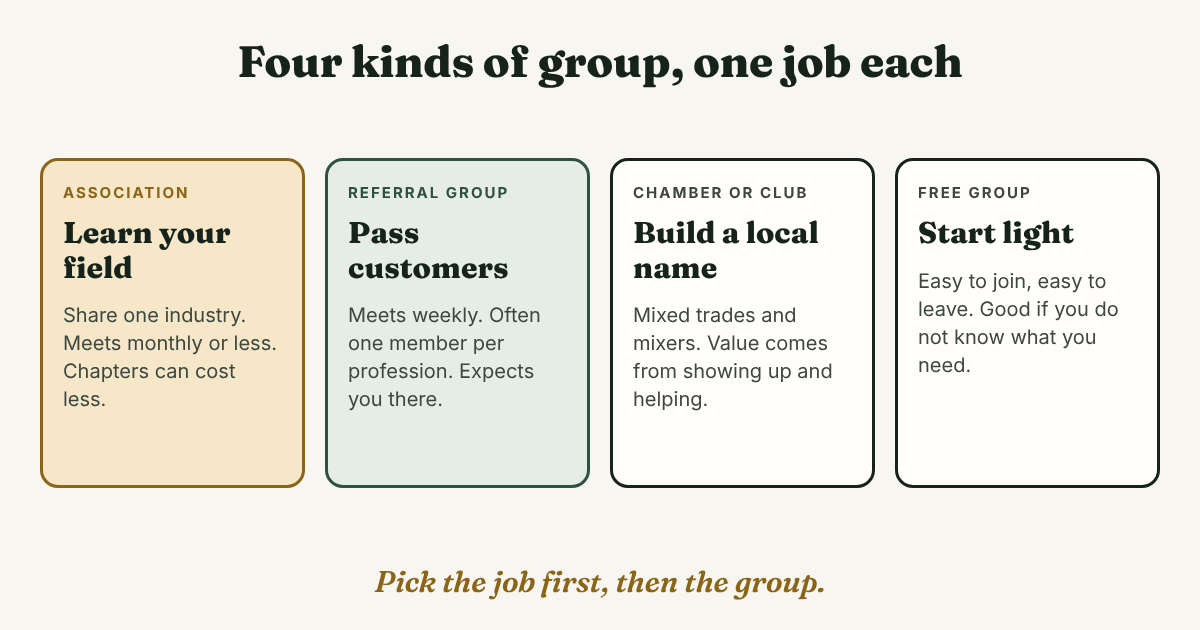
A professional networking group is any organization where people from work meet again and again. The repeat is the point. Here are the kinds you will find, by the job each does. They follow the five types of business networking organizations in Ivan Misner's Entrepreneur article, plus the free, casual groups that a Victorian government business page lists next to paid ones.
- Industry or professional association. Members share one field, and its main purpose, in Misner's words, is "to exchange information and ideas." It fits you if you want to learn your field and know people at your own level. CareerOneStop says members often hear about openings before they are posted, that local chapters can cost less than national membership, and that you can try an event before you pay dues.
- Referral group. Misner calls these "strong contact networks," groups "whose purpose is principally to help members exchange business referrals." They often meet weekly and expect you at nearly every meeting. BNI, the best-known example, says it allows "only one member in each chapter per profession." It fits you if you sell a service to local customers. Our view, not a source's: it is a weak fit if you are looking for a job, because the group exists to pass customers.
- Chamber of commerce or service club. Misner says these mixed groups are not built mainly for referrals, so you get value by attending often, volunteering and joining a committee. The U.S. Chamber's small business site adds that a chamber with regular events and engaged members "will provide far more value than one that's less active." It fits you if you want a name in your town.
- Free or casual group. Meetup-style groups, and groups run by a school or a past employer. They are easy to join and easy to leave. They fit you if you do not yet know what you need.
How do you choose between them?
Finish this sentence: In the next six months I want to [learn / find customers / know people in my city / just start]. Then match it:
- Learn my field or hear about work: an association, ideally a local chapter.
- Find customers for a service: a referral group, if your profession is open.
- Build a local name: a chamber or a service club.
- Not sure yet: a free group for a month.
The referral line has a catch that top guides skip. Because BNI admits one member per profession in a chapter, your seat may already be taken. Ask before you visit. Here is a short message for the organizer. Edit it so it sounds like you:
Hi [Name], I found [group] through [where]. I [what you do] in [city]. Before I visit: do members need to attend every meeting, can someone go in their place, how long is the term, and what does it cost? Is a seat open for [your profession]? I would like to come as a guest on [date].
The Victorian page also lists a catch: some groups "require a certain number of referrals to be generated by each member as a condition of staying in the group." Learn that before you pay.
What will a group ask of you in time and money?
Time. A BNI regional fact sheet says its chapters meet once a week for an hour and a half on average, and recommends one one-to-one with another member each week. That is a 90 minute meeting plus a one-to-one whose length the page does not give. Count the hours before you count the benefits.
Money. We found two averages, and neither is a price list. The U.S. Chamber's site says a chamber costs "between $300 and $400 per year" on average, quoting a third-party source. The Victorian page says networking fees "can cost around $1,000" a year on average. It is about Australia, shows no date and does not name the currency. Some groups are free, and prices change. CareerOneStop adds that your employer may cover fees.
Commitment. This is where people get caught. A common mistake is paying for a year before you know how the group handles a missed week. Ask whether you can pay by the quarter. The Victorian page says: "Always try before you buy."
How do you test a group in three meetings?
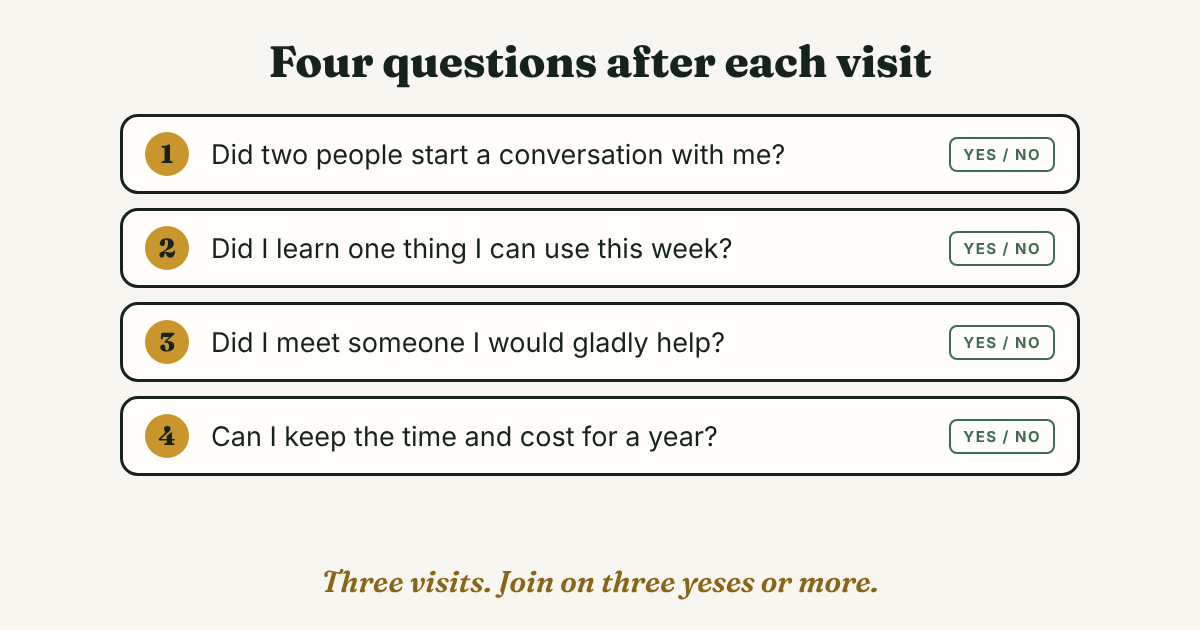
Both the Victorian page and CareerOneStop say to try a group first. Neither says how. Here is a simple method. It is ours, not from research. After each visit, answer four yes or no questions within an hour, while you still remember:
- Did at least two people start a conversation with me?
- Did I learn one thing I can use this week?
- Did I meet someone I would gladly help?
- Can I keep the time and the cost for a year?
Why three visits? The first shows you the room, the second shows whether it stays the same, and the third shows whether anyone remembers you. No study we found says how many visits are enough, so three is a rule of thumb. If you have three or four yes answers after meeting three, join. If not, do not pay. That says something about the fit, not about you.
What should you do in your first month?
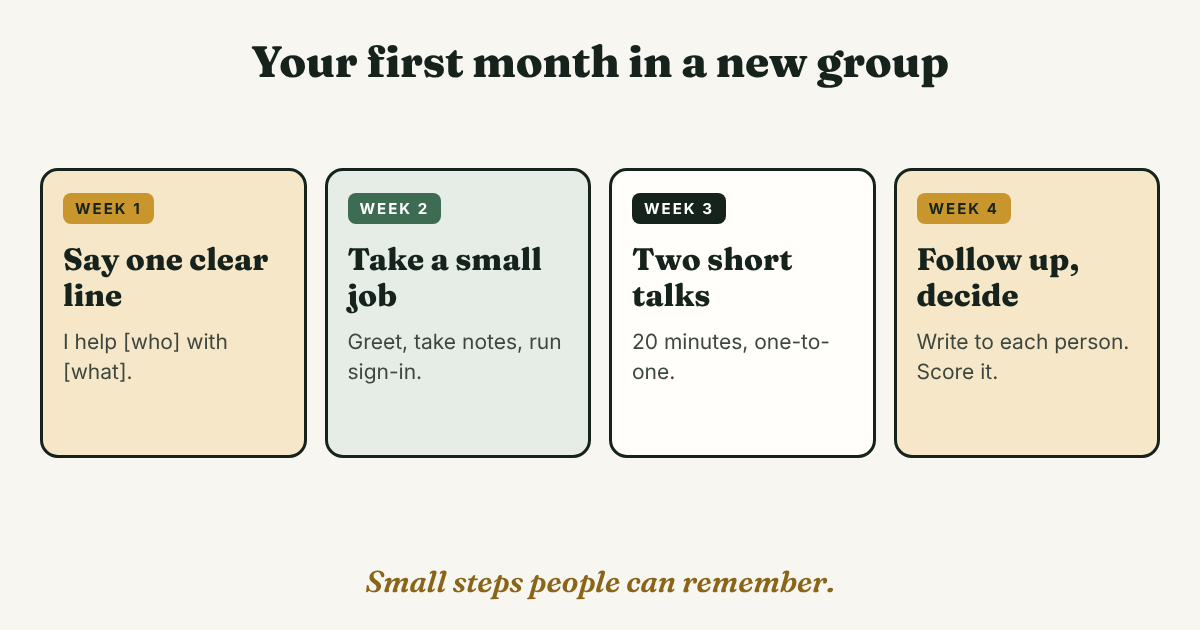
The first month decides whether people know what you do. Four small steps, one a week, are enough. For help with the writing after an event, see our guide to following up after a career fair and the follow-up message after you connect on LinkedIn.
Week 1: Say one clear line about your work
People pass on names they can picture. Use this: I help [who] with [what]. A good week for me is [one example]. Dana's was: I keep the books for freelancers and small studios. A good week for me is a client who knows their numbers before tax time.
Week 2: Take one small job
Misner's advice for associations is to look for ways to help, such as volunteering for the association's social media, and for service clubs to join "to contribute, not to gain business." Greeting people at the door, taking notes or running the sign-in sheet gives people a reason to talk to you. Try: Could I help with [task] at the next meeting?
Week 3: Ask two members for a short talk
BNI recommends a one-to-one each week, and the idea works in any group. Pick two people whose work you do not know yet: Hi [Name], I liked what you said about [topic] on [day]. Could we talk for 20 minutes before [date]? I would like to learn what a good customer looks like for you. The 20 minutes is our suggestion.
Week 4: Follow up and decide
Write to each person you talked to, one at a time, in your own words. Then run the four-question scorecard once more and decide whether to stay.
Why do groups work, and what do we not know?
A 2022 MIT News report described a five-year LinkedIn experiment with about 20 million users. It found that moderately weak ties, people you share some but not many connections with, gave the best job results. "Moderately weak ties are the best," said one of the authors. The study measured job moves on LinkedIn. It did not study groups, and several authors worked for LinkedIn.
Our reading, a guess and not a finding: a group puts you in front of the same moderately weak ties again and again, so repeat visits may matter more than one big event. For how events and groups fit together, see our guide to professional networking events. What we could not find is an independent study that compares referral groups, associations and chambers.
How do you keep track of the people you meet?
After a few meetings you will have a list of names, and people expect you to remember what they do. A notes page works: name, what they do, what they need, one next step. If your group has its own directory, use it. Misner notes that referral groups often track business exchanged, so referrals may already be covered.
Full disclosure: we make GrowthSeeded, a simple follow-up tracker for LinkedIn. It fits when group contacts also become LinkedIn connections and you want a note for each person and a list of who is due for a message. It helps you keep track of people and follow up. It does not find groups for you, and a plain notes page is enough if you only meet a few people.
FAQ
What is a professional networking group?
It is a group of people from work who meet regularly to share information, advice or business. It can be an industry association, a referral group, a chamber of commerce or a casual local group.
What is the difference between a professional association and a referral group?
A professional association is for people in one field who exchange information and ideas. A referral group is built to pass business between members, often with one member per profession and weekly meetings.
How much do professional networking groups cost?
It varies. One chamber source says $300 to $400 a year on average, a Victorian page says around $1,000 a year for networking memberships, and some groups are free. Both are checked October 2026, and prices change.
Are referral groups worth it?
We found no independent study, so we cannot say. They suit people who sell a service locally and can attend nearly every meeting. Visit as a guest and use the four-question scorecard before you pay.
Do this today
- Finish this sentence and pick the kind of group that matches: In the next six months I want to [goal].
- Find two groups of that kind near you, and send the organizer message above to one of them.
- Copy the four scorecard questions into a note on your phone, so you can answer them after the first visit.
The hard part comes after the first few meetings: remembering who said what and who is waiting for a reply. GrowthSeeded keeps a note for each person and a list of who is due for a message, so a follow-up does not depend on memory. You send every message yourself, and it never sends anything or touches LinkedIn. Free is $0 for up to 5 active people at once (checked October 2026, and plans change).
Sources
- The 5 Types of Business Networking Organizations, Ivan Misner, Entrepreneur, 2017
- Why Does BNI Allow Only One Profession Per Chapter?, BNI Global, 2026
- BNI fact sheet: what you need to know about BNI, regional BNI site, checked 2026
- Are business networking groups right for you?, Victorian government business site, no date shown, checked 2026
- 5 ways professional associations can help you boost your career, CareerOneStop, no date shown, checked 2026
- What Is a Chamber of Commerce and Why Join One?, Jamie Johnson, CO by U.S. Chamber of Commerce, 2026
- The power of weak ties in gaining new employment, MIT News, 2022
About the author
Anisur Rahman Fagun is a marketing and content strategist with more than 9 years of experience in SEO, content, paid advertising and brand growth. He holds a master's degree in mass communication and journalism, and has led content and SEO strategy, built editorial teams and worked with product, design and sales teams. He also builds simple tools that turn marketing data into clear decisions. He writes the GrowthSeeded blog, which shares practical ways to follow up and stay in touch with people on LinkedIn.