Networking
Networking Events for Entrepreneurs: Pick by Your Goal
12 min read
Key takeaways
- Choose the event after you choose the goal. A room full of founders is a good place to find peers and a poor place to find buyers.
- In a study of 112 aspiring entrepreneurs, people who knew few others were more likely to have a helpful exchange with someone new. Do not spend the night with your own circle.
- Ask what the other person needs before you say what you sell, and offer something small first.
- Judge a room after three visits, using three numbers: conversations, messages sent and next steps agreed.
Short answer: Pick one goal first: customers, referrals, peers or advice. Then choose the kind of event that fits it, go in with one specific ask and write a note after each talk. Send each person a message within a day or two. Keep a room only if three visits produce next steps.
In this article
Which networking events are worth an entrepreneur's time?
How do you pick between two events?
What should an entrepreneur do in the room?
What should you send after the event?
How do you know if a room is worth keeping?
Where does a tracker fit?
FAQ
Do this today
Which networking events are worth an entrepreneur's time?
You have a product to build or clients to serve, and this month three events each asked for an evening. A bad choice costs more than the ticket. It costs the hours you would have spent on the business. This guide gives you a way to choose, a plan for the room and the messages to send after. For the basics that apply to anyone, read our guide to professional networking events. This one is for founders and owners.
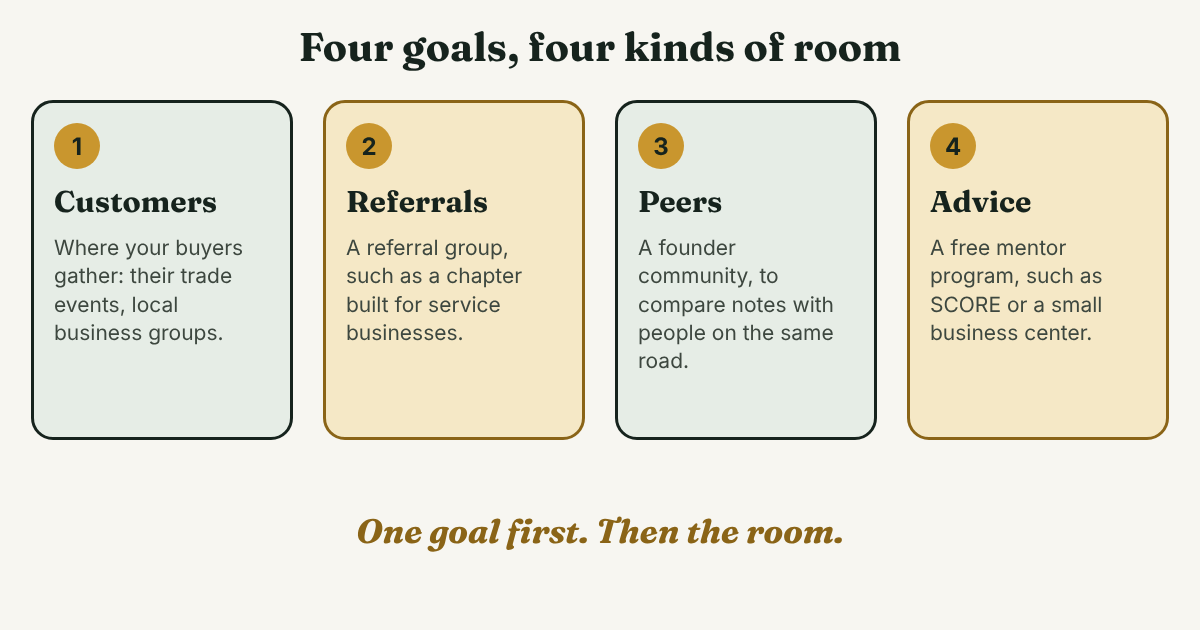
Start with one goal, not a calendar. Tech.eu, in a 2015 guide for early-stage founders, says to decide whether you want a strategic partner, investors or industry knowledge, then focus on the people who can help with that. Here are four goals that cover most founders, with the kind of room that tends to fit each. Some of the matching comes from sources and some is our reading, and we say which.
- Customers. Go where your buyers gather, not where other founders gather. This is our reading, not a study: if you sell to dental offices, a dental association event has more of your buyers than a founder evening does. For a local business, Entrepreneur (2025) says a local chamber of commerce offers networking across industries, resources and guest speakers.
- Referrals. Referral groups are built for this. Entrepreneur's list describes Business Networking International (BNI) as a referral-focused group that suits service businesses that depend on referrals.
- Peers. Founder communities are built for this. The same list names Startup Grind, which supports founders from the early stages through Series A, and Founders Network, a mentorship community for tech startup founders that is open by invitation only.
- Advice. The U.S. Small Business Administration says it offers free or low-cost counseling through partners, including SCORE (free counseling and workshops from volunteer business mentors) and Small Business Development Centers (one-on-one and low-cost training). We checked that page in 2026, and offers change.
The common mistake is a mismatch. Priya (an example, not a real person) sells bookkeeping to dental offices. Every Thursday she goes to a founder evening, has warm talks with other founders and goes home with no buyers. Nothing was wrong with the room. It fit a different goal than hers. Priya's goal was customers, so her better room is a dental association event or a local business group.
How do you pick between two events?
Ask four questions before you register. None needs more than ten minutes of research.
- Who will be there? Tech.eu says that when time is tight, you can review the guest list in advance and pick the events where the people you want to talk to will be. Mailchimp's guide (2019) adds that you should research the speakers, sponsors and hosts, so you arrive with something to talk about.
- Who hosts it, and what does it cost? Entrepreneur advises checking membership fees for chambers and other groups before you join, and choosing quality over quantity. Spreading yourself too thin dilutes the effort.
- Does the group have a rhythm? BNI's own guide (2026) says to look for a regular meeting schedule, a mix of members that does not put competitors in one room, and a culture where members follow through. BNI publishes this to promote itself, so treat the list as questions to ask, not proof. One addition from us: ask a current member what the group has led to for them.
- Can you go back? Our reading: a room you visit three times is more useful than three rooms you visit once, because people begin to recognize you and a short talk can pick up where it ended.
What should an entrepreneur do in the room?
Step 1: Walk in with one ask, not a pitch
Write two lines on your phone. The first says what you do and for whom. The second is one specific thing you want help with this month. A specific ask is easier to answer than a general one such as "let me know if you hear of anyone."
I help [who] with [problem]. Right now I am looking for [one specific thing: an introduction to X, advice on Y, two or three customers like Z].
Then spend more time asking than telling. Tech.eu's guide advises listening closely, asking what the other person needs and thinking about how you can help, not only what you can gain. It quotes the founder Candy Behunin, who says people dislike being approached with an immediate demand, so offer something of value first.
Step 2: Do not spend the night with your own circle
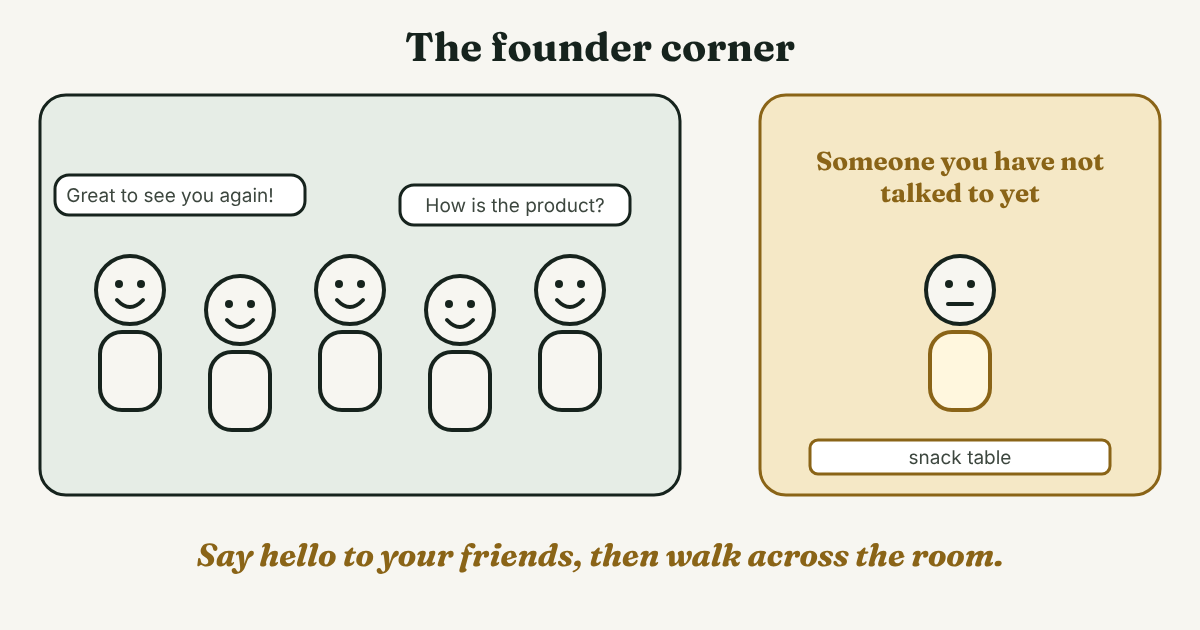
Rembrand Koning of Harvard Business School and Sharique Hasan of Duke studied 112 aspiring entrepreneurs at a three-week boot camp in New Delhi. In the Harvard summary, people who knew no one had a 25% chance of a helpful exchange with another team, against 16.6% for people who already knew someone. Hasan's advice, in Duke's write-up: the best time to build your network is the day you walk in the door.
Keep the limits in mind. It was one boot camp in one city, the task was one app, and the study looked at learning from peers, not at sales or referrals. Our reading is modest: if you go with a friend, agree to split up for the first hour.
Step 3: Write one line after each talk
Before the next conversation, note the name, one detail and anything you promised. For example (Dev is an example, not a real person): Dev. Runs a two-person landscaping firm. Wants to send quotes faster. I promised my one-page quote template. Two days later, that line is what makes your message specific. Tech.eu quotes the founder Olga Steidl on setting aside particular days for meetings and other days for focused work. Put events on those days, so an evening out does not eat a building day.
What should you send after the event?
Send each person a short message within a day or two. None of our sources sets a deadline, so that timing is our suggestion. Write every message yourself, one person at a time, and never send the same text to everyone you talked to. Each message has three parts: where you talked, one detail from the talk and one small next step that fits your goal. Three to edit:
- A possible customer: Hi [Name], good to talk at [event] about [their problem]. I mentioned [what you do]. Would a 15-minute call next week be useful, to see whether it fits?
- A peer: Hi [Name], I enjoyed our talk about [topic] at [event]. You mentioned [detail]. Here is the [article, template or tool] I promised. I would like to stay in touch.
- An adviser: Hi [Name], thank you for your advice on [topic] at [event]. I tried [one thing], and [what happened]. Could I ask you one follow-up question?
Mailchimp's guide adds one more move: introduce two contacts to each other when they might help each other. It costs you one short message and gives both people something. For more wording by situation, see our guide to the LinkedIn follow-up message after connecting. If you want to write to someone you did not get to talk to, our guide to LinkedIn outreach for founders covers it, and how to identify startup founders on LinkedIn helps you look people up before the event. Between events, how founders grow on LinkedIn shows what to keep doing. To build your name before the room, see how founders build thought leadership on LinkedIn.
How do you know if a room is worth keeping?
Step 4: Test a room for three visits
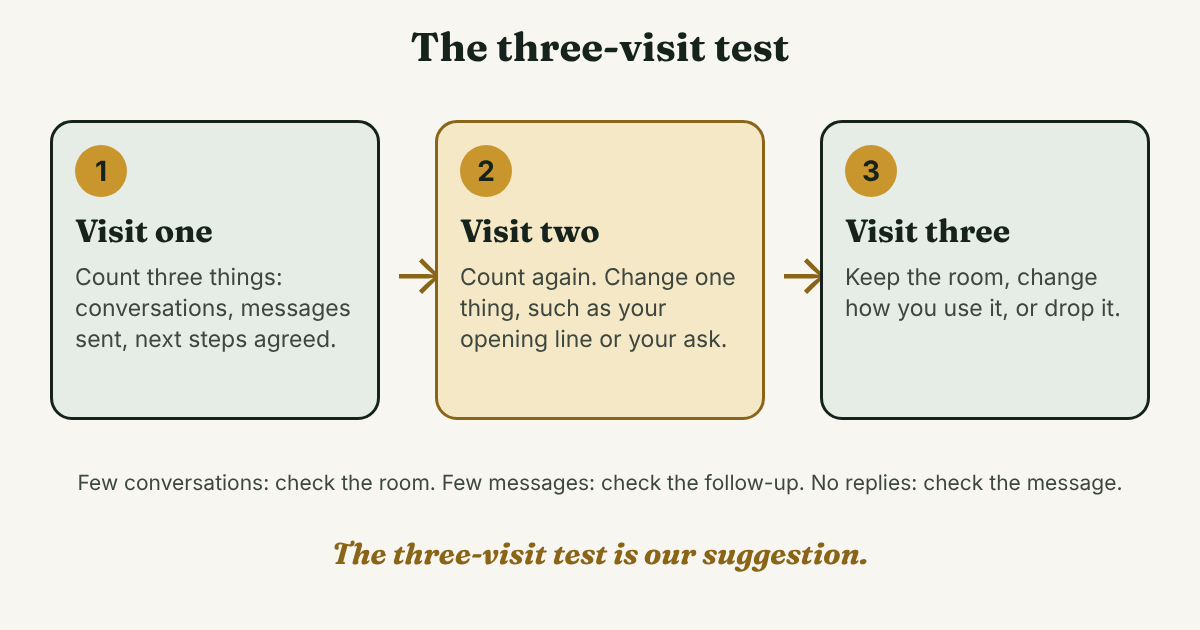
After each event, write three numbers: real conversations, messages sent and next steps agreed, such as a call booked, an introduction made or a reply with a question. These numbers are our suggestion, not a standard. After three visits, decide: keep the room, change how you use it, or drop it. Few conversations point to the room or your opening line. Many conversations and few messages point to the follow-up. Many messages and no replies point to the messages. Entrepreneur's advice to start small and favor quality over quantity fits here: test one room at a time.
We do not know how often founder events pay off. None of the sources we opened gives a typical return. The BNI and SBA pages describe what those groups offer, not how often it works, so the test above is how you find out for your own business.
Where does a tracker fit?
Full disclosure: we make GrowthSeeded, a simple follow-up tracker for LinkedIn. It does not find events, write messages or send them. It keeps a list of the people you talked to, with a note after each conversation, and a due-today view shows who is waiting for a follow-up. The next step comes from what happened, such as an accepted connection or a reply, not from a fixed date. The Free plan is $0 for 5 active people at a time, and up to 20 when friends join through invites (checked October 2026, and plans change). If a notes app or a spreadsheet already works for you, keep using it. A tracker starts to help when the list is longer than you can hold in your head. If you work alone, our guide to LinkedIn growth tools for solopreneurs covers what fits a one-person business.
FAQ
How many networking events should an entrepreneur attend?
None of the sources we opened gives a number. One founder in Tech.eu's guide advises going to many events early on and keeping them to set days, which is her view and not a measured result. For a busy owner, our suggestion is one event a month that you can follow up on well, then adjust after three visits.
Are paid memberships worth it?
Check the fee first, as Entrepreneur advises. Then ask what members get and ask a current member what the group has led to for them. Free options exist too: the SBA page lists SCORE counseling as free.
Should you bring a friend?
Mailchimp says a friend can ease nerves. The New Delhi study found that people who already knew others reached out less to new people. Both can hold: come together, then split up for the first hour.
Where do you find events near you?
Start with your local chamber of commerce and the SCORE and Small Business Development Center offices that the SBA lists. Entrepreneur's list also names Alignable, a free business networking platform. We did not test any of these, so confirm dates and fees on the host's own page. For online groups, see the best LinkedIn groups for entrepreneurs.
Do this today
- Write your goal in one line: customers, referrals, peers or advice.
- Write your two lines for the room: what you do and for whom, and one specific ask.
- Pick one event on your calendar and check its host and guest list. If it does not fit your goal, find one that does.
A room only helps if the people in it do not fade after the evening. Before your next event, add the three people you most want to talk to in GrowthSeeded, and after it, add one note about each conversation. The due-today view then shows who is waiting for your message. You send every message yourself, and it never sends anything or touches LinkedIn.
Sources
- Making connections: A guide to networking for new entrepreneurs and early-stage startups, Tech.eu, 2015
- 12 Networking Groups Every Small Business Owner Should Be Involved In, Entrepreneur, 2025
- Free small business counseling and local mentoring, U.S. Small Business Administration, checked 2026
- How to Choose a Business Networking Organization, BNI, 2026
- At Startup Camps, Entrepreneurs Are Meeting with the Wrong People, Harvard Business School Working Knowledge, summary of a 2019 study
- Well-Connected Entrepreneurs Tend to Stop Growing Their Networks, Duke Fuqua Insights, 2019
- How to Find Networking Events and Make the Most of Them, Mailchimp, 2019
About the author
Anisur Rahman Fagun is a marketing and content strategist with more than 9 years of experience in SEO, content, paid advertising and brand growth. He holds a master's degree in mass communication and journalism, and has led content and SEO strategy, built editorial teams and worked with product, design and sales teams. He also builds simple tools that turn marketing data into clear decisions. He writes the GrowthSeeded blog, which shares practical ways to follow up and stay in touch with people on LinkedIn.
Related reading
- Professional Networking Events: Pick, Prepare, Follow Up
- How Founders Grow on LinkedIn: 5 Steps to Start
- LinkedIn Follow-Up Message After Connecting: 4 Examples
- Professional Networking: What It Is and a Weekly Routine
- Business Professional Networking: Keep Three Lists, Not One
- Best LinkedIn Groups for Entrepreneurs: How to Find Yours