Networking
Business Professional Networking: Keep Three Lists, Not One
11 min read
Key takeaways
- Work in a small firm or in sales mostly comes from people who already know you. Keep in touch with them on purpose.
- Keep three short lists: clients and past clients, people who send you work, and peers who serve the same clients.
- Check in with no ask. A short note about them beats a pitch about you.
- Thank every referral and tell the person how it went. Then ask why they thought of you.
- Write to old contacts before you need them. One study found they can help as much as current ones.
Short answer: Business professional networking means keeping in touch with the people your work depends on: clients, the people who send you work, and peers in your field. Keep one short list for each. Check in with no ask, thank every referrer, and write to old contacts before you need them.
In this article
Why does your work come from people you already know?
Which three lists do you need?
How do you check in with clients without a pitch?
How do you handle the people who send you work?
What about people you talk to at events?
How do you keep up with all of it?
What should you skip?
What do we not know?
FAQ
Do this today
Why does your work come from people you already know?
Tomás (an example, not a real person) runs a small consulting practice. Last quarter, a past client mentioned him to a friend. The friend called, and he won the job. He never thanked the client. Six months later he can't remember who else has sent him work, or when he last wrote to any of them.
People slip off your mind between projects, and referrals are worth keeping for a plain reason. A study of a German bank (Schmitt, Skiera and Van den Bulte, 2011) followed 5,181 customers who came by referral and 4,633 who did not. After 33 months, 82.0% of the referred customers were still there, against 79.2% of the others. The referred customers also earned the bank about 25% more per day at first, but that edge shrank and was estimated to disappear after about 29 months.
It covers one bank and one year of new customers, and says nothing about consultants or sales reps. Still, the pattern is useful: a referral gives you a head start, and the relationship is what keeps it. If you mostly find new people at events, our guide to how to pick networking events for entrepreneurs by goal covers that side. This post is about what you do with the people you already have.
Which three lists do you need?
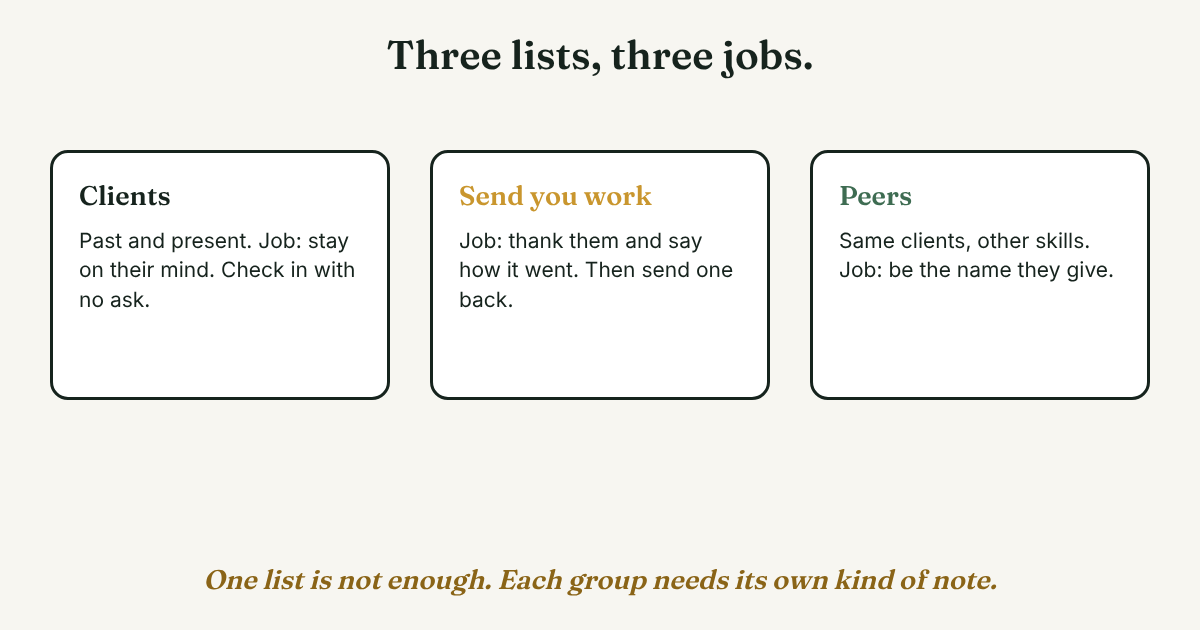
One long list of contacts gets ignored. Three short ones are easier to use, because each has a different job.
- Clients and past clients. People who pay you now or did before. The job: stay on their mind and learn what has changed for them. Start with the last five.
- People who send you work. The former colleague, the accountant, the happy client who mentioned you. The job: thank them, tell them how it went, and send work back when you can.
- Peers who serve the same clients. A financial planner and an attorney serve many of the same people. Xero's guide for accountants (Jotika Teli, 2026) calls these complementary professionals. The job: be the person they name when a client asks, "Do you know someone who...?"
Keep each list small to start. Ten names in total is plenty. ThinkAdvisor (2017) suggests knowing several people in each type of profession, because the first one you approach may not be interested.
Give every person one line: who they are, which list they are on, the last time you talked, one thing you know about them, and the day you will write next. A line on why they matter is the part you will thank yourself for in six months.
How do you check in with clients without a pitch?
A check-in has no ask in it. You say something about them, and you ask one easy question. That is all.
Good reasons to write: their company is in the news, they changed jobs, or a project you did together ended last month.
A note you can edit:
Hi [Name], I saw that [news about their company or work]. Congrats. How is [the thing we worked on] going? No ask, I just wanted to say hello.
What about people you lost touch with years ago? Write to them too. Levin, Walter and Murnighan (2011) asked Executive MBA students to consult former contacts they had not talked to in a while about a work project. The results compared well with what current contacts gave. The study looked at advice on a project, not at sales, so treat it as a reason to write, not a promise of work.
A note for an old contact:
Hi [Name], it has been about [two years] since [the project or job we shared]. I thought of you when [one specific reason]. What are you working on these days? I'd like to hear.
If the wording feels stiff, try our four-part frame for a professional LinkedIn message.
How do you handle the people who send you work?
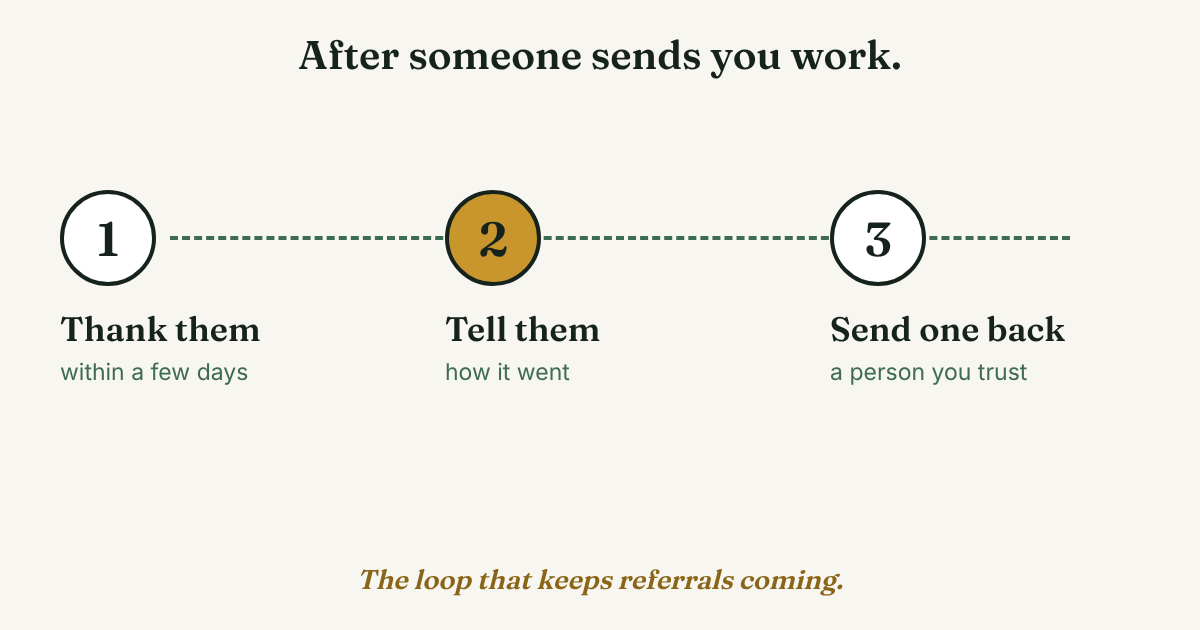
This is the list most people neglect, and it is the one that pays you back. A guide for small law firms in the Law Gazette (page shows no date) gives a simple routine. Once you have a few months of data on who sends you work, write to each one. Thank them, update them on progress as far as confidentiality allows, ask why they sent the work, and offer help in return.
The question "why did you think of me?" is worth the awkward second. The answer tells you the sentence people use when they describe you. Use that sentence on your profile and in your next intro. That part is our suggestion, not something the Law Gazette says.
A thank-you note you can edit:
Hi [Name], thank you for sending [the person or company] my way. I wanted you to know it worked out: [one line on the outcome, as far as you can share]. If I can ever send something back, tell me. And I'd like to know, what made you think of me?
Then send work back. Dave Fuller, a business coach quoted by the Canadian Bar Association's PracticeLink (Carolynne Burkholder-James, 2018), says referrals often start with you: "We can't just expect other people to refer to us." Once a month, name one person you could recommend, and only recommend someone you would trust with your own clients.
What about people you talk to at events?
Xero's guide says most networking chances fail because of weak follow-up. It advises a personal message within 48 hours, with a specific point from your talk and a concrete next step, such as a 15-minute call.
That is the whole job. Our guide to following up after you connect has four examples. If you want a steady place to talk to peers, professional networking groups explains how to pick one and test it before you commit. Both are for one person at a time. Skip anything that looks like a mass message, and read how to write outreach that does not feel like a pitch if your first note keeps coming out salesy.
How do you keep up with all of it?
Do a small amount every week instead of a big clean-up once a quarter. Here is a routine that takes about 20 minutes. It is our suggestion, not a study:
- Pick five people for the week: two clients, one referrer, one peer, and one old contact.
- Write one short message to each. No ask in the first four.
- After each reply or call, change the line you keep on that person and set the next day to write.
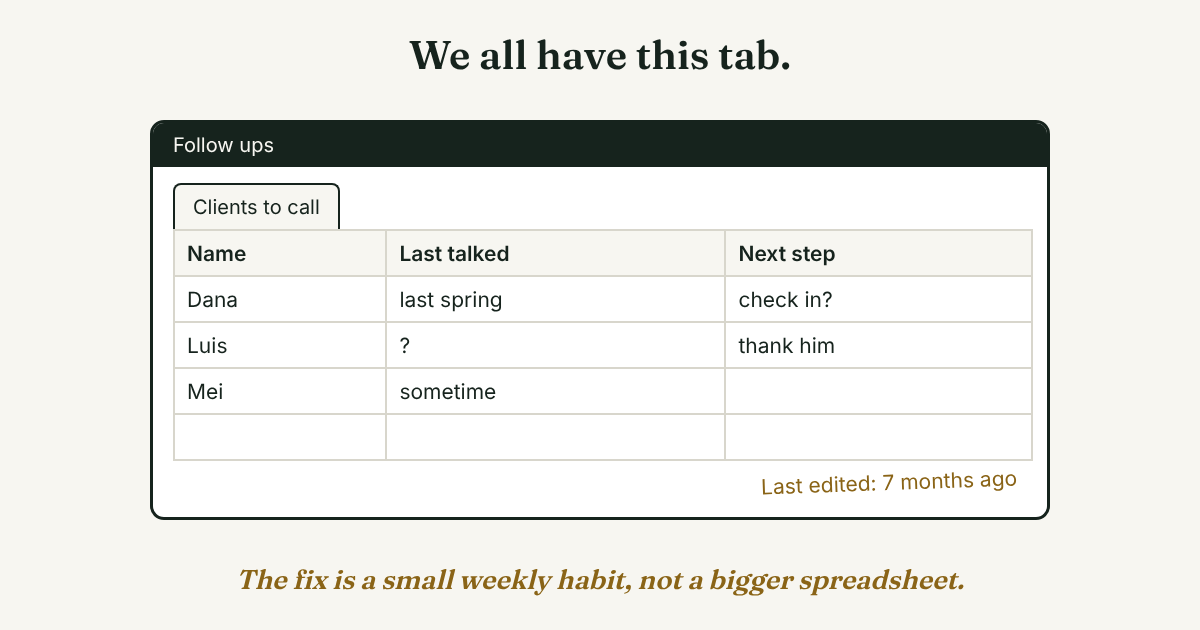
Three example lines (not real people):
- Dana, past client, a rebrand last spring. Her team just hired a new head of sales. Next: check in on November 10, no ask.
- Luis, referrer, sent me the dental group. Thanked him by email. Next: send him one introduction by the end of the month.
- Mei, peer, an accountant who serves the same owners. Next: ask her for a 15-minute call in January.
Full disclosure: we make GrowthSeeded, a simple follow-up tracker for LinkedIn. It fits when you want a note on each person and a list of who to message today. You send every message yourself. It does not write your messages, and a plain spreadsheet works fine if you only keep up with a handful of people.
One more habit from research on how managers network (Ibarra and Hunter, 2007): reach out before you need something, and stay consistent even when you are busy. If you want to add new people to your lists, building a professional network from scratch shows how.
What should you skip?
- A pitch inside a check-in. The moment you sell, it stops being a check-in.
- Asking for a referral in the first message. ThinkAdvisor says people usually need more than one meeting to understand what you do and to trust you.
- Thanking someone and then going quiet. Tell them how it went. That is what makes the next referral easy.
- One note pasted to many people. Write each one for the person who will read it. We do not recommend mass messages or tools that send them for you.
What do we not know?
We found no study of how often a check-in turns into work for a small firm or a sales rep. The bank study covers one company. The dormant ties study used Executive MBA students. Xero, ThinkAdvisor, the Law Gazette and CBA PracticeLink are practitioner advice, not research. The weekly routine, the three lists and the "why did you think of me?" question are our suggestions.
FAQ
What is business professional networking?
It means keeping in touch with the people your work depends on: clients, past clients, the people who send you work, and peers who serve the same clients. The goal is steady, trusted contact, so that when someone needs what you do, they think of you.
How is it different from networking for a job?
The habits are the same: write short notes, be specific, follow up. The difference is who is on your list. A job seeker writes to hiring managers and recruiters. A consultant, a rep or a small firm writes to clients, referrers and peers, and the goal is repeat work and introductions.
How many people should I keep in touch with?
Start with 10 to 20 names across the three lists. That is our suggestion, not a rule. A list you will actually use beats a long one you ignore.
Should I reward people for referrals?
The bank in the Schmitt study gave referrers a 25-euro voucher, but the study did not test whether the reward changed anything. Rules about referral fees differ by profession and country, so check yours first. A thank-you note costs nothing and always fits.
What if a client never answers my check-in?
Send one note, then wait for a real reason to write again, such as news about their company or the end of a project. Writing again and again with nothing new reads as pressure.
Do this today
- Write 10 names on a page, split into clients, people who send you work, and peers.
- Thank the last person who sent you work, and tell them how it went.
- Send one no-ask check-in to a past client or an old contact.
If the list grows past what you can hold in your head, GrowthSeeded can keep it. Add each person with a line on why they matter, and it tells you who to message each day, so you don't forget to follow up. You send every message yourself, and it never sends anything or touches LinkedIn. There is a free plan.
Sources
- Referral Programs and Customer Value, Schmitt, Skiera and Van den Bulte, Journal of Marketing, 2011
- Dormant Ties: The Value of Reconnecting, Levin, Walter and Murnighan, Organization Science, 2011
- Tips for building a referral network, Carolynne Burkholder-James, CBA PracticeLink, 2018
- Business networking for accountants: 10 strategies to grow your practice, Jotika Teli, Xero, 2026
- On the network: a simple but effective way for small firms to develop new business, Law Gazette, checked 2026 (page shows no date)
- 7 ways to get even more referrals, ThinkAdvisor, 2017 (year from the page address)
- How leaders create and use networks, Herminia Ibarra and Mark Hunter, Harvard Business Review, 2007
About the author
Anisur Rahman Fagun is a marketing and content strategist with more than 9 years of experience in SEO, content, paid advertising and brand growth. He holds a master's degree in mass communication and journalism, and has led content and SEO strategy, built editorial teams and worked with product, design and sales teams. He also builds simple tools that turn marketing data into clear decisions. He writes the GrowthSeeded blog, which shares practical ways to follow up and stay in touch with people on LinkedIn.