Networking
Best LinkedIn Groups for Entrepreneurs: How to Find Yours
13 min read
Key takeaways
- The lists of top groups we opened are dated 2019 to 2024, and a member count does not show whether anyone posted this week. Pick groups by what you want from them.
- Choose one goal first: customers, peers or investors. Each goal points to different groups, and customers are often in groups for their own job, not in groups for founders.
- Check who is in the room and what the group does with links. Some groups ban links in first posts, and others give promotion its own section.
- Reply with a specific detail before you post. When someone answers you, send one short note that names the thread.
- Join two groups, and write one line about each person you talk to.
Short answer: The best LinkedIn groups for entrepreneurs are the ones where the people you want to talk to are posting this week. Choose one goal (customers, peers or investors), search for it with the Groups filter, check each group's link rules, and join two. Skip any list that shows member counts without a date.
In this article
Why not just join the biggest groups?
What do you want from a group?
How do you find groups to check?
How do you judge a group as a founder?
What should you post as a founder?
How do you turn a group thread into a conversation?
How many groups, and for how long?
How do you keep track of the people you talk to?
What do we not know?
FAQ
Do this today
Why not just join the biggest groups?
Dana (an example, not a real person) runs a small design studio. She found a list of top entrepreneur groups, joined four, and posted her services in each one. Two posts were removed. The others got no replies. The list was not wrong. It just could not tell her what she needed to know: who posts in these groups this week, and what each group does with a post like hers.
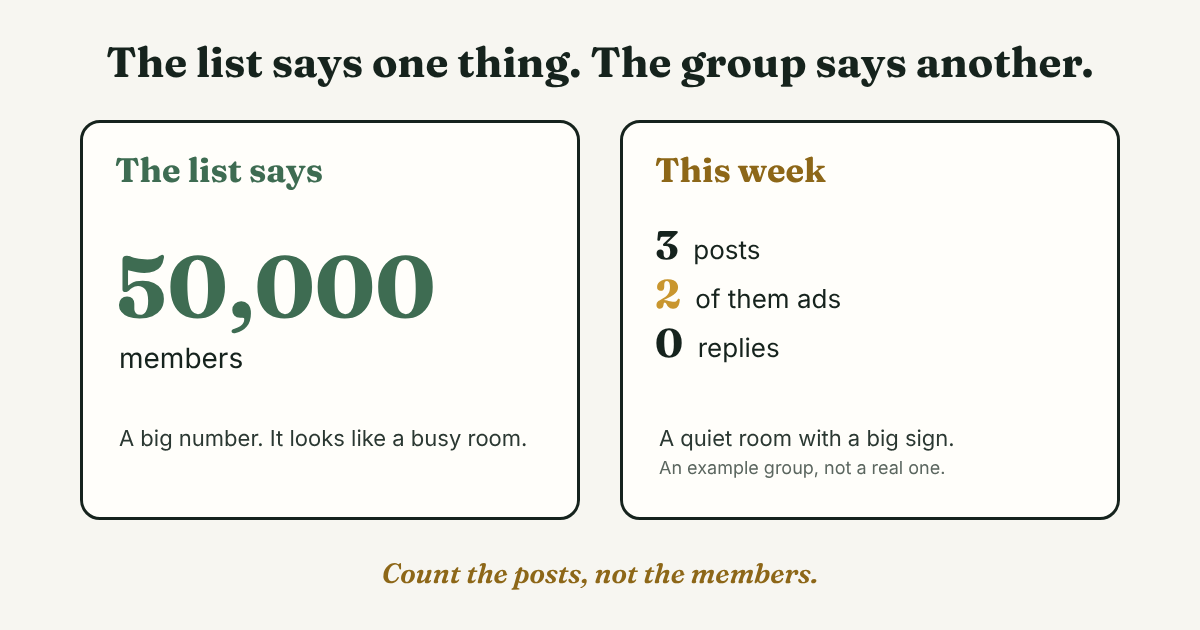
What the lists show. The lists we opened are dated 2019 to 2024. A 2022 list from the U.S. Chamber of Commerce gave Executive Suite as having more than 380,000 members and Bright Ideas & Entrepreneurs as having over 23,000. A Statusbrew article from January 2024 gave 379,834 and 22,810 for the same two groups. A count like that tells you a group is big. It does not tell you whether anyone answered a question last week. InvoiceBerry's list of 99 groups, published in 2022 with a 2026 update date, mostly gives no counts and does not show which groups are still active. Several of these sources sell software, so read them with that in mind.
Our choice. We do not give a ranked list. LinkedIn blocked our tool from reading group pages, so we could not check which groups are active today, and a list we could not check would repeat the problem. Below is a way to find and test groups yourself. For how groups work on LinkedIn and a five-sign check for an active group, read LinkedIn networking groups: worth it? A two-week test. For rooms and events as well as groups, see our guide to networking events for entrepreneurs.
What do you want from a group?
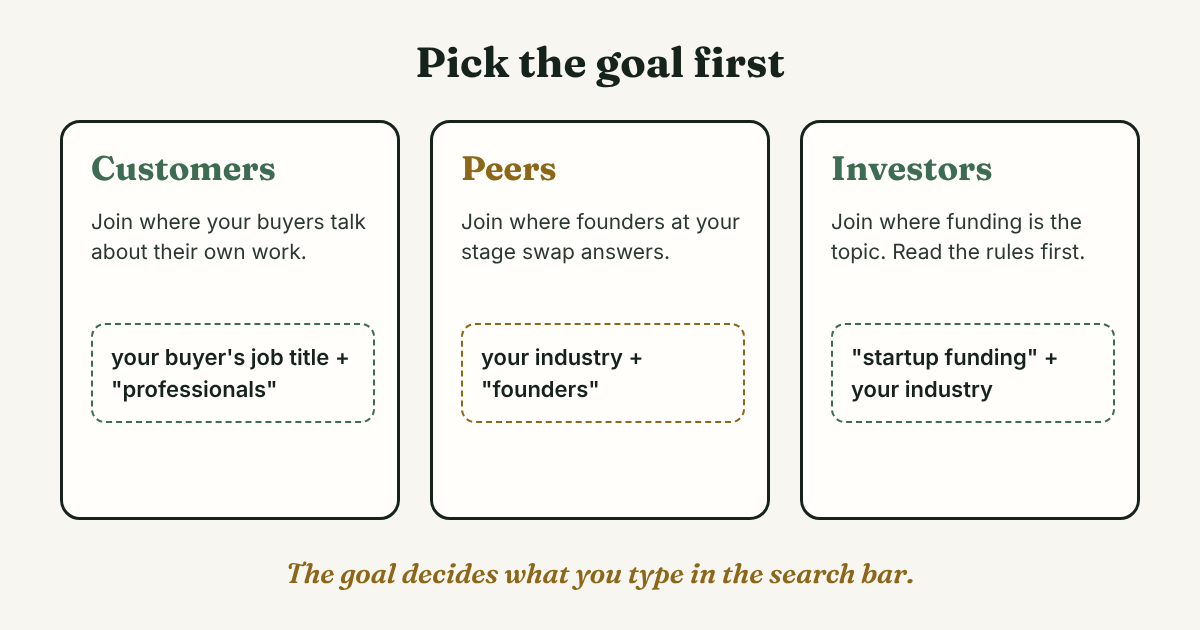
Write one sentence: I want a group to give me [customers / peers / investors]. Each one sends you to different groups.
- Customers. Our view: join groups where your buyers talk about their own job, not only groups for founders. A bookkeeper who wants dental clinics as clients will find more of them in a group for clinic managers than in a group for entrepreneurs. Statusbrew says groups suit B2B companies because members expect focused talk, and linkedinpreview gives a group for marketing chiefs as an example of reaching a target audience.
- Peers. Other founders at your stage, who will answer "has anyone dealt with this?" Kado Networks, writing about entrepreneur groups in general, advises matching the group to your goal and stage, and starting with one or two where you can take part.
- Investors. The 2022 U.S. Chamber list says startups seeking funding can look for groups that cover investors, and that some groups accept funding proposals for finished products with pilots, downloads or revenue. Read a group's rules before you post a pitch.
If you want two things, run this guide twice. One goal per group keeps your replies focused.
How do you find groups to check?
Type a topic into the LinkedIn search bar and choose the Groups filter. Menu names change, so follow what you see on screen. Try these searches:
- Customers: your buyer's job title plus "professionals" or "managers", and your buyer's industry plus your city.
- Peers: your industry plus "founders" or "owners", and your city plus "business owners".
- Investors: "startup funding" or "investors", plus your industry.
Write down three to five groups. Read each description and its rules before you ask to join. A group may ask you questions, and a 2019 excerpt from Ted Prodromou's LinkedIn guide notes that a request can be turned down if you do not meet the group's criteria. That excerpt also says you cannot read a group before you join. For public groups this has changed: Social Media Today reported in 2024 that public groups can be read by people who are not members, though only members can comment. Check what you can see on screen.
How do you judge a group as a founder?
First run the five-sign check from our groups test: a post this week, replies from several people, posted rules, a moderator who shows up, and people like the ones you want to talk to. Then add three checks that matter more when you are a founder.
- Who is in the room? Open the last ten people who commented. Count how many are people you want to talk to for your goal, and how many sell services to founders. If two or fewer are yours, move on.
- What does the group do with a link? Read the rules and the last five posts that had links. The 2022 U.S. Chamber list shows how different groups can be. Entrepreneur & Small Business Forum bans external links in original posts and has moderators approve every post. Linked Small Business Innovators has a promotion section and bans marketing outside it. Neither is better. Pick the rule that fits your goal, and check the current rules on screen, because those are from 2022.
- Do the best replies have details? Read the three posts with the most replies. Do the answers name a tool, a number or a step, or do they say "great post"? In a group where people give details, a detailed reply from you will stand out.
Score it: pass the five-sign check and at least two of these three, and join. Otherwise skip it. That cut-off is our rule of thumb, not research.
What should you post as a founder?
Reply first, and keep links out of your first posts. linkedinpreview suggests at most one link for every 10 to 15 contributions. That is its advice, not a LinkedIn rule. Statusbrew adds that groups discourage overtly promotional content and advises against sales words such as "buy" and "sell". Here is a reply to edit:
[Name], we ran into the same problem with [situation]. We tried [what you tried] for [time], and [what happened]. The step that helped was [one detail]. Have you tried [another option]?
After a week of replies, share one thing from your own work. No link. Only write what is true:
We [did something specific] for [time period]. [What happened, in plain words.] What surprised us was [detail]. Has anyone here seen the same thing with [situation]?
Put a link in only where the rules allow it, and ask an admin if you are not sure. Write every reply yourself, one at a time. Skip any tool that joins groups, comments or sends messages for you.
How do you turn a group thread into a conversation?
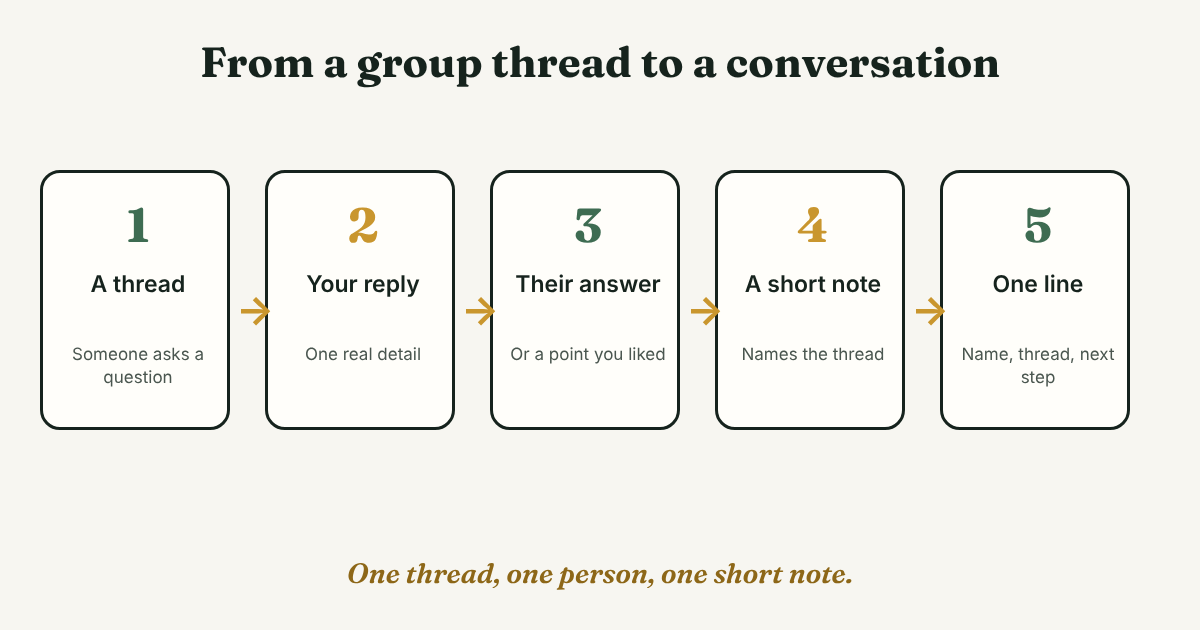
A thread becomes a conversation when you step out of it and write to one person about one thing they said. Wait until they answer you, or until you see a point of theirs you liked. Then send a connection request with a note:
Hi [Name], I liked your point about [detail] in the [group] thread on [topic]. I run [one plain line about your work]. I would be glad to stay in touch.
When they accept, write one message that offers something small:
Thanks for connecting, [Name]. Your point about [detail] stuck with me, because we hit the same thing with [situation]. I can send you [the thing you mentioned]. Want it?
Do not send the same note to everyone in a thread. Each note is about what that person said. For wording after someone accepts, see our follow-up message after you connect on LinkedIn. For writing to people you do not know yet, see how to write LinkedIn outreach for founders.
How many groups, and for how long?
Kado Networks, writing about entrepreneur groups in general, advises one or two groups where you can take part, because joining many spreads you thin. linkedinpreview suggests three to five, 15 to 20 minutes a day, and two to three months before you judge a group. We suggest two groups and a two-week first test: if you got no replies and learned nothing, leave and try the next one on your list. The day-by-day plan is in our groups test. That is our method, not research.
How do you keep track of the people you talk to?
After each exchange, write one line: the name, the group, the thread, and what you said you would send. A notes page or a sheet is enough for a few people. Without it, a good reply in week one is forgotten by week four.
Full disclosure: we make GrowthSeeded, a simple follow-up tracker for LinkedIn. It fits when a founder from a group becomes a connection and you want a note about the thread and a reminder of who to message. You send every message yourself. It does not find groups, and a plain notes page is enough if you talk to only a few people.
What do we not know?
We found no independent study of what founders get from LinkedIn groups, so every claim about results here is an author's advice. LinkedIn's help pages blocked our tool, so we state no limit on how many groups you can join or how many people you can message. HubSpot says group members can message up to 15 other members a month without a connection. We could not confirm that, so check on screen. We named no group as the best, and the groups named in this guide come from a 2022 list that we could not check. HubSpot, Statusbrew, InvoiceBerry and linkedinpreview all sell software or services, so treat their advice as advice. We checked all sources on October 31, 2026.
FAQ
What are the best LinkedIn groups for entrepreneurs?
It depends on your goal. Lists such as the U.S. Chamber's 2022 one name groups like Entrepreneur & Small Business Forum, Startup and Entrepreneurs Network and Band of Entrepreneurs, but we could not check how active they are today. Run the checks above on any group before you join.
How many LinkedIn groups should an entrepreneur join?
Two is enough to start. Kado Networks, on entrepreneur groups in general, advises one or two where you can take part, and linkedinpreview suggests three to five. Pick a number you can reply in every week.
Can I promote my business in LinkedIn groups?
Often not in a first post. Statusbrew says groups discourage overtly promotional content, and rules differ from group to group. Read the rules, reply first, and ask an admin if you are not sure.
Should I start my own LinkedIn group?
linkedinpreview says only if you have about 1,000 connections, your niche has no well-run group, and you can moderate for at least six months. That is its advice, not a rule. HubSpot also says small businesses should first ask whether they have time to run one.
Can I message group members I am not connected to?
HubSpot says you can message up to 15 group members a month, and linkedinpreview says group members can message each other within unspecified limits. We could not confirm LinkedIn's current rule, so check on screen. We suggest a connection note that names the shared thread.
Do this today
- Write your one-sentence goal: customers, peers or investors.
- Search it with the Groups filter and write down three groups.
- Run the five-sign check and the three founder checks on each, then join the best one.
When someone from a group answers you, add them to GrowthSeeded with one line about the thread. It tells you who to message each day, so you don't forget to follow up. You send every message yourself, and it never sends anything or touches LinkedIn. Free is $0 for up to 5 active people at once (checked October 2026, and plans change).
Sources
- 10 Thriving LinkedIn Groups for Entrepreneurs, Jessica Elliott, CO by U.S. Chamber of Commerce, 2022
- 8 Tips To Use LinkedIn Groups To Grow Your Network and Business, Statusbrew, 2024
- Could LinkedIn groups be making a comeback?, Social Media Today, 2024
- LinkedIn Groups: How to Use Them for Growth in 2026, linkedinpreview, 2026
- Top 99 LinkedIn Groups for Small Businesses to Follow, InvoiceBerry, 2022, update date 2026
- Getting started with LinkedIn marketing & networking, Erin Pennings, HubSpot, 2017, updated 2025
- Join LinkedIn's "Secret Societies" To Grow Your Business?, Ted Prodromou, Entrepreneur, 2019
- Entrepreneur networking groups, Kado Networks, updated 2026
About the author
Anisur Rahman Fagun is a marketing and content strategist with more than 9 years of experience in SEO, content, paid advertising and brand growth. He holds a master's degree in mass communication and journalism, and has led content and SEO strategy, built editorial teams and worked with product, design and sales teams. He also builds simple tools that turn marketing data into clear decisions. He writes the GrowthSeeded blog, which shares practical ways to build professional relationships on LinkedIn.