Networking
How Founders Build Thought Leadership on LinkedIn: 5 Steps
Updated: October 23, 2026 · 10 min read
Key takeaways
- Thought leadership on LinkedIn means being known for useful ideas from your own work. The reader decides whether you are, not you.
- Pick one problem you know well, say what you think about it, and show the work behind that view. Keep each post short.
- Count replies that add something, names that come back, and questions sent to you. Likes and views tell you less.
- Most guides we read come from agencies that sell this service, and none measured results for founders. Treat the steps as a test, and write every post, comment and message yourself.
Short answer: Founders build thought leadership on LinkedIn by choosing one problem they know from their own work, saying what they think about it, showing the work behind that view, keeping each post short, and talking with the people who reply. It comes from specific ideas repeated over time, not from posting often.
In this article
- What does thought leadership mean for a founder?
- What should you check before you post?
- How do founders build thought leadership, step by step?
- What should founders skip?
- Where does a tracker fit?
- FAQ
- Do this today
What does thought leadership mean for a founder?
Thought leadership is a big phrase for a small habit. Sweet Fish Media, which sells thought leadership services, defines it as "consistently sharing unique, experience-driven insights" that help an audience solve problems. For a founder, that means telling people what you learned from building, in a way another person can use.
The goal is harder than it sounds. In a 2017 survey of 1,300 business decision-makers and executives by Edelman and LinkedIn, 56% said that most of the time they gain no valuable insights from the thought leadership they read. In the same survey, 45% of decision-makers and 53% of C-level executives said poor-quality thought leadership had cost an organization some of their respect. The fieldwork ran in late 2016 and asked about company content, not founders' posts.
A newer report points the same way. O'Dwyer's summary of the 2025 Edelman and LinkedIn report, which surveyed 1,934 business executives, says 53% rate the quality of the insight above the brand name attached to it. It also says 86% of the "hidden buyers" in the sample, the internal influencers who shape a purchase, want content that challenges their assumptions.
These surveys report what business buyers say, not what they do. Still, the warning is clear: a reader gives you credit for what they learned, not for your topic.
What should you check before you post?
Start with your profile. The Accelerator Centre, in a February 2026 article for founders, advises searching your own name and reading your LinkedIn profile as a customer or an investor would. Does your headline say what you do, and does your About section say who you help?
A person who reads one of your comments may click your name next. In ten seconds they should see what you know about. For a target reader and a posting rhythm, see How Founders Grow on LinkedIn. This post is about what to say.
How do founders build thought leadership, step by step?
Five small steps follow, and you can finish the first one today. The sources disagree on how often to post, so we say what each suggests and leave the schedule to you.
Step 1: Pick one problem you know from your own work
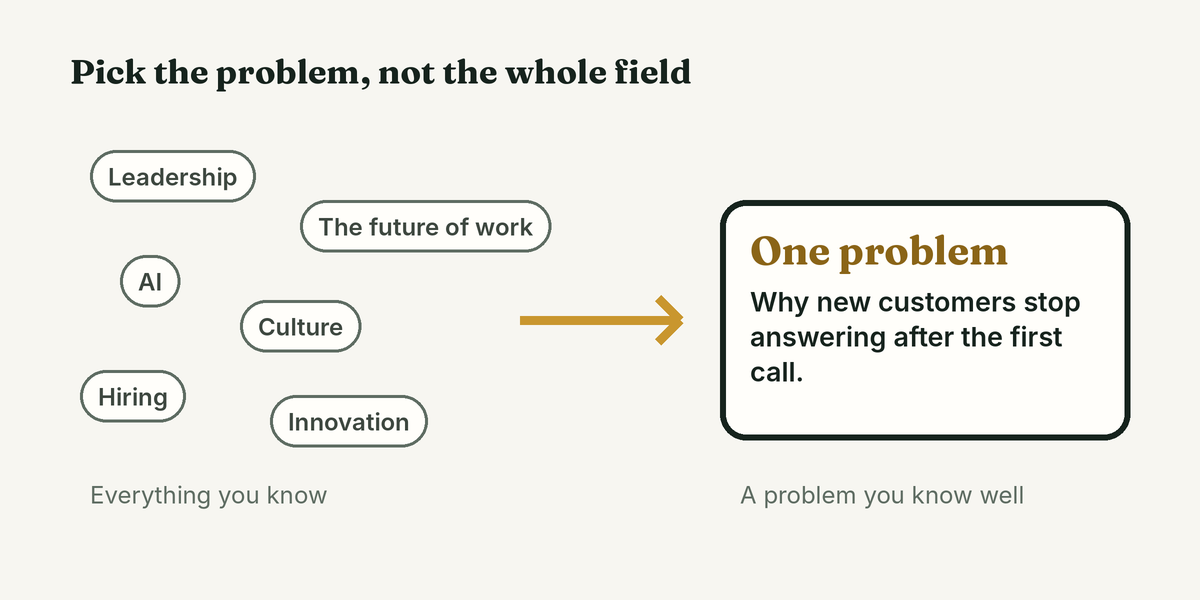
A wide topic such as leadership or the future of work is too wide to write about well. Straight North, a digital marketing agency, suggests choosing a niche from three places: questions your sales team hears often, posts that drew real engagement, and topics where you have firsthand experience.
Start smaller than that. Pick one problem and write it as a question a customer would ask. Priya (an example, not a real person) runs a small scheduling tool for dental clinics. After many calls, she sees that new clinics often stop using it after the first week. Her topic: why do new clinics drop a tool after one week?
Step 2: Say what you think about it
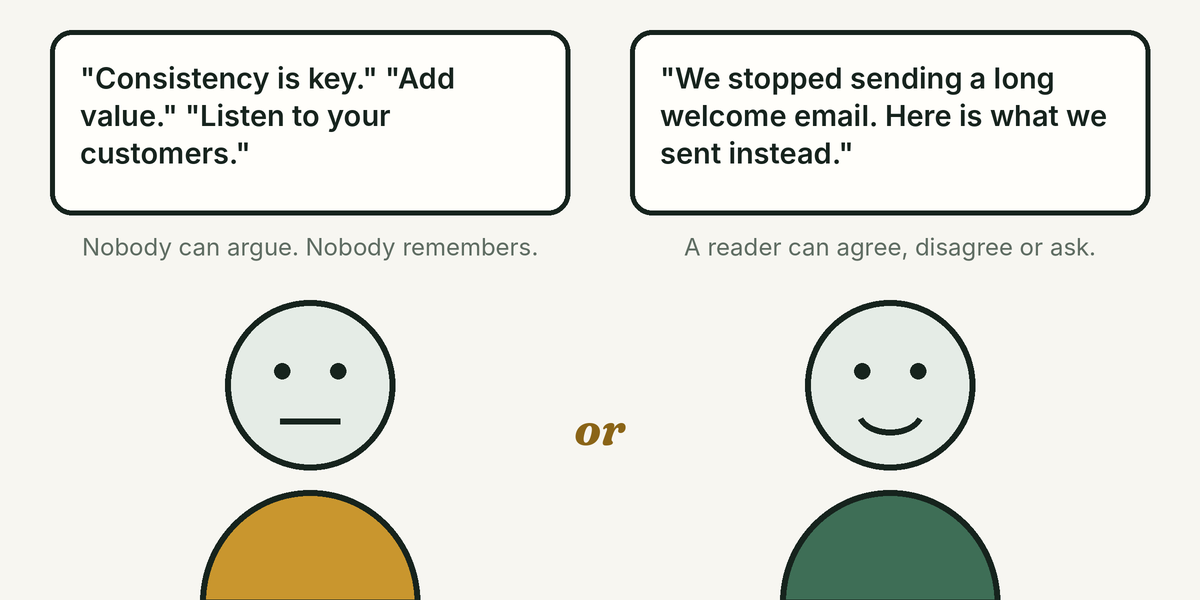
A topic gives readers something to read. A view gives them something to answer. Straight North tells brands to find where they disagree with common practice and to write a list of about five strongly held opinions to use as post ideas.
One way to find yours is to finish this sentence: Most advice says [common view]. In my work, [what I saw]. A view does not need to be loud. It needs to be yours, and open to argument. Priya might write: Most advice says to send more reminders. In my work, the first setup screen asked for too much.
The 2025 numbers fit this step: if 86% of hidden buyers want to be challenged, agreeing with everyone is not the safe choice. A view still needs a basis, which is Step 3.
Step 3: Show the work behind the view
A view with no proof reads like a slogan. Straight North says to support opinions with data, client stories told with permission, or lessons learned, including mistakes. Sweet Fish lists four kinds of post: story and lesson, problem and mistake and fix, myth-busting, and behind the scenes.
Use only facts you can stand behind. If a number is not yours or not from a source you opened, leave it out. Here is a frame to fill in:
[The common advice] is what most people say about [the problem]. When we [what you did], [what happened]. The part I got wrong: [one mistake]. If you try this, [one small thing to test].
Step 4: Keep it short and plain
In the O'Dwyer's summary of the 2025 report, 57% of hidden buyers prefer quick takeaways to deep, academic-style content. Straight North suggests opening with a specific observation and using short paragraphs. Sweet Fish suggests one or two text posts a week of about 150 to 300 words. Its full plan adds recorded video, which is more than most founders start with.
NoGood, a growth marketing agency, suggests a discovery month: post once or twice a week, note who engages, and keep the three formats that did best. It also says a team can draft and schedule posts if the founder approves each one. We suggest you write your own, since the view and examples come from your work.
Step 5: Talk with the people who answer, and count what matters
Thought leadership happens in the replies as much as in the post. Straight North suggests 10 to 15 minutes, a few times a week, on thoughtful comments under posts from your industry, clients and prospects. It says to track substantive comments, repeat engagers, direct messages and sales conversations, not likes and impressions.
NoGood suggests judging influence over six months or more, by reach, quality of engagement and inbound conversations. The 2017 Edelman survey adds a reason to care about people: 84% of decision-makers and 86% of C-level executives said thought leadership is most valuable when someone they know and respect forwards it.
When someone answers, write back as a person, one reply at a time. For a comment under someone else's post, this frame can help: I saw the same thing with [a situation]. What changed it for us was [one detail]. Does it look different for [their case]?
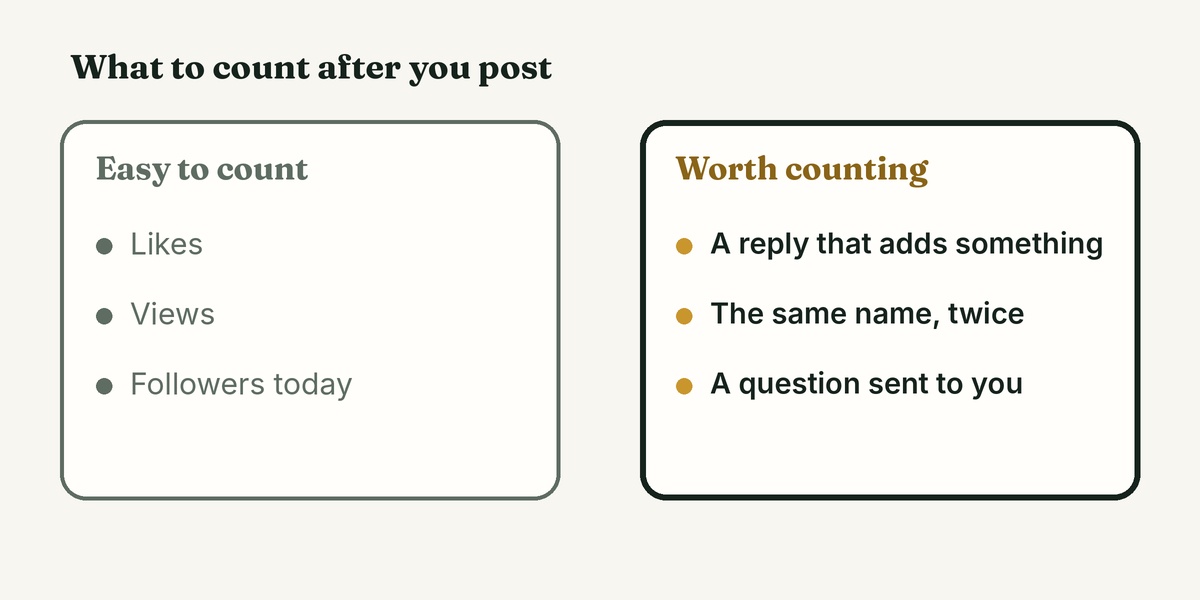
Then write down who said what: the date, the name and their point. You will use it in your next post and your next message to that person.
What should founders skip?
Skip these:
- Tools that write, post or message for you. We do not recommend automation, bots or auto-messaging. The view is yours, so the words should be too.
- A topic list with no view. Leadership and innovation are fields, not problems.
- Big numbers with no source. NoGood's playbook gives twice the engagement for executive content and names no source for it, so we left it out.
- One comment pasted under many posts. A comment that fits any post says little. Write each one for its post.
Where does a tracker fit?
Full disclosure: we make GrowthSeeded, a LinkedIn relationship tracker. It does not write posts, build an audience or touch LinkedIn. It helps with Step 5. You add the people who replied or commented, write a note after each conversation, and a due-today view shows who to follow up with. The next step depends on what happened, such as an accepted connection or a reply, not on a fixed date. You write every message, and it never sends anything.
Free is $0 for 5 active people at a time, and up to 20 when friends join through invites. Pro is $15 a month or $150 a year. Max is $29 a month. We checked these on October 23, 2026, and they change.
If your main need is a content calendar or post statistics, a different kind of tool fits better. We have not tested those, so we cannot say which to pick.
FAQ
How do founders build thought leadership on LinkedIn?
They pick one problem from their own work, say what they think about it, and show the work behind it with their own facts and mistakes. They keep posts short and talk with people who reply, one at a time.
How often should a founder post?
The sources differ: one or two text posts a week (Sweet Fish), a few updates a week (Straight North), or once or twice a week while you test (NoGood). Start with one post a week that you can keep, and adjust after a month based on who replied.
How long does it take to build thought leadership?
No source we opened gives a reliable timeline. NoGood says to judge influence over six months or more. Plan for months, and count conversations, not days.
Can someone else write my posts?
NoGood says a team can draft and schedule if the founder approves every post. We suggest you write your own, because the view and examples come from your work. Never use a tool that posts or messages for you.
Do this today
- Write down one problem you know from your own work, as a question a customer would ask.
- Write one sentence that starts with "Most advice says" and continues with "In my work", then add one thing you got wrong.
- Post it. Then leave two comments on other people's posts about the same problem, each written for that post, and note the name of anyone who answers.
A good post often starts a conversation, and a conversation is easy to lose track of. GrowthSeeded keeps each person with a note on what they said and shows who is waiting for your reply. You write every message, and it never sends anything or touches LinkedIn. The Free plan is $0 for up to 5 active people at a time.
Sources
- Edelman and LinkedIn research on how thought leadership influences B2B sales, Edelman, 2017
- 2025 B2B Thought Leadership Report, Edelman, 2025
- Summary of the 2025 Edelman and LinkedIn B2B Thought Leadership Impact Report, O'Dwyer's, 2025
- How to Establish Thought Leadership on LinkedIn, Straight North, 2026
- How to Build Thought Leadership on LinkedIn, Sweet Fish Media, 2025
- The Founder-Led Growth Playbook, NoGood, 2026
- Building Thought Leadership, The Accelerator Centre, 2026
About the author
Anisur Rahman Fagun is a marketing and content strategist with more than 9 years of experience in SEO, content, paid advertising and brand growth. He holds a master's degree in mass communication and journalism, and has led content and SEO strategy, built editorial teams and worked with product, design and sales teams. He also builds simple tools that turn marketing data into clear decisions. He writes the GrowthSeeded blog, which shares practical ways to build professional relationships on LinkedIn.