Networking
Creative Professionals Networking Group: Bring Your Work
12 min read
Key takeaways
- Pick a group that knows your craft, such as AIGA for designers or the Editorial Freelancers Association for editors and writers. Add one open creative community for company from other crafts.
- In a craft group, most of the room is peers, not buyers. That is fine. Peers swap tips and pass on work, so talk to them on purpose.
- Bring one piece of work you can show in ten seconds, and say why you made it before you show it.
- Follow up within two days with one link to one piece and one small question. Skip the 40-page PDF.
- Write one line about each person right after the night. Your memory will not keep it.
Short answer: Join one group built around your craft and one open creative community, and go three times. Bring one piece of your work, say why you made it, and ask one question about theirs. Within two days, send one link and one small question. Lead with the work.
In this article
Why does a general networking group not fit a creative?
Which kinds of creative networking group are there?
Who should be in the room?
What do you bring so people remember your work?
What if the event is only a talk?
How do you follow up after the first night?
How do you keep track of everyone?
What should you skip?
What do we not know?
FAQ
Do this today
Why does a general networking group not fit a creative?
Maya (an example, not a real person) is an illustrator. She goes to a business mixer, and a man asks what she does. "Illustration," she says. "Oh, nice," he says, and looks for the coffee. Nobody did anything wrong. A room of accountants and sales reps has no easy way to talk about her work.
A creative group fixes that. People there know what a brief is, what a rough draft looks like and why a rate is hard to name. You can show something and get a real answer. Our guide to professional networking events covers how to pick, prepare and follow up in general. This post is for people who sell work you can look at.
Which kinds of creative networking group are there?
There is no single best creative professionals networking group. There are a few types, and each does a different job. We opened the official pages of the ones below. Fees and event dates change, so check the page before you plan around them.
- A craft association. AIGA says it has 60+ local chapters for design, with "networking, programming, leadership training" and mentorship at every career level. Chapter involvement goes with AIGA membership, and the page lists no price. The Graphic Artists Guild (since 1967) serves designers and illustrators. Its site lists a monthly Town Hall open to non-members and a monthly "Show Off & Tell" where creatives share work and get feedback. For writers and editors, the Editorial Freelancers Association calls itself the largest and oldest professional organization of editorial freelancers in the US. It lists chapters, a member directory and a job list.
- An open creative community. CreativeMornings is a free breakfast lecture series. The Dallas chapter says events are usually the third Friday of the month, from 8:30 to 10 a.m. Registration is free but required. Its New York page says chapters exist in 69 countries. It draws "designers and artists" and also "entrepreneurs, business owners, and social innovators."
- A local freelancer group. The AIGA Baltimore post Finding Your Creative Communities (2020) lists one city's options, including a freelancers collective open to people who "own your own business, freelance on the side, work remotely for a large company." Search your own city the same way.
- Online communities. Noble Desktop names Dribbble and Behance as places to connect with clients and collaborators, plus LinkedIn and niche communities. We have not tested these, so we do not rank them.
If you are early in your career, our guide to networking groups for young professionals adds what to say on day one. For a general way to pick and test any group, see how to pick one professional networking group and test it. We do not repeat that test here.
Who should be in the room?
A creative group is a mix of three kinds of people. This sorting is our own idea, not a study, but it changes who you talk to.
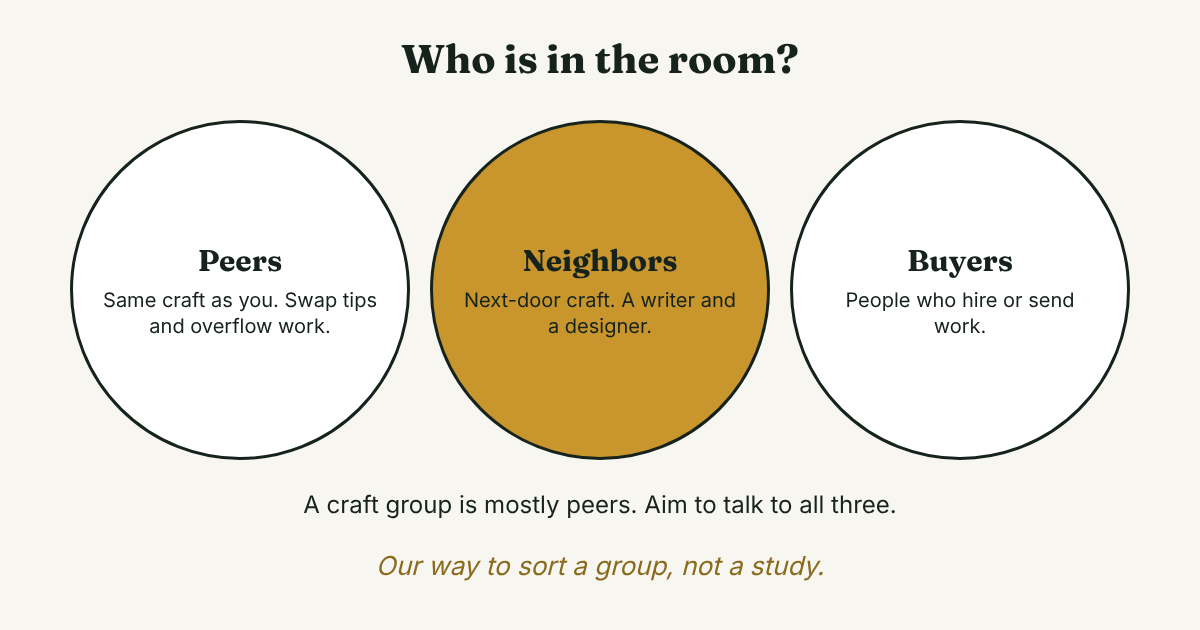
- Peers do your kind of work. They know your rates, your tools and your bad weeks. They can pass on a job they cannot take.
- Neighbors do the work next to yours. A writer needs a designer, and a photographer needs a web developer. Projects start here.
- Buyers are the people who hire, or who know someone who does.
Here is the common mistake. Many creatives only go where their craft is, and then wonder why no work comes. Others only go to business events and feel misread. Noble Desktop says networking helps you gain referrals. So join one group full of peers, and one place with neighbors and buyers, such as an open community. Then count them after each night: how many of each did you talk to?
What do you bring so people remember your work?
Creatives have an advantage. Your work can show what you do faster than a title can. The Rookies (Andrew McDonald, 2018, written for artists at meetups) gives a short list worth borrowing. Have a goal for the night. Prepare an introduction of 10 to 20 seconds. Keep your best work on your phone, offline. And give context before you show anything.
That last one is the one people skip. Do not open with "What do you think of my portfolio?" Say why you made the piece, what you want it to do for you, and what feedback you want. It turns a hard question into an easy one.
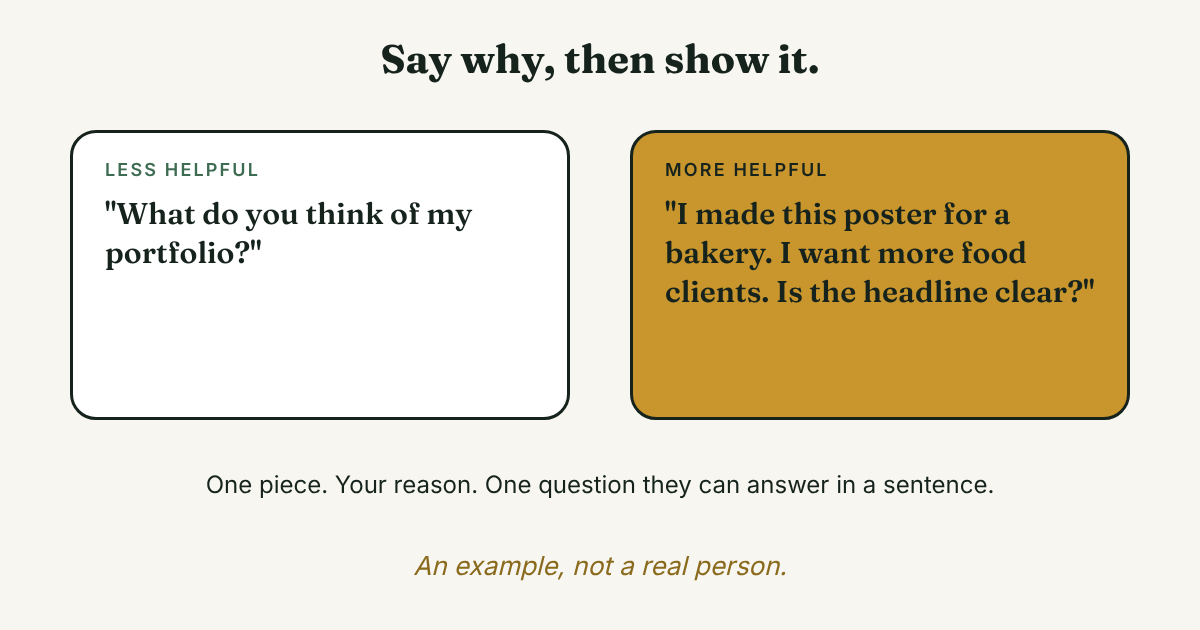
Here is a short script you can edit:
Hi, I'm [Name]. I [your craft] for [kind of client]. Can I show you one thing on my phone? It's a [piece] I made for [who]. I want to do more of that. Does [one detail, such as the headline or the first page] read clearly to you?
The Rookies also says not to rely on business cards. Keep them until someone asks, and follow up afterward. We would add one rule: never pass your work around the room. Show it to the person in front of you and then ask about theirs.
What if the event is only a talk?
Some events are a talk and a breakfast, with no mixer. The CreativeMornings Dallas page lists a 20 to 30 minute talk by a local creative, and it describes no formal networking activity. So you start the conversation yourself. The talk gives you the opener.
Turn to the person next to you and say: What part of that talk would you steal for your own work? It is easy to answer, and it leads to their work. Then ask what they do. If you want more ways to start, our guide to how to use LinkedIn groups and when they are worth it covers the online side.
How do you follow up after the first night?
Send the note within two days, while they still remember your face. The Rookies says if you do not follow up, it is a missed opportunity, and suggests a personalized email or LinkedIn request. Noble Desktop adds a regular schedule for checking in with people, and says check-ins can collect feedback for your portfolio.
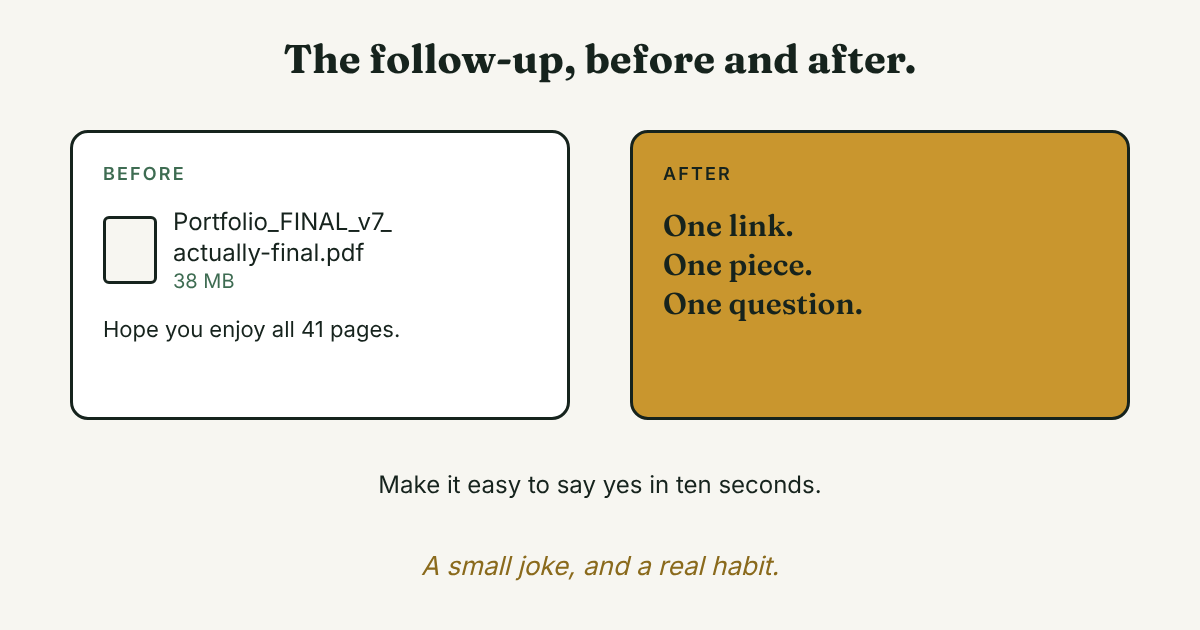
Here is the shape we suggest: where you talked, one detail, one link, one small question.
Hi [Name], we talked at [group] about [topic]. You said [one specific thing]. Here is the [piece] I mentioned: [link]. One question: [small, specific]? No rush if you're busy.
Write each note for one person. If you need help with wording and tone, see our four-part frame for a professional LinkedIn message. If they reply, you have a conversation. If they do not, wait about a week, send one short nudge, and then let it go.
How do you keep track of everyone?
After three nights you will have a stack of names and no memory of who liked what. Write one line about each person the same evening. Here are example lines (not real people):
- Dana, copywriter, Dallas group. Likes small packaging brands. Sent my poster link. Next: ask about her spring project.
- Ravi, brand designer, AIGA chapter. Needs a writer for a pitch deck. Next: send two writing samples.
- Sam, runs events at a studio. Said "send me something in March". Next: write in March.
Full disclosure: we make GrowthSeeded, a simple follow-up tracker for LinkedIn. You add a person and a line about why they matter, and it tells you who to message each day, so you don't forget to follow up. A notes app or a spreadsheet works too. Use whatever you will open every week. If a spreadsheet gets ignored, a tracker that shows you today's list can fit better.
What should you skip?
- Joining five groups at once. Pick two and go three times. Then decide.
- Sending your whole portfolio. One piece, one link, one question.
- Talking only to people who do your own job. Count peers, neighbors and buyers after each night.
- Pitching in the first message. Ask for a view on one thing before you ask for work.
- Copying one note to everyone you talked to. Write each one for the person who will read it.
- Any tool that sends messages for you. We never recommend automation.
What do we not know?
We found no study that compares which kind of group brings creatives more work, so we cannot say whether a craft association, an open community or an online group is best. The advice above comes from official group pages and from career guides, not from tests. We did not open the dues or event pages for most groups, and we did not test online communities. Prices and event days change, so check them on each group's own page. We name only groups whose own pages we opened, and there are many more in your city.
FAQ
Do I need to be a member to attend?
Not always. CreativeMornings events are free, with free registration on the Dallas page. The Graphic Artists Guild lists a monthly Town Hall that is open to non-members. AIGA chapter involvement is tied to membership. Check each group's page.
What is a good networking group for writers and editors?
The Editorial Freelancers Association says it is the largest and oldest professional organization of editorial freelancers in the US. It lists chapters, a member directory and a job list. Its page does not show dues, so check its join page. Other writer groups exist, and we have not reviewed them.
Should I bring my portfolio?
Bring one piece, not the whole thing. The Rookies suggests keeping your best work on your phone, offline, so you can show it right away. Say why you made it before you show it.
Are free creative groups worth it?
They can be. A free breakfast talk costs only your morning, and the talk gives you something to discuss. We found no study that measures results, so judge it by whether people talk to you and whether you can follow up with at least two of them.
How do I find a group in my city?
Start with a craft association chapter and an open community, then search your city for a freelancer group. The AIGA Baltimore post shows how one city lists its options: associations, local collectives, tech meetups and job boards.
Do this today
- Pick one piece of your work and write the one sentence that says why you made it.
- Find one craft group and one open creative community near you, and put the next event dates in your calendar.
- Open a list and add one line for the last creative you talked to. Write what you can send them.
Creative nights end with a few names and a good feeling that fades by Thursday. Add each person to GrowthSeeded with a line about their work, and it tells you each day who to message, so your note does not slip. You send every message yourself. GrowthSeeded never sends anything or touches your LinkedIn, and the Free plan holds 5 people at a time.
Sources
- About AIGA Chapters, AIGA, checked 2026 (page shows no date)
- Graphic Artists Guild, Graphic Artists Guild, checked November 2, 2026 (events change)
- Learn about the EFA, Editorial Freelancers Association, checked 2026 (page shows no date)
- CreativeMornings Dallas, CreativeMornings, checked 2026 (page shows no date)
- CreativeMornings New York, CreativeMornings, checked 2026 (page shows no date)
- Finding Your Creative Communities, AIGA Baltimore, 2020
- 7 crucial steps for artists wanting to network at a meetup, Andrew McDonald, The Rookies, 2018
- Tips for Getting Project Leads as a Design Freelancer, Kate Cusson, Noble Desktop, 2025 (updated 2026)
About the author
Anisur Rahman Fagun is a marketing and content strategist with more than 9 years of experience in SEO, content, paid advertising and brand growth. He holds a master's degree in mass communication and journalism, and has led content and SEO strategy, built editorial teams and worked with product, design and sales teams. He also builds simple tools that turn marketing data into clear decisions. He writes the GrowthSeeded blog, which shares practical ways to build professional relationships on LinkedIn.