Networking
Networking Groups for Young Professionals: How to Pick One

12 min read
Key takeaways
- Same name, different rules. The pages we opened set the limit at 18 to 39, 18 to 40, 21 to 41, under 35, or 0 to 5 years at work.
- Read the last three events before you join. A group that only runs happy hours does a different job from one with workshops and volunteer days.
- Dues often depend on your employer. Two chambers we checked charge about half as much when your company is a chamber member.
- On day one, say who you are, ask one question and offer to help with the next event. Three lines are enough.
- Ask what happens when you pass the age limit, so the people you know do not leave with your membership.
Short answer: Choose a young professionals networking group by checking three things before you join: who qualifies (age limits run from under 35 to 41, and some groups count years at work), what it costs and whether your employer can pay, and what its last three events looked like. Then go to one event with three lines ready.
In this article
Which kinds of young professionals groups can you join?
Who counts as a young professional?
How do you choose between them?
What does it cost, and can your employer pay?
What do you say on day one?
What happens when you pass the age limit?
How do you follow up and keep track?
FAQ
Do this today
Which kinds of young professionals groups can you join?
Priya (an example, not a real person) started her first job in a new city five weeks ago. She knows two people there, both from work. This week she got three invitations: a young professionals night at the chamber of commerce, a monthly group for people early in her field, and an online peer group run by her employer. All three call themselves young professionals groups. They set different rules for who can join, what it costs and what happens at an event.
If you are still deciding how to begin at all, start with our seven ways for young professionals to start networking. This post is about the next choice: which group to walk into. Here are three kinds, each with a real example. One page is not a survey, so read each example as a question to ask, not a rule.
- Chamber of commerce young professionals program. The U.S. Chamber of Commerce describes these as programs "designed to connect young business leaders to each other and their local chambers." The Eau Claire chamber's group is "open to anyone between the ages of 21 and 41" and holds one to three events a month, with no regular meetings. You can go to as many or as few as you like.
- Young professionals group of a professional society. AIChE, the chemical engineers' society, wrote a guide for starting one. It aims at "professionals under 35" and lists happy hours, short workshops, plant tours and volunteer days. It fits you if you want to know people in your own field.
- Employer group. A Johns Hopkins page asks, "Are you early in your career, or is Hopkins your first professional job?" It meets online monthly, and access is limited to Johns Hopkins employees. It is an easy first step, and our view is that it will not reach people outside your company.
We did not look at alumni groups or free meetup groups here. Our guide to professional networking groups covers the wider kinds and a three-visit test.
Who counts as a young professional?
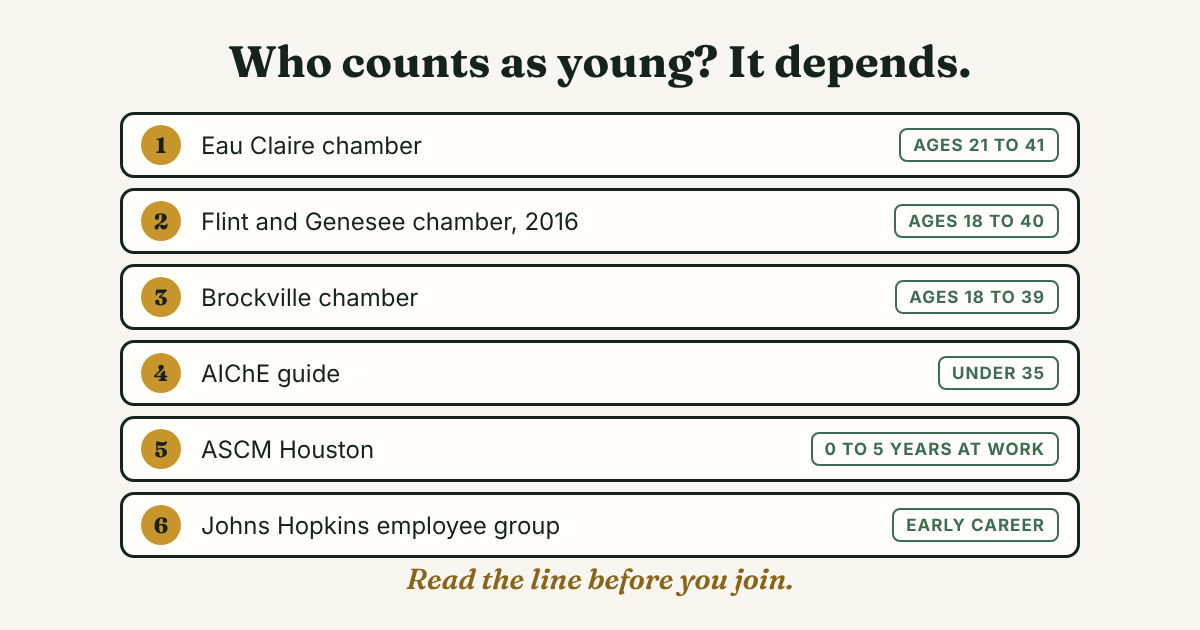
There is no standard. Each group draws its own line, and the line decides whether you can join at all. Here are the six we found:
- Eau Claire chamber: ages 21 to 41.
- Flint and Genesee chamber: ages 18 to 40, in a page from 2016.
- Brockville chamber, Ontario: ages 18 to 39.
- AIChE guide: professionals under 35, though it says the limit "should not be a strict limitation" for committee members.
- ASCM Houston: "0 to 5 years in the workplace," with no age requirement listed.
- Johns Hopkins group: early-career employees, with no years or age listed.
The difference matters for people who changed careers. A group that counts years at work, like ASCM Houston, keeps you in if you started a new field at 30. A group that counts age does not. Check the Flint page with care: it is from 2016, so it shows the range, not today's rule. We found no study that compares young professionals groups, so we cannot say which kind works best.
How do you choose between them?
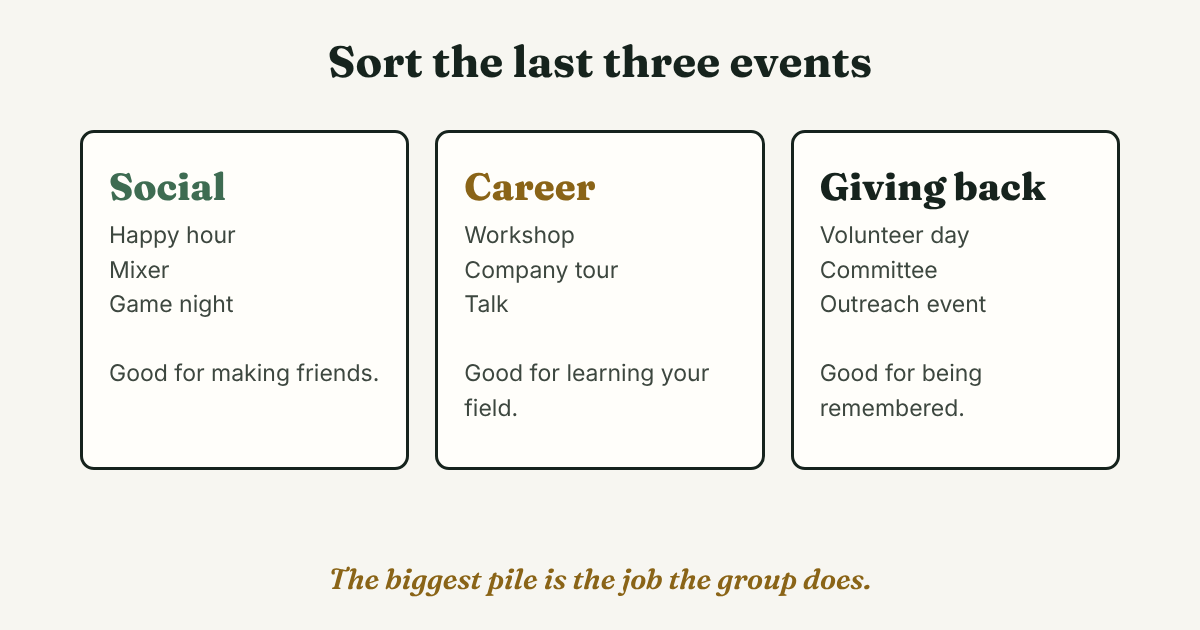
Open the group's event list and sort the last three events into three piles: social (a happy hour), career (a workshop, a tour, a talk) and giving back (a volunteer day, a committee). The sorting is our method, but the sources use the same split. Eau Claire's page groups its events into professional development, community involvement, networking and signature events. AIChE's guide describes social events, technical events, and events that are half and half.
Then match the piles to what you need:
- Mostly social: a good place to make friends in a new city, and a weaker place to learn your field.
- Mostly career: better for learning your field and for hearing what people one or two steps ahead of you do all day.
- Some giving back: a reason for people to learn your name, because you worked next to them. AIChE's guide lists volunteer and outreach events too.
Before you go, ask the organizer. Edit this so it sounds like you:
Hi [Name], I am a [role] at [company] and I found your young professionals group through [where]. Before I come: what is the age or experience limit, what do members pay, and what were your last three events? I would like to come as a guest on [date].
Josh Weiss in Entrepreneur, writing in 2021, notes that many industry groups "offer free attendance your first time so that you can try it out." If the organizer says no, that tells you something too.
What does it cost, and can your employer pay?
Dues vary, and the price often depends on where you work. These are the numbers on the pages we opened (checked October 2026, and fees change):
- Eau Claire chamber: $25 a year for full-time students over 21, $50 if your employer belongs to the chamber, $105 if it does not. The page shows no date.
- Brockville chamber: $25 if you are already affiliated with the chamber, $50 if not, plus a one-time $25 fee for new members, a $10 annual provincial fee and 13% tax. The page shows no currency and no date, and it adds "check with your employer!"
- Flint and Genesee chamber: in 2016, the chamber ended the $50 annual dues for people aged 18 to 40 whose employers were members.
The pattern shows in all three chamber pages. Your employer's membership changes your price: about half in Eau Claire and Brockville, and to zero in Flint's 2016 policy. So before you pay, send one short note to your manager or the person who handles memberships:
Hi [Name], I would like to join the young professionals group at [chamber or society]. It runs [kind of events], and I plan to [what you will bring back to the team]. Dues are [amount] for members and [amount] for others. Is the company a member, or could it cover the fee?
A company can say no. The question costs one sentence, and a yes saves real money.
What do you say on day one?
An easy mistake is to arrive late, stand next to the person you came with and leave early. Josh Weiss advises arriving early, especially at lunch events, and says that at ticketed events you should "work the room" before you sit with people you already know. AIChE's guide gives the same advice for its own events: talk with new people who show up, "and not just with current acquaintances." It also suggests name tags, so you can find a name before you walk over.
You do not need a speech. Three lines carry the whole night:
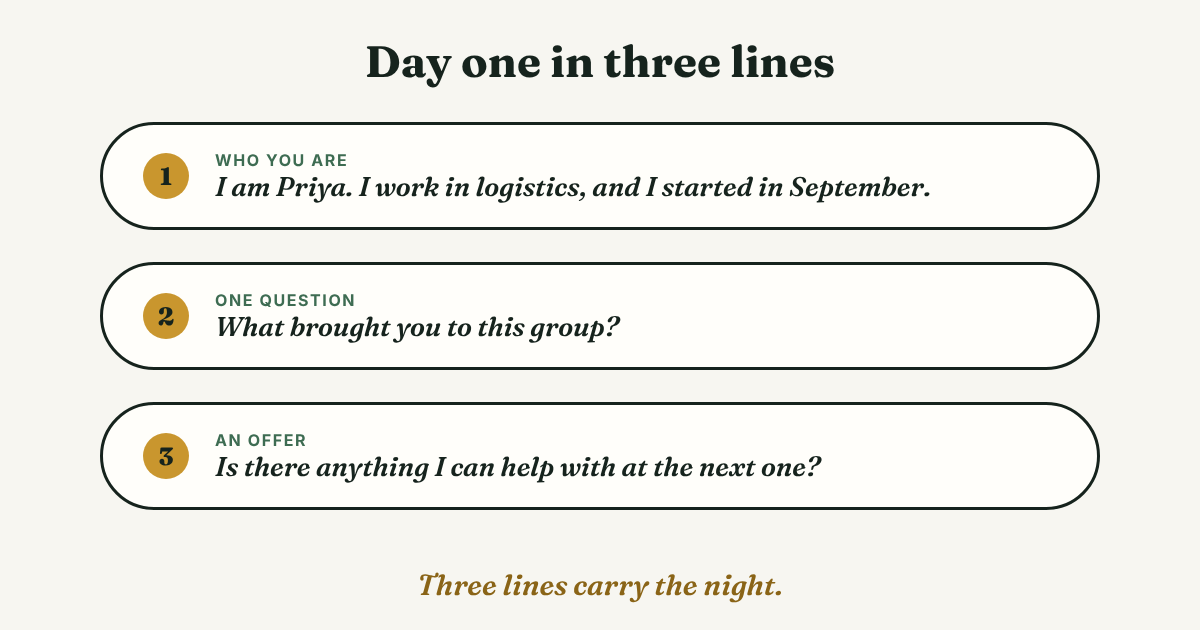
- Who you are: I am [name]. I work in [field], and I started in [month].
- One question: What brought you to this group? Then listen for something to ask about.
- An offer: Is there anything I can help with at the next one? An offer to help is easy for an organizer to say yes to. That is our view.
Aim for two real conversations, not ten handshakes. That is our rule of thumb, not a finding. Write one line about each person on your phone before you leave: their name, what they do and one thing they said.
What happens when you pass the age limit?
Every limit we found has an end: 35, 39, 40 or 41. Ask about it on the first visit: What happens to members when they pass the limit? Some groups may let you keep going as a mentor or volunteer, and others may not. The pages we opened do not say, so ask.
The groups end, and the relationships do not have to. People you talked to at 29 can still know you at 41, if you stay in touch. That is why the line about each person is worth writing early. Later, you can write to someone with a reason: Hi [Name], we talked at the [event] in [month] about [topic]. I just [what happened], and I thought of you.
How do you follow up and keep track?
Write to each person you talked to, one at a time, in your own words, within a day or two. That timing is our suggestion. Our guides to a follow-up message after a career fair and to a message after you connect have wording you can edit. AIChE's guide says to follow up after events and invite people to the next one. Josh Weiss suggests going back to the events where you liked the people "as people," and says his own strategy took at least a year before client referrals came.
A notes page is enough for a few people. Full disclosure: we make GrowthSeeded, a simple follow-up tracker for LinkedIn. It fits when the people from your group become LinkedIn connections and you want a note for each person and a list of who is due for a message. It does not find groups for you, and it cannot tell you which one to join.
FAQ
What is a young professionals networking group?
It is a group, often run by a chamber of commerce, a professional society or an employer, for people early in their careers. Each group sets its own limit, by age or by years at work, so check the rule before you join.
What age counts as a young professional?
It depends on the group. The pages we opened say 18 to 39, 18 to 40, 21 to 41 and under 35, and one counts 0 to 5 years in the workplace. There is no standard.
How much do young professionals groups cost?
The chambers we checked in October 2026 charge from $25 to $105 a year, and the price often depends on whether your employer is a member. Some groups and employer programs show no fee. Fees change, so ask before you pay.
Are young professionals groups worth joining?
We found no independent study that compares them, so we cannot say. Try one event as a guest, sort its last three events into social, career and giving back, and join if the mix matches what you need.
Can I join if I am over the age limit?
Ask the organizer. AIChE's guide says its under 35 line "should not be a strict limitation" for committee members, but other groups may enforce theirs. A general professional group, with no age limit, is another route.
Do this today
- Find one young professionals group near you, or at your company or society.
- Read its last three events and sort them into social, career and giving back.
- Send the organizer message above, and ask who qualifies and what members pay.
After your first event, the hard part is remembering who said what. GrowthSeeded keeps a note for each person and a list of who is due for a follow-up, so a good talk at a happy hour does not fade by Friday. You send every message yourself, and it never sends anything or touches LinkedIn. The Free plan is $0 for up to 5 active people at once (checked October 2026, and plans change).
Sources
- A Guide to Young Professional Programs for Chambers, U.S. Chamber of Commerce, no date shown, checked 2026
- How to Start a Young Professionals Group, AIChE Young Professional Advisory Board, no date shown, checked 2026
- Young Professionals Networking Group, Johns Hopkins University, 2025
- Young Professionals, ASCM Houston, no date shown, checked 2026
- Young Professionals, Eau Claire Area Chamber of Commerce, no date shown, checked 2026
- Exciting New Membership Changes for Young Professionals, Flint and Genesee Chamber of Commerce, 2016
- Young Professionals, Brockville and District Chamber of Commerce, no date shown, checked 2026
- How to Pick the Right Networking Events to Attend, Josh Weiss, Entrepreneur, 2021
About the author
Anisur Rahman Fagun is a marketing and content strategist with more than 9 years of experience in SEO, content, paid advertising and brand growth. He holds a master's degree in mass communication and journalism, and has led content and SEO strategy, built editorial teams and worked with product, design and sales teams. He also builds simple tools that turn marketing data into clear decisions. He writes the GrowthSeeded blog, which shares practical ways to follow up and stay in touch with people on LinkedIn.