Networking
Virtual Professional Networking: A 20-Minute Call Plan
11 min read
Key takeaways
- Online, close ties stay and casual ones fade. Write to the casual ones on purpose.
- A virtual coffee chat is the easiest start. Ask for 15 to 20 minutes, say why you picked the person, and offer a few times.
- A 20-minute call has a shape: a short hello, your questions, their turn, and one next step.
- At an online event, aim for two real conversations, not a full room.
- Follow up the same day with one detail from the call, then keep one line of notes on each person.
Short answer: Start with one short video call, not a big event. Ask one person for 15 to 20 minutes, say why you picked them, and offer a few times. On the call, ask about their work. Send a thank-you the same day with one detail from the chat, and write again when you have news.
In this article
Why is networking on a screen harder?
Who should you ask first?
How do you ask for a virtual coffee chat?
What does a good 20-minute call look like?
How do you network at an online event?
How do you follow up?
How do you keep track of everyone?
What should you skip?
What do we not know?
FAQ
Do this today
Why is networking on a screen harder?
Priya (an example, not a real person) goes to three online events in a month. She keeps her camera off, reads the chat and types "Great session!" once. She leaves each event with no conversation and no one to write to. She was in the room, and nobody knew it.
Part of it is the format. Career advice from Johns Hopkins says virtual chats "require more effort to establish rapport and maintain engagement." Part of it is what happens to casual contacts. In a large study of about 50,000 Microsoft employees during the all-remote year, people mostly stayed close to the people they already worked with and let casual contacts fade, according to researcher Abigail Sellen on a Microsoft Research podcast (2021). The podcast gives no method, and it covers one company in one unusual year. Still, it fits what many people feel: nobody bumps into you on a screen.
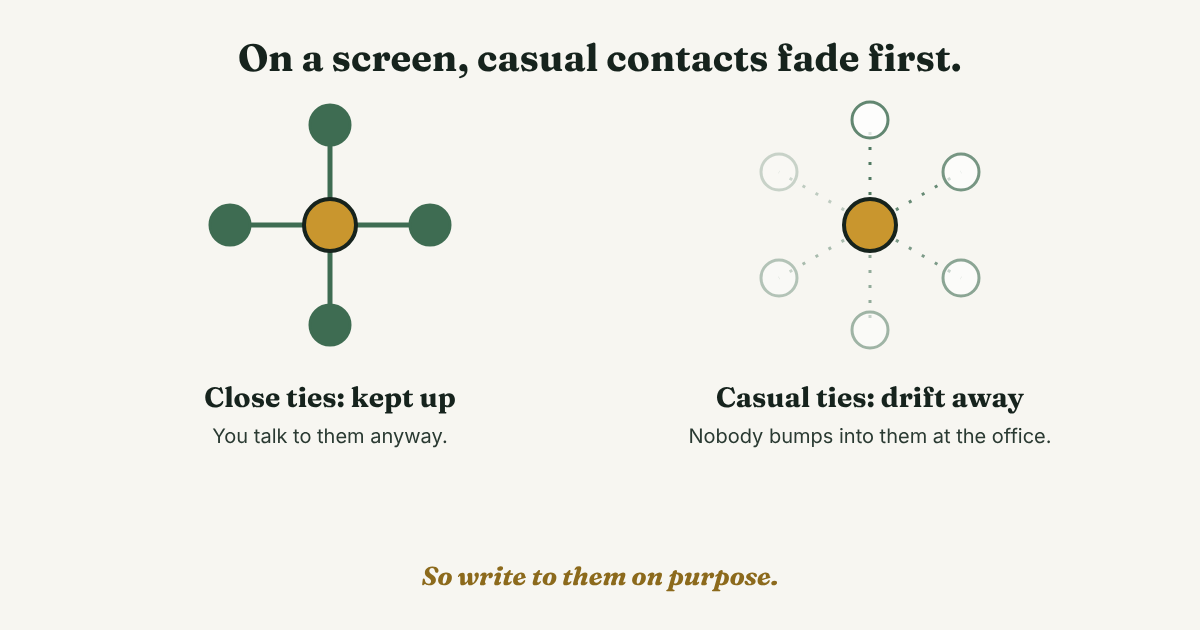
So virtual networking is doing on purpose what an office or an event hall used to do by accident, one call at a time. The same ideas hold in person, and our guide to how to pick, prepare for and follow up on professional networking events covers that side.
Who should you ask first?
Start with people who already know your name a little: a former coworker, a classmate, someone who answered you in a group, a speaker whose talk you liked. Deloitte's virtual networking tips list friends, colleagues, alumni networks and community or interest groups as places to start. Pick one or two people, not twenty.
Choose by a reason, not a title. "I liked your point about onboarding" is a reason. "You are a director" is not. If your LinkedIn list is still thin, our guide to using LinkedIn as a working network covers who to add and what to do after they accept.
How do you ask for a virtual coffee chat?
Keep the ask small and easy to say yes to. The Muse (Elliott Bell, updated 2024) suggests asking for 15 to 20 minutes, giving a clear reason and a personal hook, and offering a virtual option like Zoom or Meet. A recruiter writing for Scotiabank (2021) says that if your note takes longer than 60 seconds to read, it is too long, and suggests offering three or four weekdays instead of one fixed time. West Virginia University's career page adds one more: be mindful of time zones.
A note in that shape:
Hi [Name], I read your post on [topic] and it changed how I think about [one thing]. I'm a [your role], working on [one problem]. Could I ask you three questions about how you got into [their area]? Twenty minutes on a video call would be plenty. I can do [day], [day] or [day] between [time] and [time] [your time zone]. If the timing is bad, no problem.
Two details people skip. The Muse says not to sound like a job hunt: mention a search only after you have talked. And it prefers email, with a LinkedIn message as the backup when you cannot find an address. If you write on LinkedIn, our four-part frame for a professional LinkedIn message helps with the wording.
No reply? The Muse says to answer your own email after about a week and ask if they had a chance to read it. Send that one nudge, then let it go.
What does a good 20-minute call look like?
The sources agree on setup. Test your tech first, pick a quiet place with a clean background, and turn off notifications (Johns Hopkins, Scotiabank, Bath). Scotiabank also says to look at the camera for something close to eye contact, and not to read from a script. Bath says to expect questions about yourself, and to open with small talk.
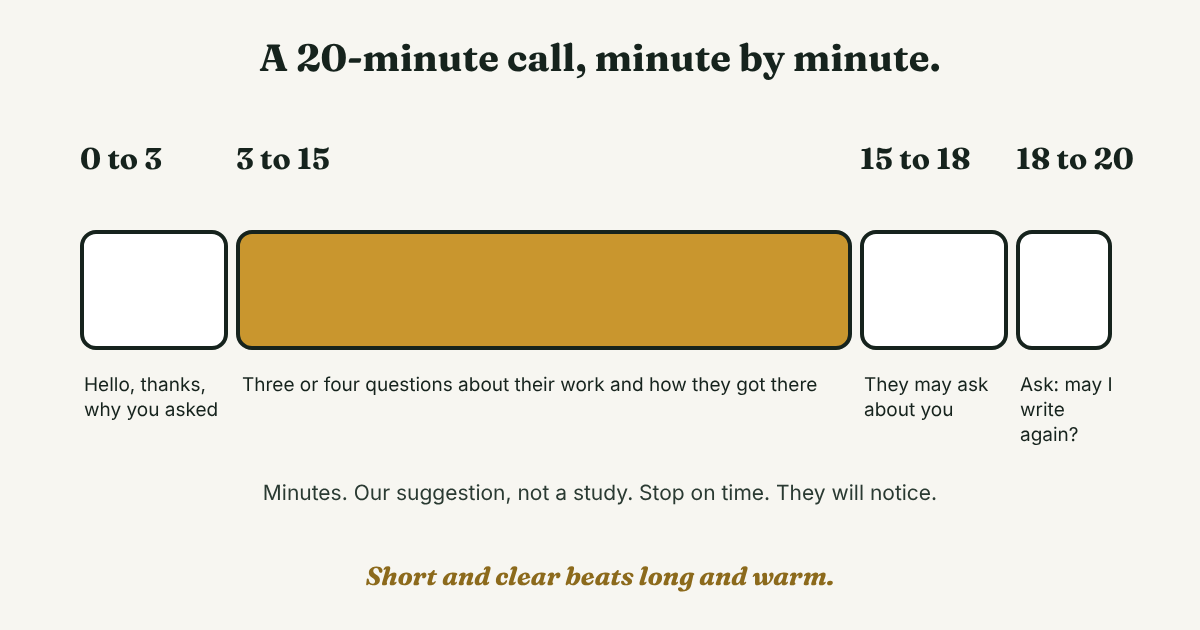
None of them gives a minute-by-minute plan, so this one is our suggestion:
- Minutes 0 to 3. Thank them. Say in one sentence why you asked.
- Minutes 3 to 15. Ask three or four questions about their work.
- Minutes 15 to 18. Their turn. Say in two or three sentences what you do and what you want next.
- Minutes 18 to 20. Ask for the next step: "Is it okay if I write to you again in a few months?" and "Is there someone else you'd suggest I talk to?" Bath adds that you should ask whether you can say they referred you.
Pick your questions from this list:
- How did you get into [their area]?
- What does a normal week look like in your role?
- What do people new to [field] get wrong?
- If you were in my place and wanted [goal], what would you do first?
Scotiabank says to skip anything a quick search would answer, such as a company's latest news. And do not ask for a job on the first call. Bath is blunt about it: "Never ask for a job straight away."
How do you network at an online event?
The UCSF career office (Sara Ayazi, 2020) gives five moves for a virtual conference: set goals and read the attendee list, dress and set up your space as you would for an in-person event, ask a question in the Q&A, join the informal parts such as hangouts and coffee breaks, and follow up afterward.
Our addition is a smaller goal. Leave with two people you can write to, not a full contact list. Here is how:
- Before. Pick two names from the speaker or attendee list. Write one line on why each.
- During. Ask one question in the Q&A, and say your name and role when you do. In a small breakout room, keep your camera on. That last part is our habit, not a study.
- Within a day. Message each of the two: Hi [Name], I was in the [session] where you said [one thing]. It made me think about [one line]. I'd like to stay in touch.
Groups work the same way. Our guide to professional networking groups shows how to pick one and test it before you commit.
How do you follow up?
Do it the same day. Scotiabank says to send a short thank-you that repeats your interest and names one takeaway. West Virginia University says to thank them for their time afterward. If they do not reply, Scotiabank adds, that does not mean you made no impression.
A note you can edit:
Hi [Name], thanks for the 20 minutes today. You said [one specific thing]. I'm going to [one action you will take]. I'll tell you how it goes.
The last line matters. It gives you a reason to write again.
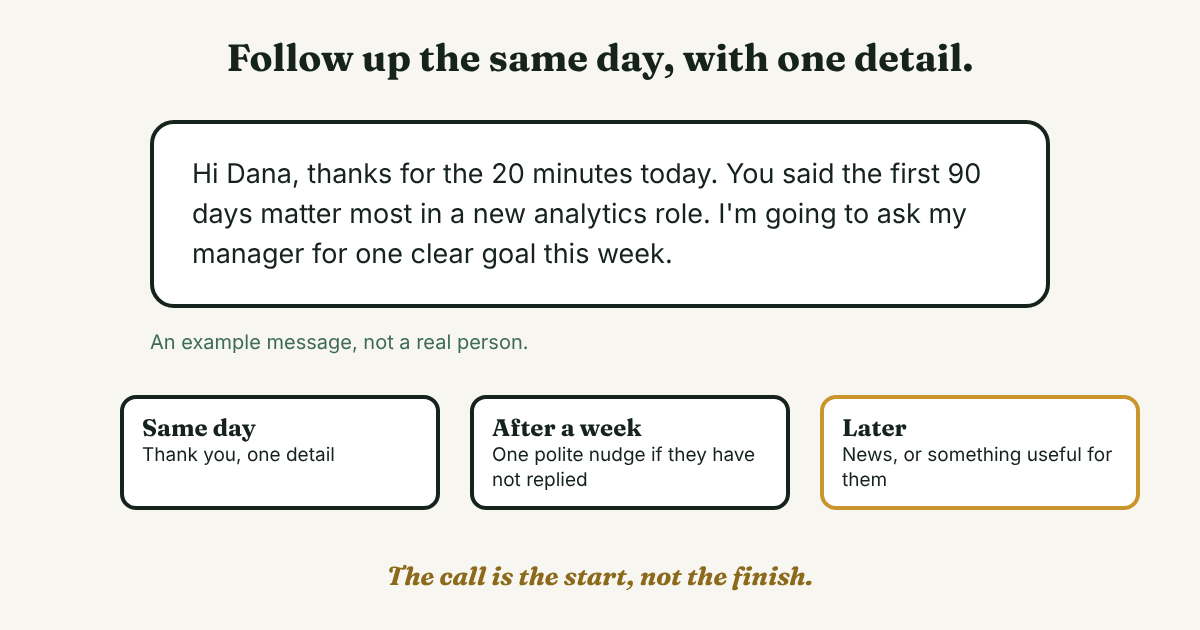
After that, the rhythm is simple. Nudge once after about a week if you asked for something. Later, write when you have news or something useful for them. If you met at an event and want to stay in touch, UCSF suggests a LinkedIn request, and our examples of following up after connecting show what to write.
How do you keep track of everyone?
By your fourth call you will not remember who said what. Keep one line per person: where you talked, what they said, what you promised, and the day to write next. Three example lines (not real people):
- Dana, former coworker. Said the first 90 days matter most. Promised to tell her my first goal. Next: November 14.
- Luis, speaker at a data meetup. Said small teams hire for range. Next: one nudge on November 7 if no reply.
- Mei, alumni network. Talked October 20. Next: January, with news.
Full disclosure: we make GrowthSeeded, a simple follow-up tracker for LinkedIn. It fits when you want a note on each person and a list of who to message today. You send every message yourself. It does not book calls or write your messages, and a plain spreadsheet works if you talk to only a few people.
What should you skip?
- A request with no reason and no end time. The Muse says vague asks, such as wanting to "know more," make it harder to say yes.
- A long first note. Under 60 seconds to read, says Scotiabank.
- Interruptions on the call. Bath says to make sure there are none.
- Asking for a job in the first call.
- One note pasted to many people. Write each one for the person who will read it. We do not recommend mass messages.
- Going quiet after the call. The first call is the easy part. A missed follow-up is how most of these chats go nowhere.
What do we not know?
We found no study that compares how often virtual and in-person chats lead to advice, a referral or a job. The Microsoft finding comes from a podcast account of one company's employee study, with no method details. The minute plan and the same-day timing are our suggestions, built from the advice above. Platform features and time zones change, so check yours before the call.
FAQ
Is virtual networking as good as in-person?
We found no study that compares them. Career advice from Johns Hopkins says virtual chats take more effort to build rapport, so plan for it: a clear ask, a short call and a same-day follow-up.
How long should a virtual coffee chat be?
Ask for 15 to 20 minutes. That is what The Muse and Scotiabank suggest, and West Virginia University says about 20. If the talk goes well, they can offer more.
Should you keep your camera on?
Scotiabank suggests looking at the camera for something close to eye contact. Camera on is our default in a one-to-one call. If the other person prefers audio, follow them.
How do you start a conversation at an online event?
Ask a question in the Q&A, or say one specific thing in a breakout room, then message the person afterward. UCSF also suggests the informal parts, such as hangouts and coffee breaks, where talk is more relaxed.
Can you ask for a call on LinkedIn?
Yes. The Muse prefers email, but says a LinkedIn message works if you cannot find an address. Keep it short, give one reason, and offer a few times.
Do this today
- Pick one person who knows your name a little. Write down why you want 20 minutes with them.
- Send the request with three time options and your time zone.
- Open a list with one line for that person: where you know them from, the day you asked, and the day to nudge.
Calls are easy to book and easy to lose track of. Add each person to GrowthSeeded with a line about what you talked about, and it tells you who to message each day, so you don't forget to follow up. The Free plan is $0 for up to 5 active people at a time (checked October 2026, and plans change). You send every message yourself, and it never sends anything or touches LinkedIn.
Sources
- Virtual Networking, Deloitte US, checked 2026 (page shows no date)
- How do I network at a virtual conference?, Sara Ayazi, UCSF Office of Career and Professional Development, 2020
- How to Ask for an Informational Interview and Get a Yes, Elliott Bell, The Muse, updated 2024
- Tips for Mastering a Virtual Coffee Chat, Scotiabank Careers blog, 2021
- The Art of the Coffee Chat, Kara Hunter, Johns Hopkins University, 2024 (year from the page address)
- Tips for Virtual Networking, West Virginia University career services, checked 2026 (page shows no date)
- Online networking: starting the conversation, University of Bath careers blog, checked 2026 (page shows no date)
- The New Future of Work, Microsoft Research Podcast episode 126, Microsoft Research, 2021
About the author
Anisur Rahman Fagun is a marketing and content strategist with more than 9 years of experience in SEO, content, paid advertising and brand growth. He holds a master's degree in mass communication and journalism, and has led content and SEO strategy, built editorial teams and worked with product, design and sales teams. He also builds simple tools that turn marketing data into clear decisions. He writes the GrowthSeeded blog, which shares practical ways to follow up and stay in touch with people on LinkedIn.