Networking
Follow-Up Message to a Recruiter on LinkedIn: 4 Examples
Updated: October 24, 2026 · 10 min read
Key takeaways
- Wait for the date the recruiter gave you. With none, career offices say one to three weeks and do not agree.
- Name the role, add one detail from your last contact, and ask one question.
- Send one or two notes, spaced at least a week apart, then move on. Sources differ on the exact count.
- Write every note yourself, to one recruiter at a time. Skip tools that send it for you.
Short answer: Wait until the date the recruiter gave you, or about two weeks if they gave none. Then send one short note in the same thread. Name the role, mention one detail from your last contact, and ask one question, such as whether there is an update. Write it yourself.
In this article
- Why do recruiters go quiet?
- When should you follow up?
- Should you use LinkedIn or email?
- What should the message include?
- What are four examples you can edit?
- What should you skip?
- Where does a tracker fit?
- FAQ
- Do this today
Why do recruiters go quiet?
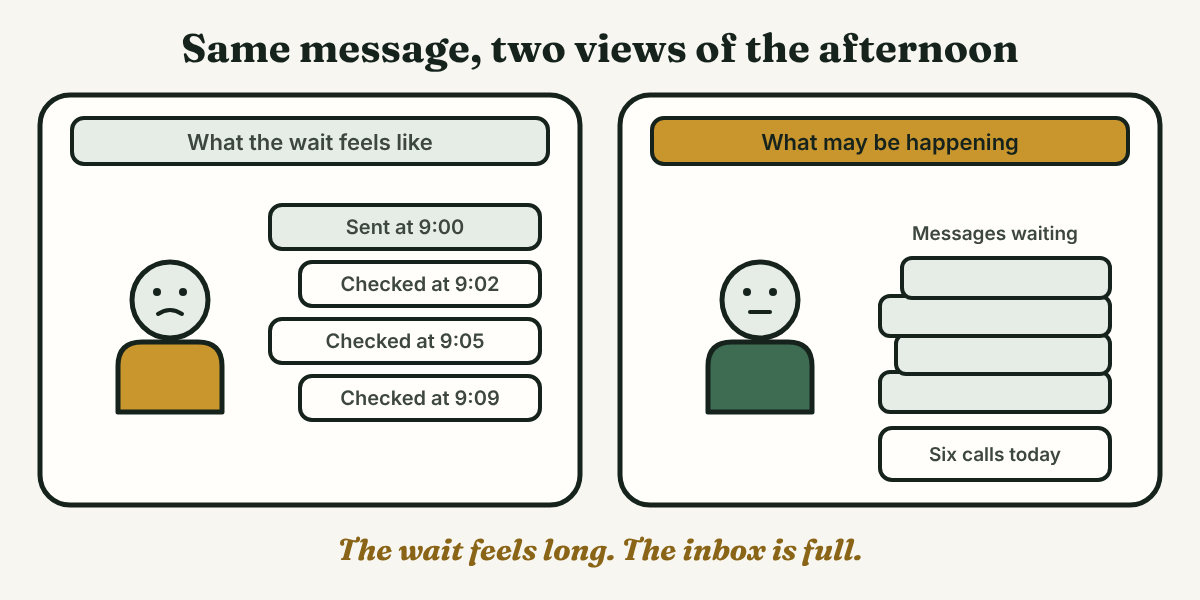
You sent a good message, and then nothing came back. It feels like a verdict, but the sources we read describe a busier picture.
A UTS Careers article says some recruiters read applications as they arrive and others wait until the closing date. You usually cannot tell which, so early silence does not mean no. RippleMatch lists plainer causes: vacations, illness, campus visits, backlogs and urgent projects. Welcome to the Jungle adds slow internal steps for reviewing and scheduling. These are advice articles, not studies, so none says how often each cause happens.
Our suggestion is to treat the first week of silence as normal. A follow-up is not a complaint. It is a short, easy reminder.
When should you follow up?
The sources do not agree on one number:
- Arcadia University: if the recruiter gave a date and it has passed, write. With no date, wait a week or two.
- University of Arizona: two weeks after you apply.
- Santa Clara University career center: three or more weeks after you applied.
- UTS Careers: one to two weeks after the closing date.
- Welcome to the Jungle: at least ten days at a large company, about a week at a start-up, and not at all if the posting says not to contact them.
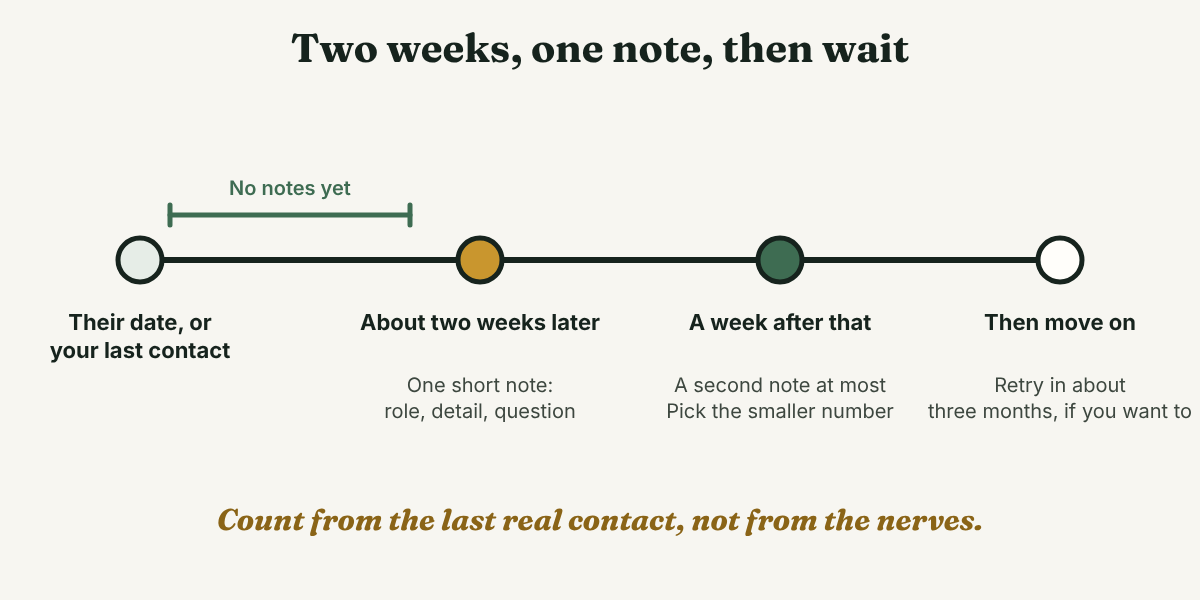
Read together, they point to one rule: let the recruiter's own timeline decide, and use one to two weeks when there is none. Our suggestion is to count from the last real contact, not from the day you felt nervous.
For a second note, RippleMatch says to wait at least a week. Welcome to the Jungle allows up to three attempts, while RippleMatch stops at one or two. Pick the smaller number. After that, Arcadia says to move on, and to set a calendar reminder to try again in about three months if you still want the company.
Should you use LinkedIn or email?
Use the channel you already have. If the recruiter wrote to you on LinkedIn, or you have only their profile, write there. If you have their email address, Arcadia and Welcome to the Jungle both prefer email, because it is easier to answer when free and leaves a written record.
The University of Arizona page names three places to find a recruiter: Handshake, the company website and LinkedIn. The Santa Clara page gives the route for a stranger: find a recruiter on LinkedIn, choose Connect, then Send Note.
One rule all the sources share: do not call. Arcadia calls it the most important tip. We could not open LinkedIn's own help pages, so we cannot confirm the length limit on a connection note. Check your own screen.
What should the message include?
The sources ask for nearly the same parts. Each one is a single sentence.
Step 1: Name what you are following up on
Say the role and the day you applied or talked. The University of Arizona sample states both.
Step 2: Add one detail from your last contact
Arcadia says to refer to a specific moment so the recruiter can place you. It can be a topic from the call or a line in the posting that matches your work.
Step 3: Ask one question
RippleMatch suggests ending with a direct question, such as whether there are updates on next steps. Do not ask for the job.
Step 4: Keep the tone light
Arcadia says to write with "enthusiasm, not desperation." Welcome to the Jungle asks for no more than three short paragraphs. Read it out loud once before you send it.
What are four examples you can edit?
Priya (an example, not a real person) is job hunting for a marketing analyst role, and she stands in four different places with four recruiters. She writes a different note each time. Change every part in [brackets], and send each note to one person.
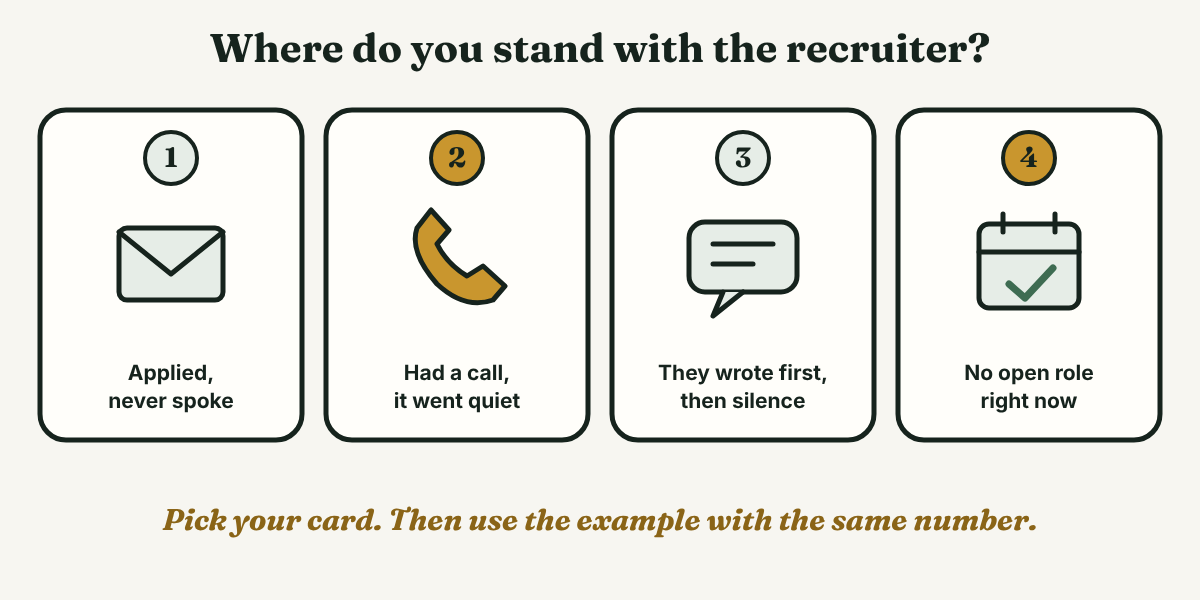
1. You applied and found the recruiter, but never spoke
This is the University of Arizona setup: you applied, waited about two weeks, and now reach out on LinkedIn. Add it to the request, or send it after they accept.
Hi [Name], I applied for the [role] position on [date] and wanted to say hello. My work on [one project] matches [one line from the posting]. If it helps, I can send anything else you need. Thank you for your time. [Your name]
2. You had a call with the recruiter, and it went quiet
Arcadia and RippleMatch say to refer to a moment from the call and ask for an update. If something changed since, such as an award, add one short line about it.
Hi [Name], thank you again for our call on [day]. I have kept thinking about [topic from the call]. I am still very interested in the [role]. Do you have an update on next steps? [Your name]
3. The recruiter wrote first, you replied, and then silence
Welcome to the Jungle says to reply in the existing email thread. Our suggestion is to do the same on LinkedIn, so the recruiter sees the earlier messages above yours.
Hi [Name], I wanted to follow up on your message about the [role] at [company]. I replied on [day] and I am still interested. Is the role open, and is there a good time for a short call? [Your name]
4. There is no open role right now
The Pepperdine blog's last template is a thank-you after the recruiter accepts: stay in touch, and mention your background in case something fits. Add the month you will check back, as Arcadia's three-month reminder suggests.
Hi [Name], thank you for connecting. I work in [field] and I am looking at [type of role] roles for next year. If something that fits opens up, I would be glad to hear about it. I will check back in [month]. [Your name]
What should you skip?
Skip these:
- A call or voicemail. Arcadia and RippleMatch both say not to. Write instead.
- "Just checking in" with nothing else. A note with no role, detail or question gives the recruiter work. Our suggestion is to add the three parts above.
- Posting about the delay. RippleMatch says not to complain about a company on public profiles.
- The same note to many recruiters. If you could paste it to ten people, it is not written for the one reading it.
- Tools that send it for you. We do not recommend automation, bots or mass messaging for notes like these.
Where does a tracker fit?
Full disclosure: we make GrowthSeeded, a LinkedIn relationship tracker. It does not write notes, send them or touch LinkedIn. In a job search the hard part is often memory: which recruiter said what, and when you last wrote. You add each recruiter and write a note after every conversation, such as "call on Oct 20, decisions by early November." A due-today view shows who you owe a follow-up, and the next step follows what happened, like an accepted request or a reply, not a date you picked.
Prices, checked October 24, 2026: Free is $0 for 5 active people at a time (up to 20 when friends join through invites), Pro is $15 a month or $150 a year, and Max is $29 a month. They change.
It tracks people, not applications. If you mostly need a list of jobs with the stage and deadline of each, a spreadsheet is the better fit. And with only two or three recruiters, a notes app is enough.
FAQ
How long should you wait before following up with a recruiter?
Until the date the recruiter gave you. With no date, the sources say one to three weeks. Our suggestion is about two weeks from your last contact.
Should you follow up with a recruiter on LinkedIn or by email?
Use the one you have. Arcadia and Welcome to the Jungle prefer email when you have the address. LinkedIn fits when it is your only channel.
How many times can you follow up?
RippleMatch says one or two notes, and Welcome to the Jungle says up to three, spaced a couple of weeks apart. Neither tested the number, so our suggestion is two at most.
What if the recruiter never replies?
Stop after your last note and keep applying. UTS Careers says not to take it personally. Arcadia says you can try again in about three months. Our post on the LinkedIn follow-up message covers what to add to a second note.
Do this today
- Open your last conversation with the recruiter and find the date. Write down their timeline if they gave one, or add two weeks if they did not.
- On that day, write one short note in your own words: the role, one detail from your last contact, and one question.
- Send it to that one person, in the same thread when there is one. Then write the next check date, a week out, where you will see it.
Following up well mostly comes down to remembering who said what and when. GrowthSeeded keeps each recruiter next to your own note and shows in a due-today view who is waiting on a message. You write every message, and it never sends anything or touches LinkedIn. Free costs $0 for up to 5 people at a time, which can hold the few recruiters you are following right now.
Sources
- How to Check in With a Recruiter When You Haven't Heard Back, Arcadia University Career Launchpad, 2024
- How to Follow Up After Applying for a Job, University of Arizona Center for Career Readiness, 2022 (updated 2026)
- Following-Up with Employers, Santa Clara University career center, checked 2026
- Am I Being Ghosted by a Recruiter?, UTS Careers, 2019
- What To Do if You Think a Recruiter Has Ghosted You, RippleMatch, 2020
- Ghosted by a recruiter? Here's what to do, Welcome to the Jungle, 2019
- How to Message Recruiters to Connect on LinkedIn (with Examples!), Pepperdine Graziadio career blog, 2025 (year from the page address)
About the author
Anisur Rahman Fagun is a marketing and content strategist with more than 9 years of experience in SEO, content, paid advertising and brand growth. He holds a master's degree in mass communication and journalism, and has led content and SEO strategy, built editorial teams and worked with product, design and sales teams. He also builds simple tools that turn marketing data into clear decisions. He writes the GrowthSeeded blog, which shares practical ways to build professional relationships on LinkedIn.