Networking
LinkedIn for Sales: A Simple Weekly Routine, Step by Step
11 min read
Key takeaways
- Start with 25 people and one reason to write to each. A list you can read in five minutes beats a long one you never open.
- Comment on their work first, then send a request that says why. Pitching right after they accept is the mistake the top guides warn about.
- In a 2025 Gartner survey, 73% of B2B buyers said they actively avoid suppliers who send irrelevant outreach. Relevance is the work.
- The top guides stop at the accepted request. Plan your next two messages and a next date before you send the first one.
- You do not need exactly five follow-ups. The "80% of sales need five follow-ups" figure has no study behind it that we could find.
Short answer: Pick 25 people and write down why each one matters. Comment on one of their posts, then send a request that says why you are connecting. After they accept, ask one question about their work. Write a next date next to every name, and follow up once with something new.
In this article
Why do most LinkedIn sales guides leave you stuck after the first message?
Why should the first message be about them, not your product?
What does a simple weekly routine look like?
Do you need five follow-ups to win a sale?
What should you track so nobody slips?
What about Sales Navigator, tools and automation?
Where does a simple follow-up tracker fit?
What do we not know?
FAQ
Do this today
Why do most LinkedIn sales guides leave you stuck after the first message?
Priya (an example, not a real person) sells software to HR teams. On Monday she sends 30 connection requests. By Friday, nine people have accepted. She meant to write to six of them. Now she cannot remember which six, or what she wanted to say.
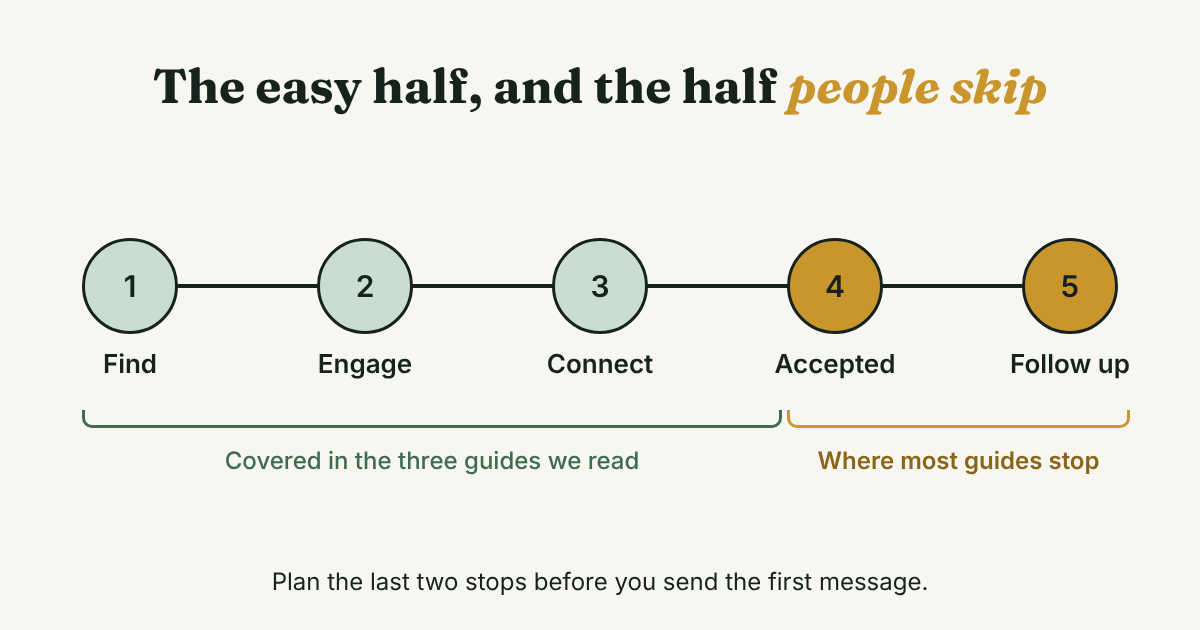
That gap is where most LinkedIn selling stalls. We read three popular guides: Pipedrive's five steps, Salesforce's three steps and LinkedIn's own three steps to social selling. They agree on the first half. Fix your profile, find the right people, share something useful, then take the talk off LinkedIn. They say little about the days after someone accepts, or how to keep track of who is waiting on you. This guide spends most of its time there.
If you are still building a wider network, start with professional networking and a weekly routine. This post is for the narrower job of reaching prospects and keeping the conversation going.
Why should the first message be about them, not your product?
Gartner surveyed 632 B2B buyers in August and September 2024. Its June 2025 release says 73% actively avoid suppliers who send irrelevant outreach. A year later, Gartner reported that 67% of 646 buyers prefer a rep-free experience.
Two limits. These are different samples with different fieldwork, so do not read them as a trend. And the releases do not say the buyers' roles or regions, or how "rep-free" was worded. They are about buyers in general, not about LinkedIn messages.
Here is what we take from them, as a rule of thumb: your first note is not a pitch. It is a reason. The 2025 release also says buyers still prefer to ask sellers about fit, such as whether a product suits their company. So the useful move is to be easy to ask, not to push.
What does a simple weekly routine look like?
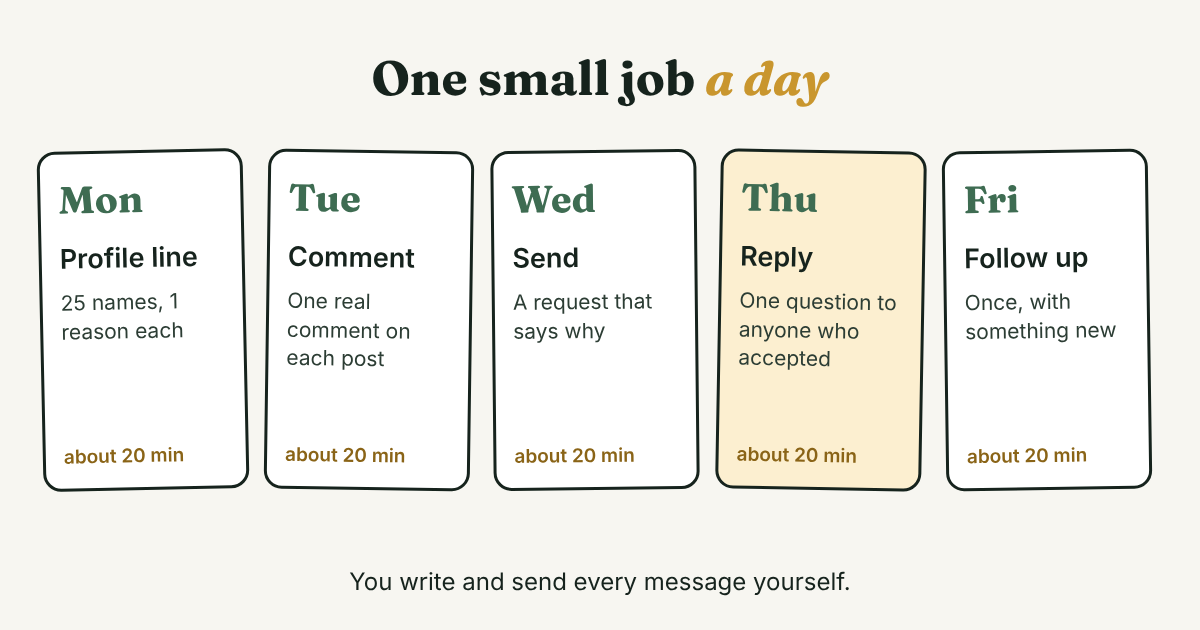
This routine is for one person selling alone, about 20 minutes a day. The time is our estimate, not a study. If you want a longer manual version, see our 14-day LinkedIn activity sequence for B2B sales.
Monday: make your profile say who you help
Pipedrive says your profile should work "more like a buyer-facing landing page than a resume." Check two things. Your headline says who you help and with what. Your first About line says it in plain words. That is enough for today. Do not rewrite everything.
Monday: pick 25 people and write why next to each
Choose by role and type of company. Then add one reason to write now. Pipedrive lists trigger events such as hiring, funding, a leadership change or a launch. A reason can also be small: they posted about a problem you solve. Write it in one line next to the name. No reason, no name on the list.
Twenty-five is our rule of thumb, not a study. Pick a number you can read in five minutes.
Tuesday: comment before you message
Comment on one recent post from each person, with something you actually think. Pipedrive says to engage publicly before you message privately. Salesforce says to share and comment with expertise before you sell. Skip "Great post!" Add a fact, a question or a short example.
Wednesday: send a request that says why
Now send the request, one at a time, written by you. Our post on connection request messages for sales has four examples. A short one to edit:
Hi [first name], I saw your post about [topic]. I work with [type of team] on [problem]. Glad to connect either way.
Send a few a day, not a big batch. For the limits, read LinkedIn maximum connections per day.
Thursday: when they accept, ask one question
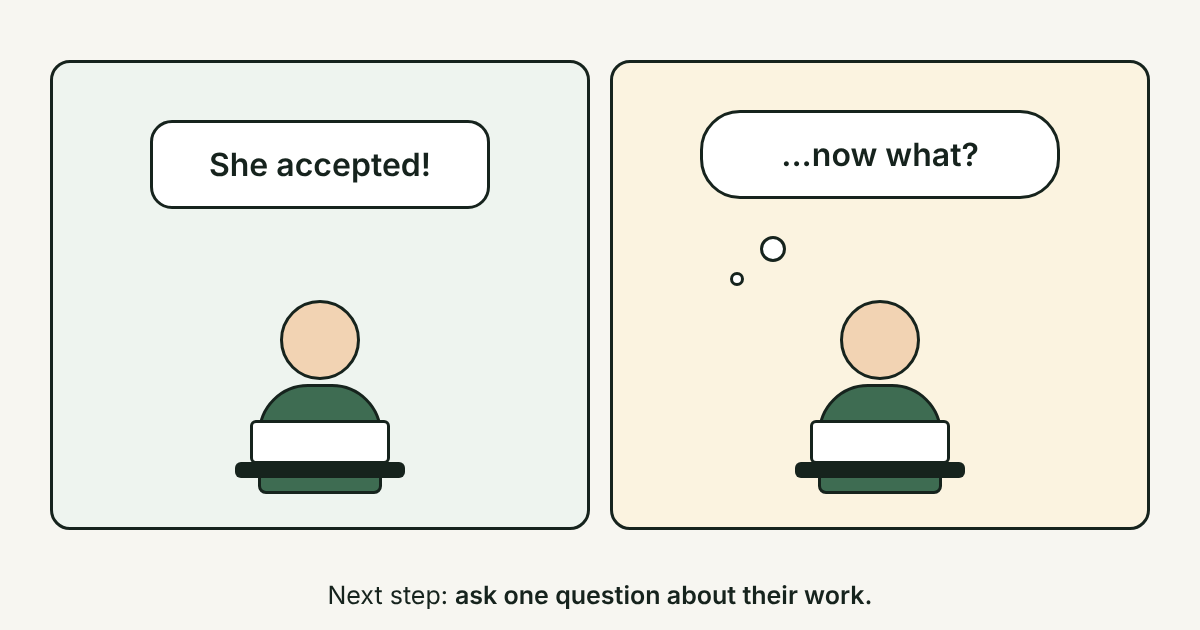
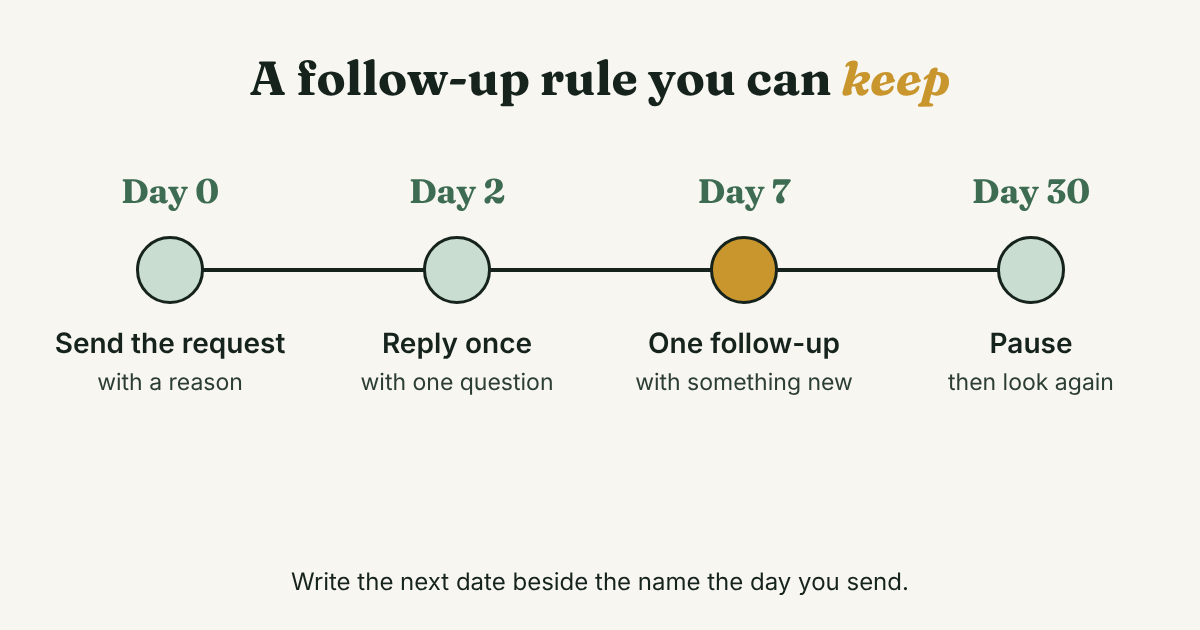
This is the step the top guides skip. Pipedrive warns against "pitching too soon." Salesforce says to move to email or a call later, and to mention something they posted. Neither gives you the actual message. Reply within two days:
Thanks for connecting, [first name]. I saw you [specific thing from their post or role]. How are you handling [problem] right now?
One question, about their work. No link, no calendar invite. Then write a next date next to their name.
Friday: follow up once, with something new
If nobody has replied in about a week, send one follow-up that adds something: an article, a number or a short example. Not "just checking in." That is our rule of thumb. After that, pause for a month. For wording, see our four LinkedIn follow-up templates.
Ask for a call only when they show interest
Salesforce says you are probably not going to send quotes back and forth through LinkedIn. When someone answers with interest, offer a 15-minute call or an email, and say what you will cover. Until then, keep it a conversation.
Do you need five follow-ups to win a sale?
You will see "80% of sales need five follow-ups" in many sales posts. We went looking for the study. A 2026 source audit by AInora, a company that sells phone follow-up services, says it found none. It traces the idea to a 1942 survey of fewer than 40 members of one chapter, which it says was never published, and to a 2009 column that cited unnamed studies.
We could not open those older documents ourselves, so this is one vendor's finding, not proof that no study exists. It is enough for us to stop quoting the number. Do not count to five. Ask whether your message gave the person a reason to answer.
What should you track so nobody slips?
One line per person is enough: name, why you wrote, the last thing that happened, the next step and a next date. Sort by the next date each morning and message whoever is due. Then update the date before you close the list.
Marcus (an example, not a real person) | Hiring two recruiters | Accepted Nov 3, I asked one question | Reply, or one follow-up with the article | Nov 10
Our post on whether you need a CRM for LinkedIn follow-ups has the six-column version and explains when a CRM starts to earn its price.
What about Sales Navigator, tools and automation?
LinkedIn's pricing pages would not open for our reader, so we quote no prices. Check them yourself. Whatever you pay for search, the routine above stays the same.
Skip any tool that sends requests or messages for you. We do not recommend automation or mass messaging. Our post on why to avoid automating LinkedIn activities has the sourced reasons.
Where does a simple follow-up tracker fit?
Full disclosure: we make GrowthSeeded, a simple follow-up tracker for LinkedIn, so we are biased. It tells you who to message each day, so you don't forget to follow up. It is not a complex CRM. You add a person and why they matter, and the next step follows what happened, such as an accepted connection or a reply.
You send every message yourself. It never sends anything and never connects to LinkedIn, so it adds no risk to your LinkedIn account. It is not built for deal values, a team working one pipeline or email sync. If you need those, a CRM fits better. More on that in how a tracker helps with LinkedIn follow-ups.
What do we not know?
- How many replies any message gets. We found no data we could open that measures it, so we give none.
- How Gartner defined "rep-free" or who the buyers were. The releases do not say.
- What LinkedIn plans cost today. The pricing pages would not open for us.
- Whether a study backs the five-follow-ups rule. We found none, and the audit we read is a vendor's.
FAQ
How do I use LinkedIn for sales?
Pick a short list of people you have a reason to write to. Comment on their work, send a request that says why, and ask one question after they accept. Write a next date for each person and follow up once with something new.
Is LinkedIn good for B2B sales?
It can be a place to start conversations. We found no data that says how often it leads to a sale. Gartner's surveys suggest buyers dislike irrelevant outreach, so a short, relevant note matters more than volume.
What should my first message say?
Say why you are writing to this person, in one or two lines. Mention something they posted or a change at their company. Do not pitch and do not attach a link.
How often should I follow up?
As a rule of thumb, once after about a week, with something new. Then pause for a month. No study we could open sets the right number.
Do I need Sales Navigator to sell on LinkedIn?
No. The weekly routine here works with a free account. A paid plan changes how you search for people, not how you write to them or keep track.
Do this today
- Write 25 names on a list, with one line each on why you would write to them.
- Comment on one recent post from three of them. Say something specific.
- Add a next date to every name, so tomorrow you know who to message.
If you want the list to tell you who is due each day, GrowthSeeded is a simple follow-up tracker for LinkedIn. You send every message yourself, it never sends anything or touches LinkedIn, and the Free plan covers 5 active people at a time.
Sources
- Gartner Sales Survey Finds 61% of B2B Buyers Prefer a Rep-Free Buying Experience, Gartner, 2025
- Gartner Sales Survey Finds 67% of B2B Buyers Prefer a Rep-Free Experience, Gartner, 2026
- How to use LinkedIn for sales to generate qualified leads consistently, Pipedrive, 2026
- Step By Step, How To Make A Sale Using LinkedIn, Salesforce, 2020
- 3 Steps to Social Selling with LinkedIn, LinkedIn Sales Solutions, 2013
- "80% of Sales Need 5 Follow-Ups": Where the Statistic Really Comes From, AInora, 2026
About the author
Anisur Rahman Fagun is a marketing and content strategist with more than 9 years of experience in SEO, content, paid advertising and brand growth. He holds a master's degree in mass communication and journalism, and has led content and SEO strategy, built editorial teams and worked with product, design and sales teams. He also builds simple tools that turn marketing data into clear decisions. He writes the GrowthSeeded blog, which shares practical ways to build professional relationships on LinkedIn.
Related reading
- Professional Networking: What It Is and a Weekly Routine
- LinkedIn Activity Sequence for B2B Sales Professionals
- LinkedIn Connection Request Message for Sales: 4 Examples
- LinkedIn Follow-Up Message: 4 Templates and When to Send
- LinkedIn for B2B Sales: Reach Several People at One Company
- LinkedIn Prospecting: Decide Who Is Worth a Message First