Networking
LinkedIn Connection Request: Note or No Note, Then What?
10 min read
Key takeaways
- A LinkedIn connection request is an invitation to one person. Sending it takes ten seconds. The follow-up after they accept is where the conversation starts.
- Studies from outreach software disagree on whether a note changes who accepts. In one large data set, people who accepted replied more often when the request had a note.
- Add a note only if you can name something specific about that person. If you can't, send the request blank.
- Write each request yourself, for one person. Skip tools that send them in bulk.
- Keep one line per request: who, why, the date, and your next step.
Short answer: A LinkedIn connection request is an invitation to connect with one person. Add a note if you can name something specific about them. Send it blank if you can't. When they accept, send one short message within a few days, and write down who you asked and why.
In this article
What is a LinkedIn connection request, and what happens next?
Should you add a note to a connection request?
Who is worth a request?
What do you do after someone accepts?
How long should you wait for an accept?
How do you keep track of who you asked?
What should you skip?
What do we not know?
FAQ
Do this today
What is a LinkedIn connection request, and what happens next?
Daniel (an example, not a real person) met a recruiter at a talk and sent her a request that night. Ten days later he can't remember if she accepted, what he wrote, or whether he ever messaged her.
That is how most requests go wrong. Sending one is quick. The work comes after: knowing who said yes, saying something useful, and remembering who never answered.
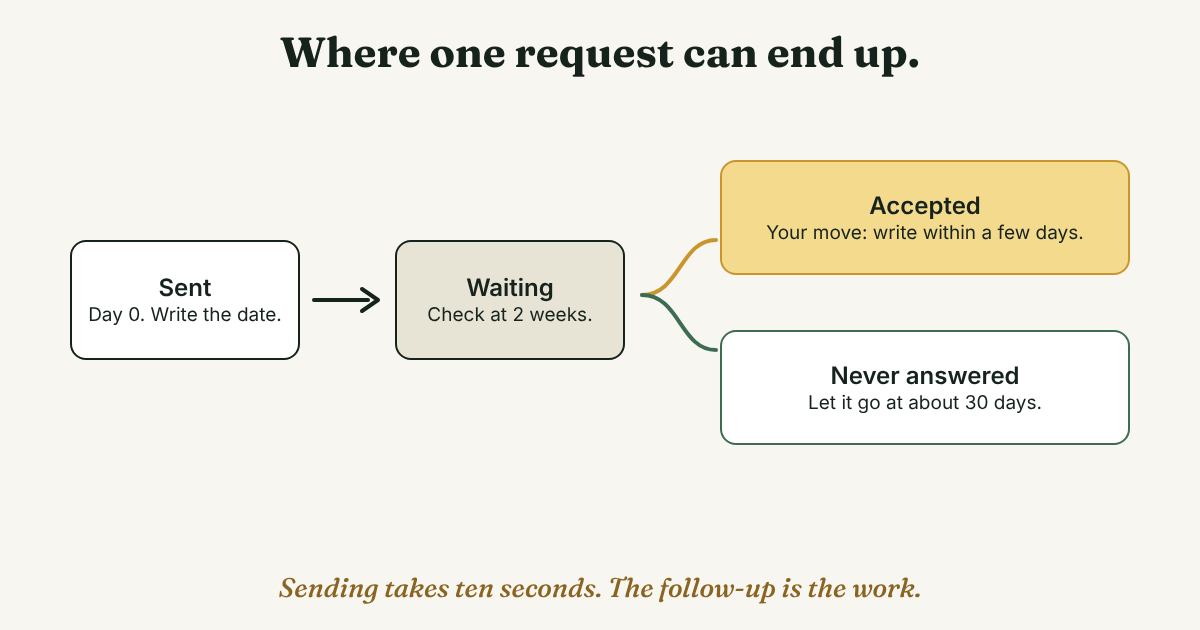
A connection request is an invitation to connect with one person. LinkedIn’s own help pages call them invitations, according to a 2026 guide that summarizes them. Once you send one, it is waiting, accepted, or never answered. You are connected only after the person accepts.
This guide covers the request and what comes right after it. If you are still deciding how much time to give networking in general, start with our guide to professional networking and a weekly routine. For how requests fit into the rest of LinkedIn, see how to use LinkedIn as a working network.
Should you add a note to a connection request?
Advice splits. A Boston University Questrom career guide says to always add a note, and warns that the default message can make you “appear lazy.” A LinkedIn blog guide says the opposite: if you can't fill the note with something specific to that person, send it blank.
The numbers are messier than either view.
- Reachium looked at 180,155 requests sent between January 2025 and August 2026. Acceptance was 22.60% with a note and 27.66% without. But the gap flipped in two of the three accounts it could compare against themselves, so the study calls the acceptance effect inconclusive.
- Among people who did accept, 47.80% replied when the request had a note, and 25.54% when it did not. That gap showed up in all three paired accounts.
- Belkins, an outreach firm, reported 26.42% acceptance with a note and 26.37% without, across more than 20 million attempts, in a comparison of seven studies by Outscore.
Read these with care. All of the numbers come from outreach software vendors and their customers, and nobody was randomly assigned to write notes. People who write notes may differ from people who do not. We do not recommend sending requests in volume, and we can't tell how many of these senders did.
Still, the pattern is useful. A note does not reliably change whether someone accepts. It may change whether a conversation starts afterward. So save notes for people you want to talk to.
A test you can use
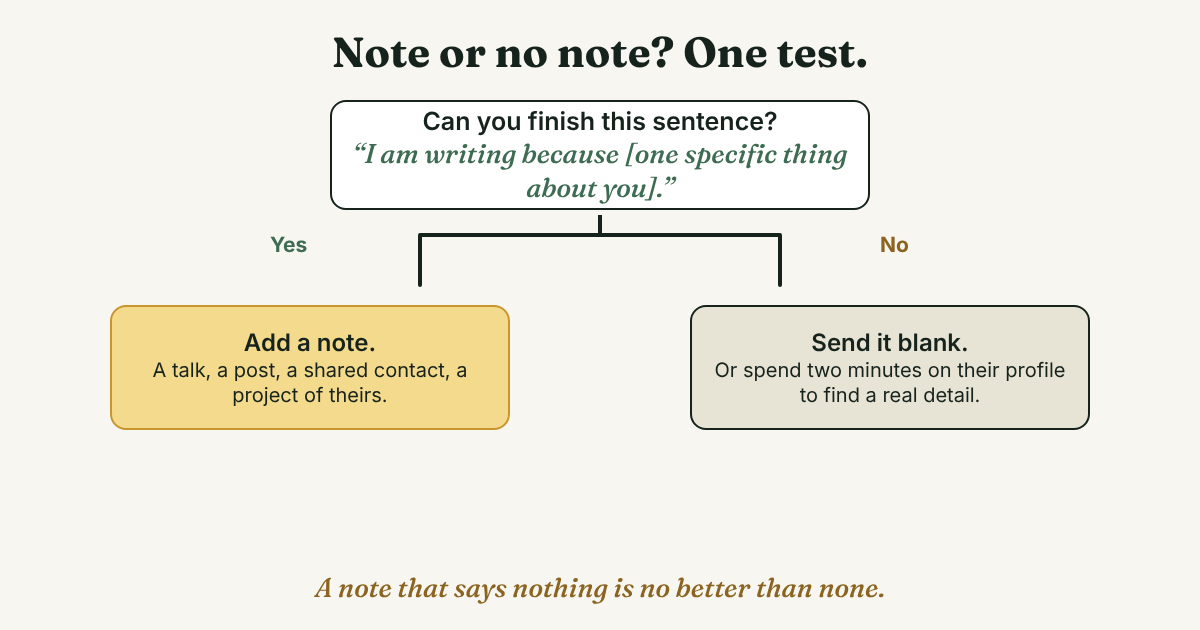
This is our suggestion, not a study. Try to finish this sentence: I am writing to you because [one specific thing about you].
If you can finish it, add a note. If you can't, send the request blank, or spend two minutes on their profile to find a real detail first. Good details are a talk they gave, a post you both commented on, a person you both know, or a project of theirs you used. “Your impressive background” is not a detail.
Two notes you can edit:
Hi [Name], I was at [event] and liked your question about [topic]. I would like to stay in touch.
Hi [Name], your post on [topic] made me rethink [one thing]. Good to be connected.
How long can a note be?
LinkedIn limits the length of a note, and free accounts also have a monthly limit on notes. The figures we found disagree: 200 or 300 characters, and three or five notes a month, depending on the page. LinkedIn’s help pages would not open for us, so we give no number here. Your own invitation box shows your limit. If free notes run low, keep them for people where you have a real detail.
Who is worth a request?
Pick people you have a reason to talk to: someone you met, someone whose work you use, someone in a role you want to learn about.
Mailshake, which sells outreach software, lists common mistakes. Sending generic, copy-pasted requests. Connecting with no reason. Pitching a product in the first message. All three leave the other person unsure why you wrote.
Send each request yourself, to one person, after you have looked at their profile. For the wording of a first message to someone you know little, see our 4-part frame for a professional LinkedIn message.
What do you do after someone accepts?
This is where most people stop. Someone accepted, nothing happened next, and the connection just sat there. Decide the next step before you send.
Step 1: Write down why you asked
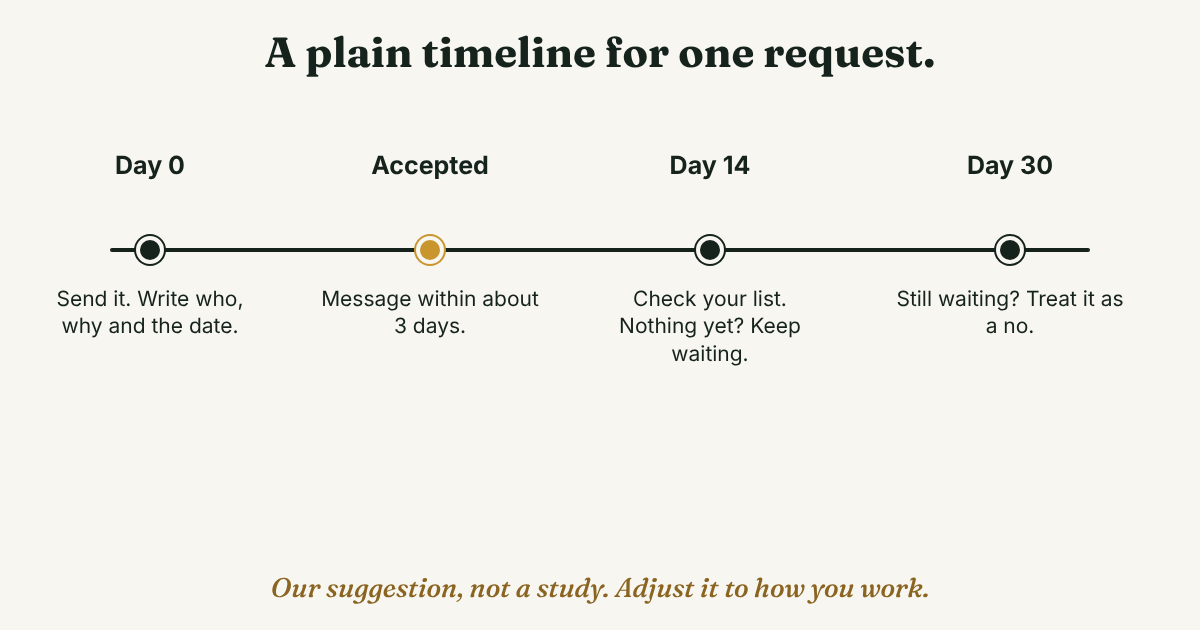
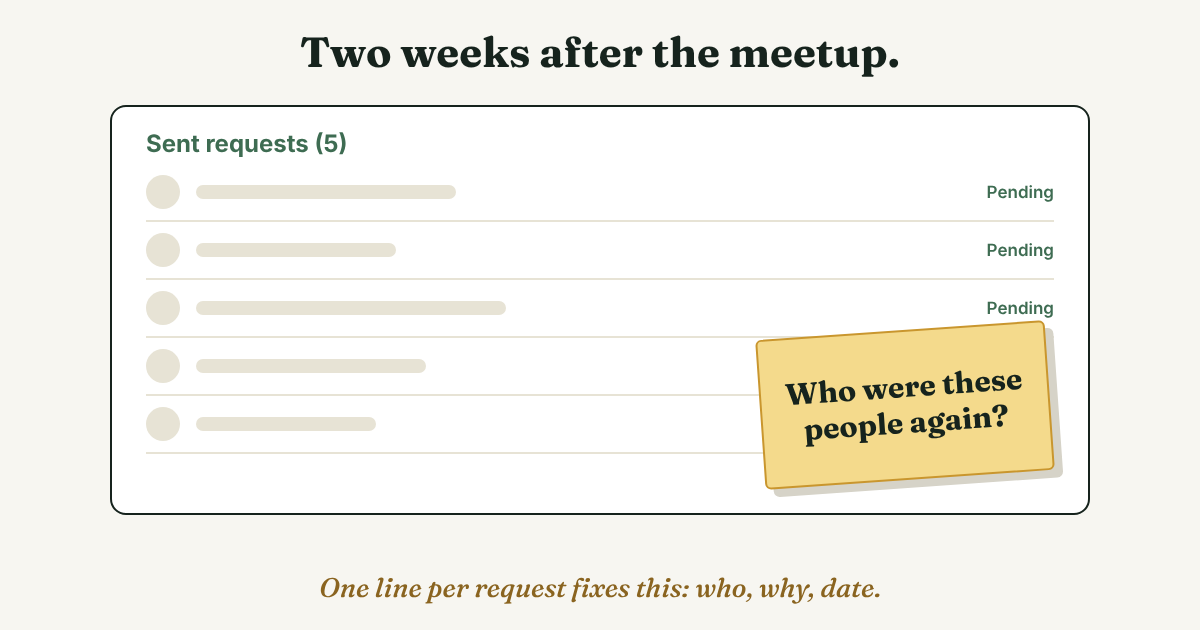
One line, the day you send: the person, the reason, the date. It takes 20 seconds. You will want it in two weeks.
Step 2: Message within a few days of the accept
Our suggestion, not a study: send one short message within about three days, while the reason is still fresh. The Questrom guide also says to thank the person and follow up on the reason you asked.
Hi [Name], thanks for connecting. I asked because [the reason, one line]. [One easy question about their work.]
For four full examples by situation, see our guide to what to send after someone connects.
Step 3: Send one follow-up, then let it go
Amplemarket, an outreach vendor, suggests a polite follow-up about a week later if you get no reply. We agree with one. Our guide to follow-up messages and when to send them has the timing and the wording.
How long should you wait for an accept?
We could not find a rule from LinkedIn on this. One vendor, Botdog, reported that 99% of the acceptances in its data came within 30 days, as listed in the Outscore comparison. Reachium counted only requests that were at least 30 days old, for the same reason.
Our suggestion: check your list at two weeks. Treat a request that is still waiting at 30 days as a no, and put your time into people who answered.
How do you keep track of who you asked?
Two weeks after a busy event, you will not remember. Keep one line per request, holding the person, where you found them, why you asked, the date you sent it, and your next step.
Three example lines (not real people):
- Priya, speaker at the Austin product meetup. Asked about her talk on pricing. Sent Nov 1. Next: if she accepts, thank her and ask one question about the talk.
- Marcus, hiring manager at a company I applied to. Sent Nov 2, no note. Next: check on Nov 16.
- Elena, former classmate. Sent Oct 20, still waiting. Next: let it go on Nov 19.
Full disclosure: we make GrowthSeeded, a simple follow-up tracker for LinkedIn. It tells you who to message each day, so you do not forget to follow up. You add the person and why they matter, and the next step follows what happened, such as an accepted connection or a reply. You send every message yourself. A spreadsheet like the one above works fine if you only keep up with a handful of people.
What should you skip?
- Tools that send requests for you. Bots, auto-messaging and mass messaging. We do not recommend any of them. Revenueflow, which summarizes LinkedIn’s help pages, says LinkedIn lists sending many invitations in a short time, and leaving many ignored or pending, among the reasons for restrictions. We could not open LinkedIn’s pages to confirm that.
- A pitch inside the request. Ask to connect. Save the rest for after they accept.
- Chasing a daily number. We give none. Revenueflow says LinkedIn publishes no numeric limit, and figures elsewhere are third-party estimates.
What do we not know?
We have not tested note styles on a real account, and we found no independent study of notes. The note limits, weekly limits and penalties come from LinkedIn and change, so check LinkedIn’s own pages before you rely on a number. The figures above are outreach vendors’ own data, not a promise for your account.
FAQ
Is a connection request the same as an invitation?
Yes. LinkedIn’s own help pages say invitation, and people say connection request. It is not a friend request.
Do I have to add a note?
No. In the Reachium data, 160,639 of the 180,155 requests had none. Add one when you have a specific detail about the person.
What should I do after someone accepts my request?
Send one short message within a few days. Say why you asked and ask one easy question.
What if nobody accepts my request?
Check your list at about two weeks. If it is still waiting at 30 days, treat it as a no and spend your time on people who answered.
Do this today
- Look at the requests you sent this month and mark which ones were accepted.
- Send one short message to someone who accepted and never heard from you.
- Write one line for each request still waiting: who, why, and the date you sent it.
If keeping that list is the part you skip, GrowthSeeded can hold it for you. Add each person and why you asked, and each day you see who to message. You send every message yourself, and it never sends anything or touches your LinkedIn. You can start free with up to 5 people at a time.
Sources
- Do connection notes work? An analysis of 180,155 LinkedIn requests, Reachium, 2026
- Average LinkedIn connection acceptance rate in 2026: 7 studies compared, Outscore, 2026
- Should you add a note to a LinkedIn connection request?, LinkedInsider, checked 2026
- LinkedIn invitations: the rules LinkedIn publishes, and the ones it contradicts, Revenueflow, 2026
- Connection requests on LinkedIn: tips and examples, Boston University Questrom, no date shown, checked 2026
- LinkedIn connection requests: templates and best practices, Mailshake, 2026
- 10 steps to write a LinkedIn connection request, Amplemarket, checked 2026
About the author
Anisur Rahman Fagun is a marketing and content strategist with more than 9 years of experience in SEO, content, paid advertising and brand growth. He holds a master's degree in mass communication and journalism, and has led content and SEO strategy, built editorial teams and worked with product, design and sales teams. He also builds simple tools that turn marketing data into clear decisions. He writes the GrowthSeeded blog, which shares practical ways to follow up and stay in touch with people on LinkedIn.
Related reading
- Professional Networking: What It Is and a Weekly Routine
- LinkedIn Follow-Up Message After Connecting: 4 Examples
- LinkedIn Professional Network: 4 Steps to Make It Work
- LinkedIn Connection Request Message: 5 Examples to Edit
- Sent Invitations on LinkedIn: Find Them, Then Decide
- LinkedIn Connection Request Message for Sales: 4 Examples