Networking
LinkedIn Outbound Sales: Read Your Numbers, Fix the Weak Step
13 min read
Key takeaways
- LinkedIn outbound means you start the conversation with someone who did not ask to hear from you. To improve it, count three numbers from your own month: requests accepted, replies and calls booked. The weakest one shows which step to fix.
- The biggest dataset we could open (13,302 Expandi accounts, May 2025 to April 2026) shows 28.5% of requests accepted and 10.4% of outbound messages answered. Most of those senders use automation, so treat the figures as a rough ruler, not a target.
- In that same data, campaigns with three messages got a 9.8% reply rate, against 6.3% for one message and 5.0% for five or more. It shows a pattern, not a cause. Write three messages, then stop.
- Sending less can help. In PhantomBuster's survey, reps who sent under 25 requests a week were almost twice as likely to reach 40% acceptance as reps who sent 26 or more.
- Keep one line per person: last message, next step, next date. Without it, messages two and three never get sent.
Short answer: LinkedIn outbound sales means starting conversations with people who have not asked to hear from you. Send a short, specific request, write one message after they accept, follow up once or twice, then stop. Each month, count accepts, replies and calls. The weakest number shows which step to fix first.
In this article
What counts as LinkedIn outbound sales, and what does not?
What numbers should you expect from LinkedIn outbound?
How do you read your own three numbers?
What does a three-message plan look like?
When do you stop, and where does the thread go next?
How many people a week is enough?
Where does a simple follow-up tracker fit?
FAQ
Do this today
What counts as LinkedIn outbound sales, and what does not?
Emeka (an example, not a real person) sells inventory software to independent pharmacy owners. In October he sent 60 connection requests and booked one call. A colleague told him to send more. That advice skips the question that matters: which step broke, the list, the request, the first message or the ask?
Outbound sales means you start the contact. Sales Focus, an outsourced sales company, describes it as a rep who initiates contact with a prospect "rather than waiting for the prospect to reach out first." Apollo, a sales data company, puts it as reaching out to buyers "before they raise their hand." On LinkedIn that is a connection request, then a message, to someone who has not asked to hear from you.
This post is narrower than LinkedIn for sales: a simple weekly routine, which covers your whole week, including the people who write to you first. It also starts after you have a list. If you are still deciding who to write to, read LinkedIn prospecting: decide who is worth a message first. The question here is smaller: when outbound is not working, which step is breaking?
Your title does not change the work. Cognism, a sales data company, reports that in its own 2025 outbound teams, SDR tasks were 57% calls, 27% LinkedIn and 15% email. That is one company's teams, so don't copy the mix. It does show that LinkedIn is one channel among several, which matters later when a thread goes quiet.
What numbers should you expect from LinkedIn outbound?
Start with the largest sample we could open. Expandi, a LinkedIn automation vendor, published figures from 13,302 active accounts between May 1, 2025 and April 30, 2026: 13,218,869 connection requests and 6,730,447 outbound messages. In its LinkedIn outreach benchmarks, across all of them:
- Accepted: 28.5% of requests.
- Replied to the connection note: 3.0% of requests. That figure fell from 3.5% in May 2025 to 2.2% in April 2026.
- Replied to a message: 10.4% of messages sent, steady at 10% to 11% through the year.
Industries differ. Staffing and recruiting ran at 36.5% accepted and 18.9% message replies. Computer software ran at 27.5% and 8.8%. Seniority moved acceptance only a little: 29.4% for C-level, 26.3% for junior roles.
Other sources land nearby. PhantomBuster, which sells LinkedIn automation, ran a Q4 2025 survey of B2B sellers. In its State of Sales on LinkedIn report, acceptance mostly fell between 30% and 40%, and nearly two-thirds of sellers booked five or fewer meetings a month from LinkedIn. Valley, another outbound vendor, says that below 30% acceptance you should fix your audience and profile before sending another batch. That is Valley's rule, not a measured line.
Two limits before you use any of this as a target. First, these are senders' numbers. They say what happened to those senders, not what you will get. Second, most of them use automation. PhantomBuster's survey says about 80% of its respondents use some, and only 5.7% are fully manual. We do not suggest automating anything, and why to avoid automating LinkedIn activities explains the account risks. A message you write by hand to a well-chosen person may land differently from these averages. Use them as a ruler, not a promise.
How do you read your own three numbers?
Take the last four weeks. Use your sent invitations and your inbox, and count by hand:
- Accepted: people who accepted, divided by requests sent.
- Replied: people who answered, divided by people you messaged after they accepted.
- Calls: calls booked, divided by people who replied.
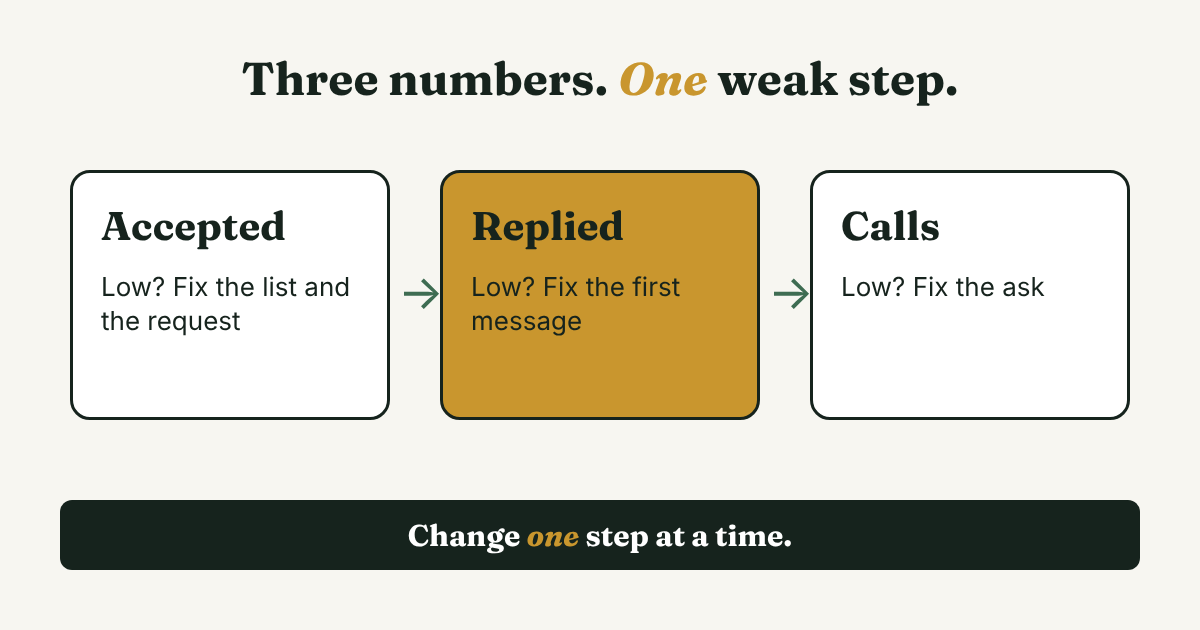
Find the weakest of the three. Each one points at a different step, and a different fix.
- Accepted is low, well under 28%. The problem is before your message: the list, your profile or the request. PhantomBuster's survey found that reps who "always personalize their connection requests are 4–5× more likely" to reach high acceptance, and that reps sending under 25 requests a week were almost twice as likely to reach 40% acceptance as reps sending 26 or more. Both are self-reported, so read them as a hint. The fix is fewer requests to better-fit people, with a note that names something real. LinkedIn connection request message for sales has four notes to edit.
- Accepted is fine, replies are low. The first message is the weak step. Trellus, which sells a calling tool, says "The biggest mistake reps make is pitching immediately after acceptance," and suggests two or three sentences ending in a question. Gong Labs, which analyzed cold email rather than LinkedIn, found that pitching cut reply rates "by as much as 57%." The medium is different, but the lesson carries: ask one question about their work, and leave your product out of message one.
- Replies are fine, calls are low. The ask is weak, or the people who reply cannot buy. Read what they said. If it was "interesting, not my area," the list is the problem again. If they asked questions and you answered at length, offer a specific 15 minutes instead. We found no benchmark for calls booked per reply that sources define in the same way, so your own trend is the number to watch.
- All three look fine, but the total is small. Then the issue is volume or follow-up. The next two sections cover both.
Here is Emeka's October, with made-up numbers to show the math. He sent 60 requests and 14 were accepted, which is 23%. He messaged all 14, two replied, which is 14%. One of the two booked a call. Acceptance sits a little under 28.5%. Replies are fine, though two people is a small sample.
The weak step is the first one. He looked at who accepted: 11 of the 14 owned one or two pharmacies. Most of the other 46 requests had gone to head-office buyers at chains, who do not pick software for a single store. So his November change is one thing: the next 40 requests go only to owners of one to three pharmacies. He leaves the note alone. Changing one step at a time is how he will know what helped.
What does a three-message plan look like?
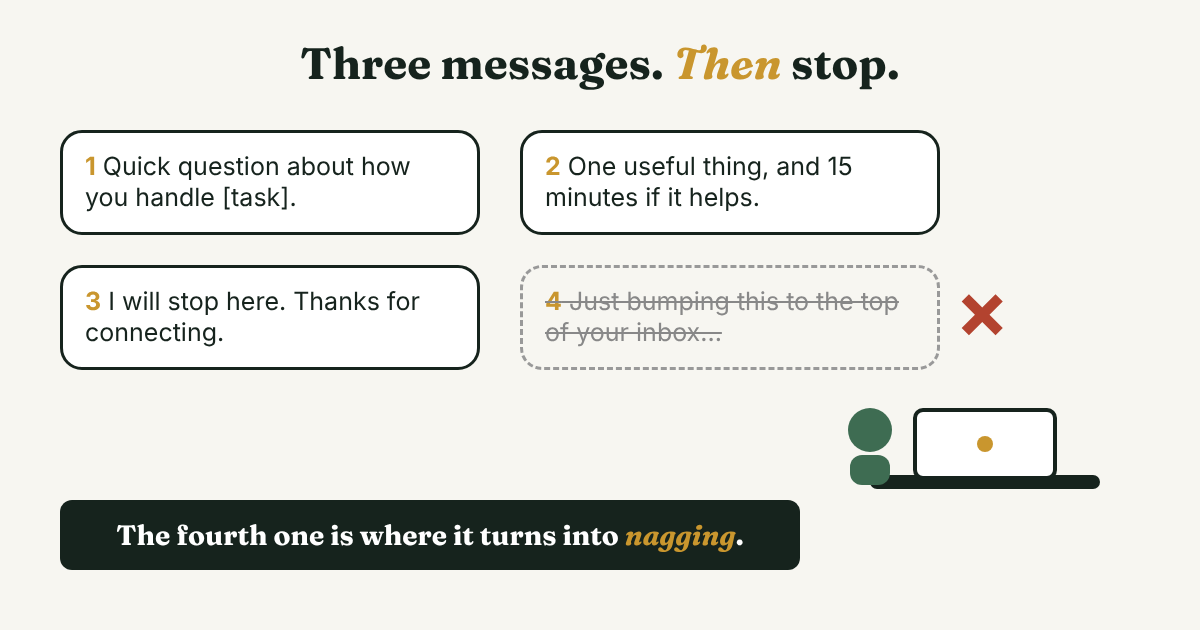
Expandi's H2 2026 report looked at 2,966 campaigns with at least 50 contacts each. The reply rate by number of messages was 6.3% for one, 6.8% for two, 9.8% for three, 7.9% for four, and 5.0% for five or more, which the report calls "worse than sending a single message." It also says the first message after someone accepts has the highest reply rate per send, 8.8%. Expandi labels these findings as association, not proof of cause. Valley, from its own experience, says one or two follow-ups about a week apart, and "A third bump reads as pressure." Trellus suggests five messages over about six weeks. The sources do not agree on the exact count. They agree that a long chain of nudges hurts.
So write three messages, one at a time, to one person each. This is a plan to edit, not a script to paste.
Day 0: the request
Short enough to fit the note box. Name one real reason you picked this person.
Hi [first name], I help [type of business] with [one problem]. I noticed [specific thing: their post, a new location, a role change]. Glad to have you in my network.
Day 2 after they accept: message one
Amplemarket, a sales engagement vendor, suggests waiting 24 to 48 hours after the connection before you write, and keeping the first message under 300 characters. Ask a question. Leave out the pitch.
Thanks for connecting, [first name]. Quick question: how do you handle [specific task] at [company] today? I ask because [one line on why]. No pitch, I'm just learning how [role] do this.
About day 9: message two
Add one useful thing, and make a small, specific offer.
[First name], one more thought on [topic]: [one or two sentences from your own work, such as a mistake you have seen or a short example]. If it helps to compare notes, I can do 15 minutes on [day]. If not, no problem.
About day 16: message three, the last one
Close the loop politely. Don't add a fourth.
[First name], I'll stop here so I don't fill your inbox. If [problem] comes up later, you know where to find me. Thanks for connecting either way.
If anyone replies at any point, drop the plan and answer them like a person, ideally the same day. Then write one line in your log: what they said and what happens next.
When do you stop, and where does the thread go next?
Stop after message three. Write "closed" and the date next to the person's name. Come back in about three months, and only if you have a real reason, such as a post of theirs worth answering or a job change. "Just bumping this" is not a reason.
You may have read that "most deals require five or more touches to close," which is Sales Focus's wording. That sentence is about winning a deal over calls, emails and demos. The page does not say those touches are five LinkedIn nudges to the same person, and Expandi's data suggests that five or more messages in one chain does worse than one. Cognism's own outbound teams averaged 3.36 touches per prospect in 2025.
When a LinkedIn thread goes quiet after message two, Valley suggests moving it to email instead of sending a third bump. Only use an address you found in a normal place, such as the company's own website. Don't guess addresses. Follow-up email or LinkedIn message? How to choose walks through the decision. Amplemarket tells a story about an unnamed twelve-person SDR team whose reply rate went from 1.7% to 8.4% when it put LinkedIn first and email second. That is one team's anecdote, not a study, but it explains why many playbooks start on LinkedIn.
How many people a week is enough?
There is no official number you can read off a LinkedIn page. Salesforge, a sales outreach vendor, says that LinkedIn never publishes an official number and puts what senders see at about 100 requests per rolling seven days. Kondo, a LinkedIn inbox tool, says that sending all 100 in one hour is a red flag. We could not open LinkedIn's own help page, so check it yourself before you rely on any figure. LinkedIn maximum connections per day explains why a weekly view works better than a daily one.
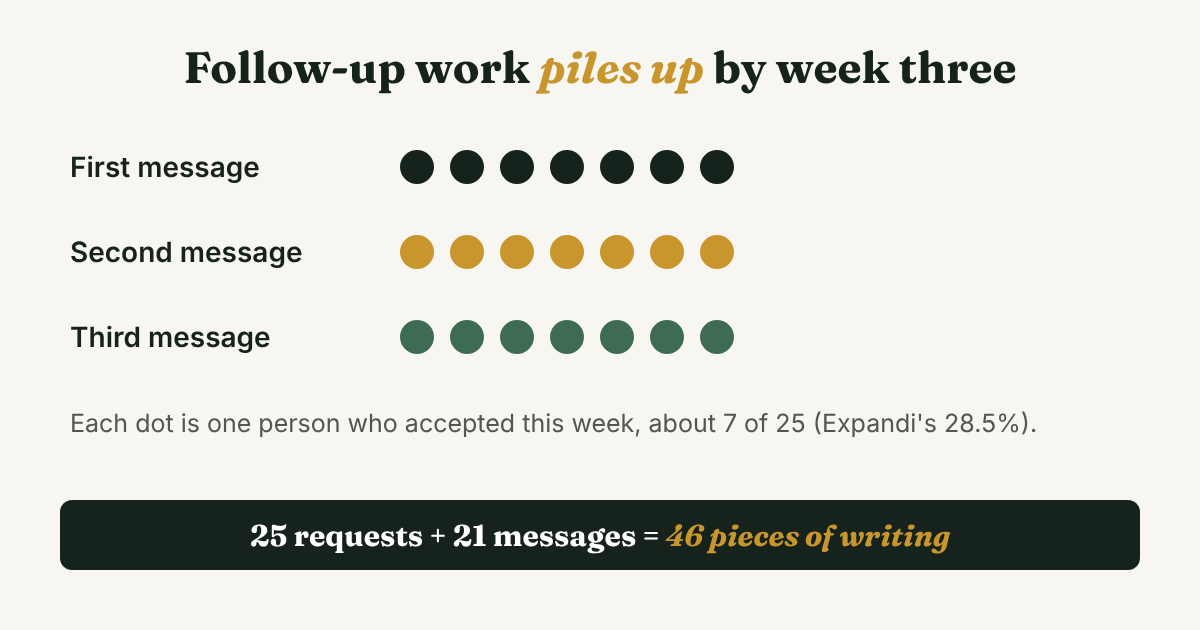
The limit matters less than your capacity to follow up. Here is the arithmetic, using Expandi's 28.5% acceptance and assuming nobody replies, which is the heavy case. You send 25 requests a week. About 7 people accept each week. Each of them needs message one now, message two a week later and message three a week after that. By week three you are writing about 7 first messages, 7 second messages and 7 third messages every week, plus 25 new requests. That is roughly 46 pieces of writing a week from "just 25 people." If you cannot write that well, send fewer requests.
Where does a simple follow-up tracker fit?
Full disclosure: we make GrowthSeeded, a simple follow-up tracker for LinkedIn. It tells you who to message each day, so you don't forget to follow up. In outbound, the people who slip are the ones in the middle of the plan: accepted, no reply yet, message two still unwritten. You send every message yourself, and it never touches LinkedIn. You can count the three numbers in this post by hand in a plain sheet. If you need stages, forecasts or several reps on one list, a CRM is the better tool, and should you use a CRM for LinkedIn follow-ups? covers when.
FAQ
What is LinkedIn outbound sales?
It is the practice of starting contact with people who have not asked to hear from you, using a connection request and then a short message. Sales Focus describes outbound as contact the rep starts "rather than waiting for the prospect to reach out first."
Is outbound or inbound better on LinkedIn?
They do different jobs. Inbound waits for people to raise their hand, outbound reaches people before they do. Apollo's comparison says inbound converts at a higher rate and outbound at a lower one, with no figures to back it. Many sellers do both.
How many follow-ups should you send?
One message after they accept, then one or two follow-ups about a week apart. Expandi's data peaks at three messages and drops at five or more. Valley says a third bump reads as pressure. Pick three and stop.
Is it safe to send 100 requests a week?
Vendors say about 100 a week is what senders observe, but none of the pages we read quoted LinkedIn for it, and Salesforge says LinkedIn publishes no official number. Start lower, space the requests across the week, and check LinkedIn's own pages.
What if someone says they are not interested?
Thank them in one line, write "closed" in your log, and do not send the rest of the plan. A polite no is a useful answer.
Do this today
- Count your last four weeks: requests sent, accepted, messaged, replied and calls booked. Write the three percentages.
- Circle the weakest number and change only that step for your next 20 people.
- Add a next-message date to everyone who accepted and has not replied.
If the follow-ups after message one are the part that slips, GrowthSeeded is a simple follow-up tracker for LinkedIn. Add each person and why they matter, and it tells you who to message today. You send every message yourself, it never touches LinkedIn, and the Free plan holds 5 active people at a time.
Sources
- LinkedIn Outreach Benchmarks 2026: Acceptance, Reply, and Message Response Rates from 13.2M Outreach Attempts, Expandi, May 2026
- The State of LinkedIn Outreach: H2 2026, Expandi, 2026
- The State of Sales on LinkedIn for 2026, PhantomBuster, December 2025
- State of Outbound 2026, Cognism, 2026
- Does cold email even work any more? Here's what the data says, Gong Labs, July 2025
- Why Your LinkedIn Outreach Gets Ignored and the 2026 Reply-Rate Benchmarks, Valley, July 2026
- The multichannel outbound playbook: email, LinkedIn, phone, and AI in 2026, Amplemarket, April 2026
- 7 Ways on How to Use LinkedIn for Prospecting in 2026, Trellus, March 2026
- The Complete Guide to Outbound Sales in 2026, Sales Focus, updated July 2026
- What Is Outbound Sales and How Does It Differ from Inbound?, Apollo, April 2026
- LinkedIn Connection Request Limit in 2026, Salesforge, September 2026
- LinkedIn Weekly Connection Limit: Everything You Need to Know, Kondo, December 2025
About the author
Anisur Rahman Fagun is a marketing and content strategist with more than 9 years of experience in SEO, content, paid advertising and brand growth. He holds a master's degree in mass communication and journalism, and has led content and SEO strategy, built editorial teams and worked with product, design and sales teams. He also builds simple tools that turn marketing data into clear decisions. He writes the GrowthSeeded blog, which shares practical ways to build professional relationships on LinkedIn.