Networking
Networking With Recruiters on LinkedIn: Start Before You Need a Job
14 min read
Key takeaways
- Recruiters work for the employers who pay them, so write to the ones who hire in your field. Pick five to ten, not fifty.
- Your first note says what you do, which roles you want next, and asks one easy question.
- The sources do not agree on how often to write. Our suggestion is every two to four weeks while you search, and about every three months when you do not.
- Every note needs a reason that is not a request: news, a good referral, a reply to their post, or thanks.
- Keep one line per recruiter: what they hire for, what you last said, and the day to write next.
Short answer: Write to a few recruiters who hire in your field. Say what you do and which roles you want, and reply when they write to you, even if you are not looking. Check in every two to four weeks while you search, and about every three months when you do not, each time with news or something useful.
In this article
Why do some people stay on a recruiter's mind?
Which recruiters should you get to know?
What should your first note say?
What should you tell a recruiter so they can place you?
How do you answer a recruiter who writes when you are not looking?
How often should you write?
What can you send that is not a request?
How do you keep track of every recruiter?
What should you skip?
What do we not know?
FAQ
Do this today
Why do some people stay on a recruiter's mind?
Marcus (an example, not a real person) is a product analyst with 600 connections and no job worries. Then his team is cut. He sends the same message to eight recruiters: "Hi! Do you have any openings?" Two reply with a polite no. Six never reply. Marcus did nothing rude. He was just a stranger to all eight.
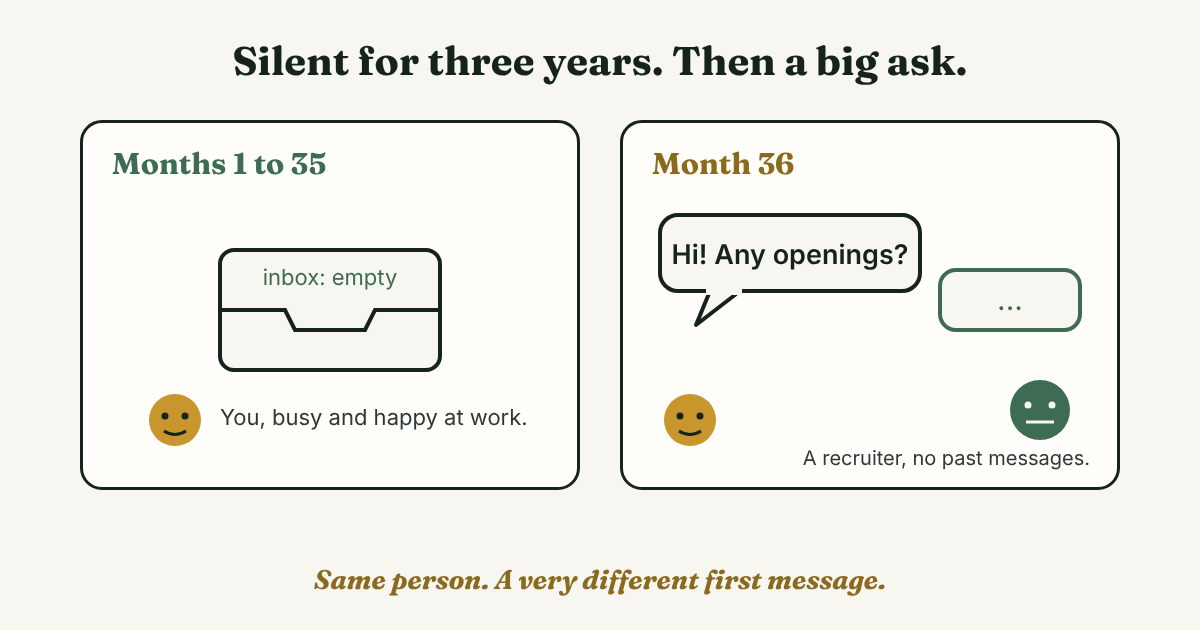
A CNBC piece by a former executive recruiter quotes a recruiter who says strong candidates build good relationships with recruiters when they are not looking for a job, so the relationship already exists when they need help. A career blog from Ivy Exec, posted by the University of Minnesota, calls it one-sided to engage only when you need a job.
It also helps to know who a recruiter works for. The Chronicle of Philanthropy puts it plainly: recruiters work for the employer, not the job seeker. Indeed says an in-house recruiter works for one company, and an agency recruiter fills openings for several. A Boston University Feld Center post goes one step further: if you are not a fit for a recruiter's current search, you are not their priority.
So the goal is not to get a recruiter to find you a job. It is to be the person who comes to mind when a search matches you. That takes small, honest notes over months. This post covers that long game. For one note after you applied or after a call, use our guide to LinkedIn follow-up messages and our post on following up with a recruiter about one role.
Which recruiters should you get to know?
Start with five to ten, not fifty. Pick by what they hire for. A recruiter at a company you would like to join knows that company's roles. An agency recruiter who works in your field sees openings at many companies. Both are worth a note.
Three ways to find them:
- Search LinkedIn for "recruiter" or "talent acquisition" plus your field and your city. Apex Systems suggests searching for those words in your area.
- Ask two people in your network which recruiter has written to them. Apex also suggests asking your network for recommendations.
- Open each profile and read the last few posts. Keep the recruiters whose roles look like yours, and skip the rest. A recruiter quoted by CNBC says writing without doing your research "comes off as lazy."
What should your first note say?
Keep it short and specific. The Feld Center post says to open with one or two sentences on your experience and the problems you solve, name the roles you want next, and end with one low-effort question. It adds that context and relevance matter more than volume.
A note in that shape:
Hi [Name], I'm a [your role] with [number] years in [field]. I work on [one problem you solve]. Over the next year I'm looking at [type of role] roles in [city or remote]. Do you recruit for roles like that, or is there someone on your team who does?
Skip the generic version. The recruiter in the CNBC piece says she gets many messages asking whether a company has openings, and they give her no reason to help. Send the note with your connection request if it fits in the box, or right after they accept. For tone, see our 4-part frame for a professional LinkedIn message, and for what comes after the accept, our message after someone accepts.
What should you tell a recruiter so they can place you?
The Chronicle of Philanthropy says the biggest mistake people make is being vague. A recruiter can only match you to what you have said. Our suggestion, built on that advice, is to be able to say five things:
- The role and level you want next.
- Where: your city, or remote or hybrid.
- Two or three skills you are strongest in.
- What would make you say yes, such as the kind of team or the size of company.
- Pay. The Chronicle says to name a clear minimum instead of saying you are flexible. We would share it when a recruiter asks about a real role, not in a first note.
You do not need all five in the first message. Have them ready for the first call.
How do you answer a recruiter who writes when you are not looking?
Many people ignore these messages. Answering is one of the easiest ways to start a relationship, because the recruiter has already written first. The Feld Center post says to reply even when the timing or the role is wrong: thank them, say whether the role fits your goals, and offer help if it does not.
Be honest about where you are. April Starcadder, writing for The Muse (updated 2020), says her early habit of answering "maybe" strained the relationship when she later said no. What worked was saying she was happy where she was and would like to stay in touch if the recruiter had the time. A note in that spirit:
Hi [Name], thank you for thinking of me for the [role]. I'm happy at [my current job] and not looking right now, so the timing is off. I would like to stay in touch. If you ever recruit for [type of role], I would be glad to talk. If I know someone who fits what you are searching for, I will send you their name.
How often should you write?
The sources do not agree, and none of them tested a number:
- The Ivy Exec post says to follow up once after 5 to 7 business days, and to post something useful every week or two so recruiters see you are active.
- Apex Systems says to send a short update every 2 to 4 weeks while you are looking, and to ask the recruiter how often they like to hear from you.
- A recruiter in the Chronicle piece says she admires people who ping her about every six months.
- The Feld Center post gives no number. It says to check in from time to time with an update or a useful insight.
- Alison Green at Ask a Manager (2010) says weekly check-ins are too much when a recruiter has said they will tell you when something changes. Recruiters in the comments disagreed: one recruiter said he checks in with candidates every week and that a call from a candidate is not a problem.
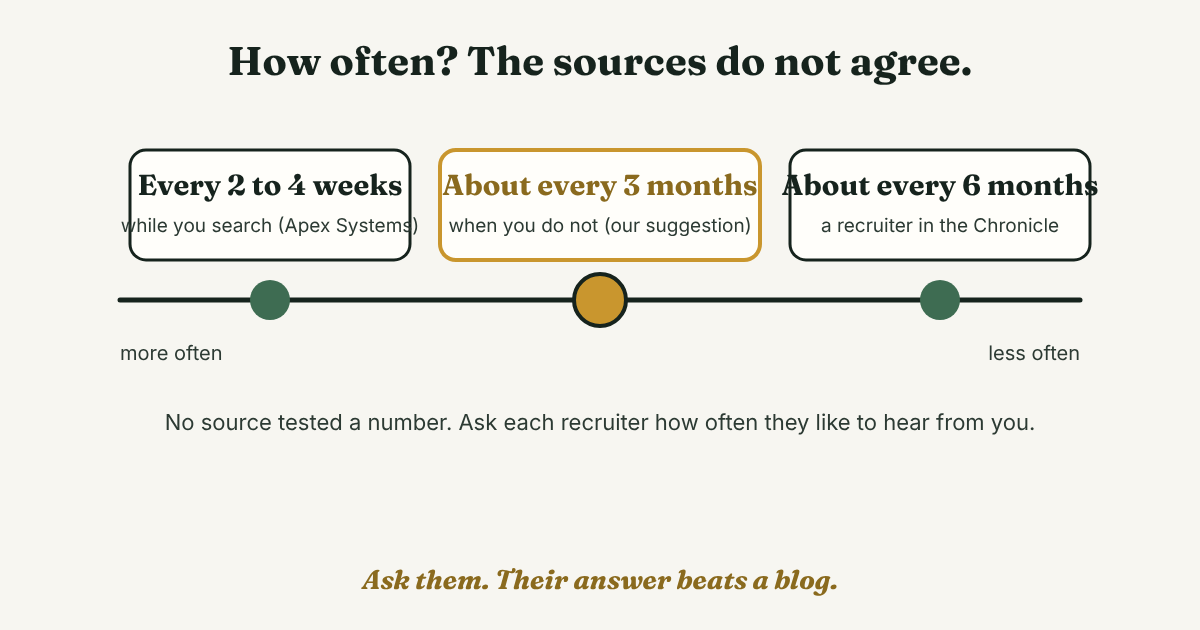
Our suggestion. While you are searching, write every two to four weeks, and ask each recruiter how often they like to hear from you. When you are not searching, write about every three months, and only when you have a reason from the next section. If a recruiter says they will contact you, wait. A recruiter's own answer beats any number from a blog.
What can you send that is not a request?
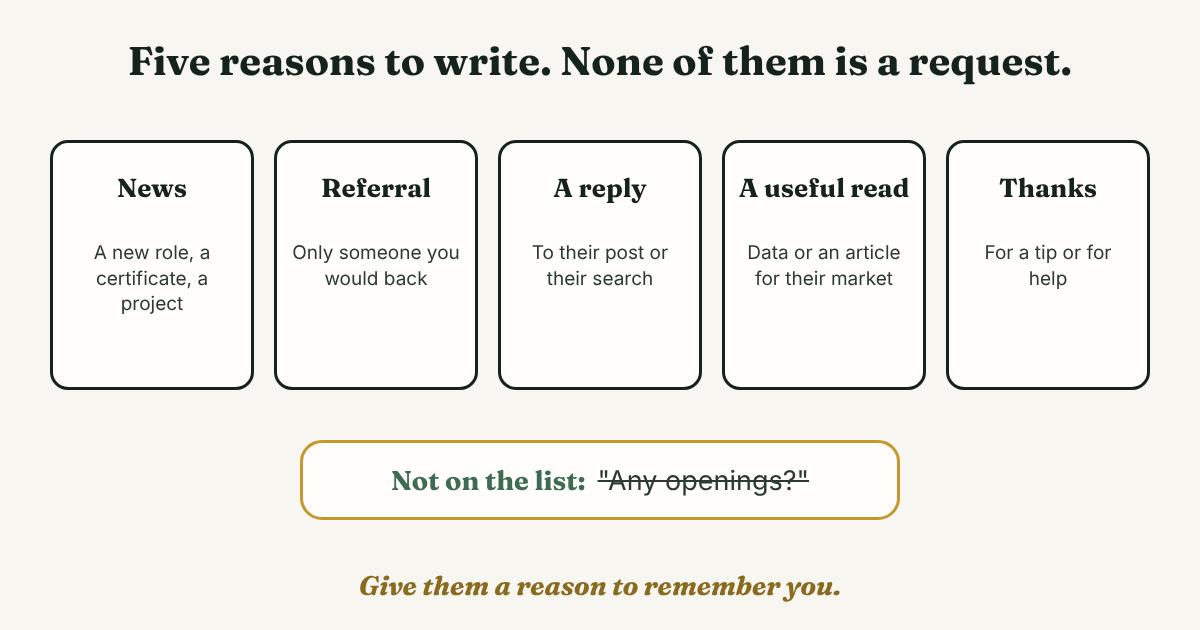
Every note needs a reason to exist. These five come up across the sources:
- News about you. A new role, a certification or a project. Apex and TopResume both suggest sharing new certifications.
- A strong referral. The Chronicle, CNBC, TopResume and the Feld Center all say to refer people to recruiters, but only people who are well qualified for the search. The Feld Center warns that quality beats volume.
- A reply to their post or their search. The Feld Center says to comment when you have something to add, and to write after company news or a published search.
- Something useful for their market. TopResume suggests sending industry data or an article about the company or its field.
- Thanks. Apex suggests thanking a recruiter for a tip or for help, with an email, a card or a post that tags them.
Two notes you can edit. The first is an update:
Hi [Name], a quick update since we last talked in [month]. I [started a new role / finished a certificate / led a project on topic]. I'm [happy where I am / starting to look at [type of role] roles]. If a search comes up in [field], I would be glad to hear about it.
The second is a referral. Ask the person first, and refer them only if you would put your own name behind their work:
Hi [Name], I saw you are recruiting a [role]. A former colleague, [Name], did this work for [time], and I would recommend them because [one specific reason]. Would you like an introduction?
How do you keep track of every recruiter?
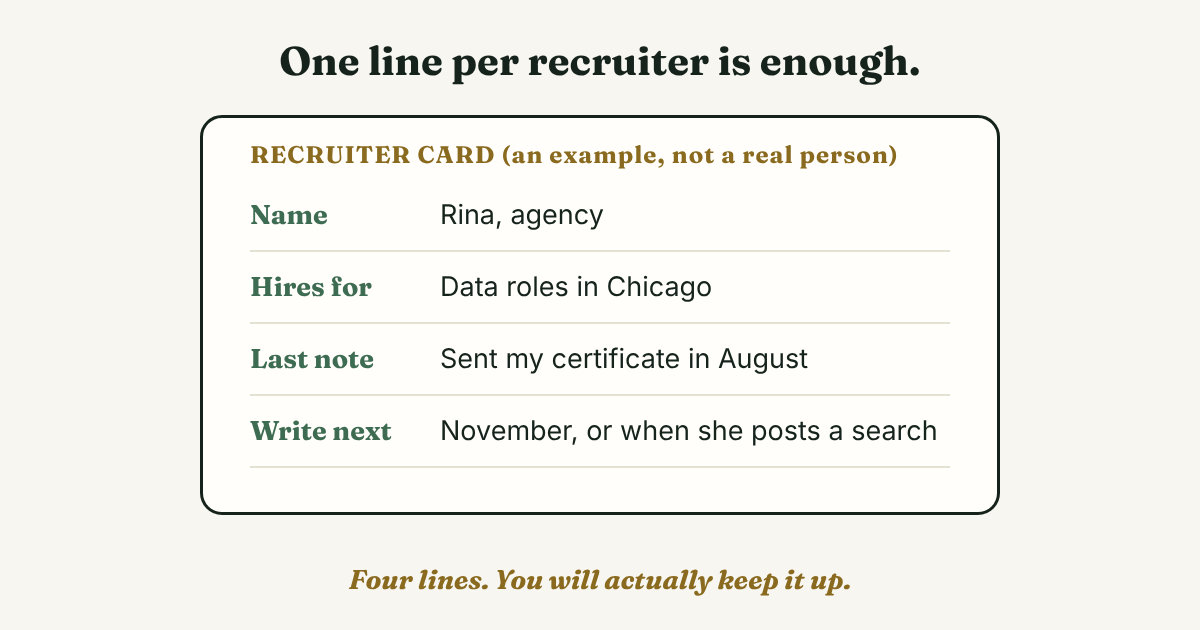
By month five you will not remember which recruiter hires for what. Give each one a one-line card: their name, what they hire for, what you last told them or promised, and the day to write next. Here is a list for Marcus after a year (an example, not a real person):
- Rina, agency, data roles in Chicago. Last: sent my new certificate in August. Next: November, or sooner if she posts a search.
- Tom, in-house at a logistics company. Last: told him I was not looking and offered to refer a friend. Next: January.
- Ana, agency, analytics in Austin. Last: no reply to my update. Next: one follow-up in two weeks, then wait three months.
Full disclosure: we make GrowthSeeded, a simple follow-up tracker for LinkedIn. It fits when you want a note on each recruiter and a list of who to message today. You send every message yourself. It does not find recruiters or write your notes, and a plain spreadsheet works if you keep up with only a few people.
What should you skip?
- Weekly check-ins with nothing new. Ask a Manager says a recruiter who promised to update you may be asking you to back off.
- "Any openings?" with no detail. The CNBC recruiter says it gives her nothing to work with.
- One note pasted to many recruiters. Write each one for the person who will read it. We do not recommend bots or tools that message people for you.
- Referring people who are not a fit. TopResume and the Feld Center both say to refer only qualified people.
- "Maybe" when you mean no. The Muse author found it cost her goodwill later.
- Treating a recruiter as your agent. They work for the employer, so keep your own search going.
What do we not know?
We found no study on how often to write to recruiters, or on whether staying in touch leads to more offers. The advice here comes from career offices, recruiters sharing their own views and a few articles. Several pages show no date, which we say in the sources. We also could not open LinkedIn's help pages, so we make no claim about LinkedIn's limits for notes or messages.
FAQ
How often should you contact a recruiter when you are not job hunting?
About every three months is our suggestion, and only with a reason such as news or a referral. A recruiter in the Chronicle piece likes a ping about every six months. No source tested a number.
Should you connect with recruiters when you are not looking for a job?
Yes. The CNBC piece and the Ivy Exec post both say to build the relationship before you need it. Keep the first note short, name the roles you might want later, and ask one easy question.
Do recruiters mind being messaged on LinkedIn?
They mind generic and frequent messages. Specific, short notes with a reason are what the sources recommend. Preferences differ, so ask a recruiter how often they like to hear from you.
What if a recruiter does not reply?
Follow up once after about a week. The Ivy Exec post says 5 to 7 business days, and Apex allows up to three follow-ups. Our suggestion is one follow-up, then a pause until you have news, about three months later.
Should you turn on Open to Work?
It is a separate choice from networking. Coursera (updated December 2025) says the recruiters-only setting shows your profile only to members who use LinkedIn Recruiter, but LinkedIn cannot guarantee that recruiters at your own company will not see it. Your employer may still find out. Weigh that before you switch it on.
Do this today
- Write down five recruiters who hire for roles like yours. Search "recruiter" plus your field and city.
- Send the first note to one of them, in your own words: what you do, the roles you want next and one easy question.
- Open a list with one line for each recruiter: name, what they hire for, what you last said, and the day you will write next.
Writing to recruiters over a year is mostly remembering who said what. Add each recruiter to GrowthSeeded with a line about your last note, and it tells you who to message each day, so you don't forget to follow up. Five recruiters fit the Free plan, which is $0 for up to 5 active people at once (checked October 2026, and plans change). You send every message yourself, and it never sends anything or touches LinkedIn.
Sources
- How to Stay on Recruiters' Radar Without Spamming, University of Minnesota career blog (from Ivy Exec), 2025 (year from the page address)
- How to Stay on a Recruiter's Radar, Marsha Hebert, TopResume, updated 2024
- How To Stay In Touch With Recruiters, CNBC, checked 2026 (page shows no date)
- Insider Tips to Find and Connect With Recruiters, Feld Center, Boston University Questrom, 2026
- 10 Tips for Better Recruiter Relationships, Erica Woods, Apex Systems, checked 2026 (page shows no date)
- am I annoying my recruiter with weekly follow-up?, Alison Green, Ask a Manager, 2010
- What to Do When a Recruiter Contacts You Out of the Blue, April Starcadder, The Muse, updated 2020
- 11 Tips for Dealing With Headhunters, Heather Joslyn, The Chronicle of Philanthropy, 2016
- Choosing In House Recruitment vs Agency Recruitment, Indeed, checked 2026 (page shows no date)
- How to Let Recruiters Know You're Open on LinkedIn, Coursera, updated 2025
About the author
Anisur Rahman Fagun is a marketing and content strategist with more than 9 years of experience in SEO, content, paid advertising and brand growth. He holds a master's degree in mass communication and journalism, and has led content and SEO strategy, built editorial teams and worked with product, design and sales teams. He also builds simple tools that turn marketing data into clear decisions. He writes the GrowthSeeded blog, which shares practical ways to follow up and stay in touch with people on LinkedIn.