Networking
LinkedIn Follow-Up Message After You Apply: 4 Examples
10 min read
Key takeaways
- Start the clock from the posting, not from your click. If the posting names a date or says not to follow up, do what it says.
- With no timeline, the sources we read suggest waiting about one to two weeks, then sending one short message.
- Write to the recruiter or hiring manager for that role, one person, in your own words. Do not guess names or write to a whole team.
- Pick the first line by your situation: not connected, connected, past a closing date, or a rejection you want feedback on.
Short answer: After you apply, wait about 7 to 14 days unless the posting says otherwise. Then send one LinkedIn message to the recruiter or hiring manager. Name the role and the date you applied, add one reason you fit, and ask one question about next steps. If you hear nothing, stop and keep applying.
In this article
- Why does the wait after applying feel so long?
- When should you send a follow-up message after applying?
- Who should you write to?
- Should you use LinkedIn or email?
- What should the message include?
- What are four examples you can edit?
- What should you skip?
- Where does a tracker fit?
- FAQ
- Do this today
Why does the wait after applying feel so long?
You click submit, and then nothing happens. No reply, no status, just a quiet inbox. Silence is easy to read as a no, but often it is not. The role may still be open, or the reader may be busy.
A follow-up message gives you one calm way to act while you wait. It is not a push for an answer. The University of Arizona says the point is to "draw their attention to your application if it has not already been reviewed."
If your moment is different, see our guides to the follow-up after connecting and the follow-up after a career fair.
When should you send a follow-up message after applying?
The sources we read do not agree on one number, so here is what each one says.
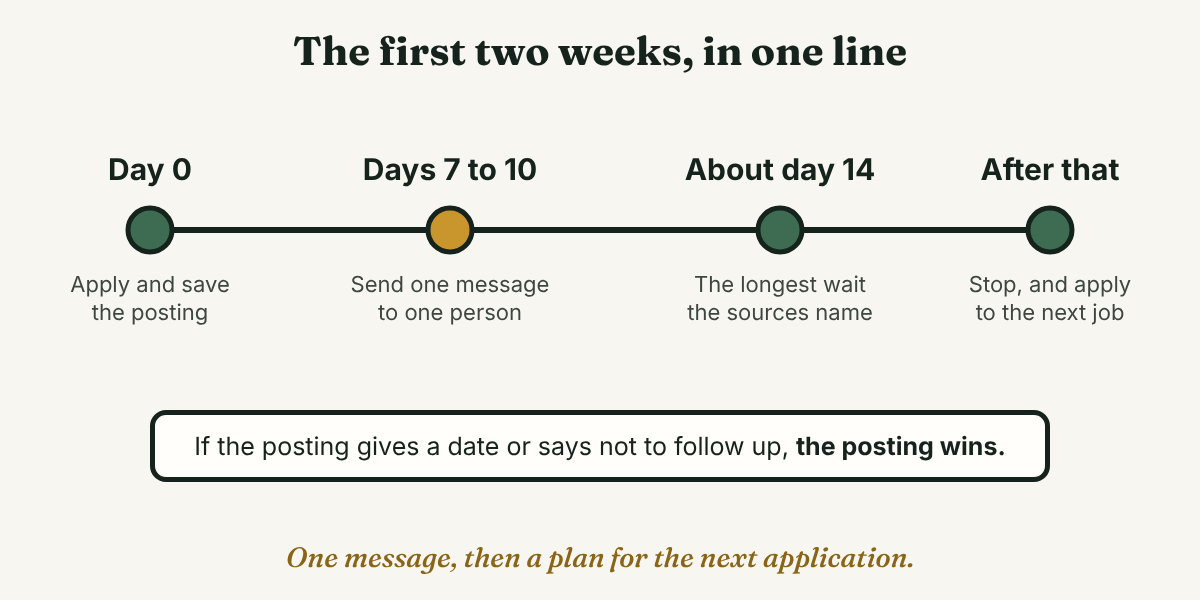
- UNLV Career Services: wait about 7 to 10 days, "unless the posting specifies a timeline."
- Handshake: wait about one week after you apply.
- MyCareersFuture (Singapore): 5 to 10 business days after you apply. If the posting has a closing date, wait one week after that date.
- University of Arizona and Coursera: wait about two weeks.
Our reading: the range is one to two weeks, and the posting beats every rule. Coursera adds one check: reread the posting first, because some companies ask applicants not to follow up. If yours does, do not send a message.
A simple plan: save the date you applied, and set a reminder for day 10. If the posting gives a closing date, set it for one week after that date instead.
Who should you write to?
Write to the person responsible for the role. Arizona says to contact the recruiter, and that you can find the name on the company website or on LinkedIn. Coursera says the hiring manager is the person responsible for filling the open position, and suggests checking who posted the job and looking them up on LinkedIn.
Our suggestion: use the name on the posting, or the person whose title matches the role. If you cannot tell who it is, do not guess. Write to one person, not several people at the same company.
Should you use LinkedIn or email?
The sources lean toward email, and they make room for LinkedIn in different ways.
- UNLV calls email the most common follow-up method and says a LinkedIn message is acceptable if you have connected with the recruiter, the hiring manager or the interviewer.
- Handshake calls email typically preferred and says LinkedIn works if the company is active there, with a personalized connection request and a brief note.
- Coursera mentions LinkedIn as the way to message the hiring manager when no email is listed.
- MyCareersFuture says to email or call first, and to move to LinkedIn only after the hiring manager agrees in that email.
So LinkedIn fits in two cases: you are already connected, or you have no email address. If you have both, our guide on choosing between a follow-up email and a LinkedIn message walks through the choice.
What should the message include?
Keep it to four short parts. UNLV says to keep messages short and not to restate your whole application.
Step 1: Name the role and the date
Say which job you applied for and when. The date helps them find yours, and UNLV's sample includes it.
Step 2: Add one reason you fit
Arizona says to restate your interest and explain why you would be a strong candidate. Handshake agrees, and says to do it briefly. One line is enough: one skill or one project that matches one line in the posting.
Step 3: Ask one question
Ask about the timeline or the next step, as UNLV suggests. Do not ask for an interview.
Step 4: Thank them and stop
Close with a thank you and your name. Do not add a second ask.
What are four examples you can edit?
Here is one example for each situation. Pick the one that matches yours. Change every part in [brackets], and send each one to one person.
1. The posting names a recruiter, and you are not connected
Send a connection request with a short note. The note box on a connection request is small, so check what your screen allows and keep it brief.
Hi [Name], I applied for the [role] position on [date] and would like to connect. My work on [one project] fits [one line from the posting]. Thank you for your time.
2. You are already connected
Send a message about 7 to 10 days after you apply, or on the day the posting gave.
Hi [Name], I applied for the [role] position on [date] and wanted to check in. I am still very interested, especially in [one part of the role]. Could you share where the team is in the process? Thank you, [Your name]
3. The posting has a closing date
Wait until one week after the date, as MyCareersFuture suggests. Before then, the team may not have started reading.
Hi [Name], I applied for the [role] position before the [closing date] deadline. I know the team may still be reviewing applications. When you have time, could you tell me when applicants will hear next? Thank you, [Your name]
4. You got a no, and you want to learn from it
Arizona says a rejection message is a good moment to thank the sender, ask for feedback, or say you want to hear about similar roles. It also says some companies have policies against sharing feedback, so make the ask easy to decline. Reply to a message from a person, not to a no-reply address.
Hi [Name], thank you for letting me know about the [role]. If your team can share it, I would value one piece of feedback on my application. I am still interested in [kind of role] at [company] and will watch for new openings. Thank you, [Your name]
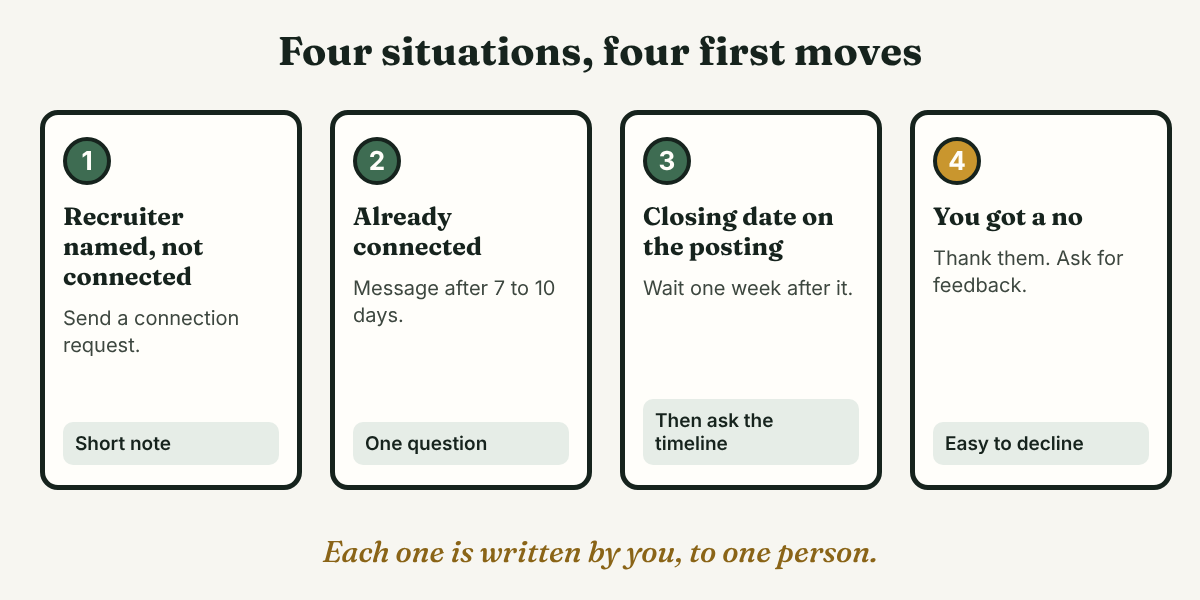
Each example names the role, adds one detail and asks for very little.
What should you skip?
Skip these:
- More than one follow-up. If there is no reply after one message, use your time on the next application.
- Messages every few days. Handshake warns against being overly persistent or seeming desperate.
- Messages to several people about one job. Pick the one person who owns the role.
- Retelling your whole application. UNLV says not to restate it. Link your LinkedIn profile if they want more.
- Phone calls. UNLV says to call only if the employer gave a number and encouraged calls.
- Tools that send for you. We never recommend automation, bots or mass messaging for notes like these. Write each one yourself.
Where does a tracker fit?
Full disclosure: we make GrowthSeeded, a simple follow-up tracker for LinkedIn. It does not write your message, send it, or touch LinkedIn. It helps with the part around the message: who you wrote to, which job it was about, and when to check back. You add each person, write a note after each conversation, and a due-today view shows who to follow up with. The next step comes from what happened, such as an accepted connection or a reply, not from a fixed date.
Prices, checked October 25, 2026: Free is $0 for 5 active people at a time (up to 20 when friends join through invites), Pro is $15 a month or $150 a year, and Max is $29 a month. They change.
If you apply to only two or three jobs, a notes app with the apply date is enough.
FAQ
How long should you wait to follow up after applying?
About one to two weeks. UNLV says 7 to 10 days, Handshake says about one week, and Arizona and Coursera say about two weeks. If the posting gives a timeline or a closing date, follow that.
Should you follow up on LinkedIn after applying?
Yes, if you are connected with the recruiter or hiring manager, or if no email address is listed. Otherwise the sources lean toward email first.
What should you say in a follow-up message after applying?
Name the role and the date you applied, add one reason you fit, and ask one question about next steps. Keep it short. UNLV advises against restating your application.
How many times can you follow up on a job application?
Once is usually enough, according to UNLV. Handshake allows another after a reasonable time, without seeming desperate. In our view, one is the safe choice.
What if the posting says not to follow up?
Do not send a message. Coursera says some companies ask applicants not to follow up, so reread the posting before you write.
Do this today
- Open the posting for one job you applied to, and look for a timeline, a closing date or a note about follow-ups.
- Write the apply date in your notes and set a reminder for day 10, or one week after the closing date.
- Find the one person who owns the role, and write three or four sentences in your own words from the example that matches your situation.
The hard part is remembering which job, which person and which date. In GrowthSeeded you can add the recruiter, write down what you applied for, and see on the due-today view when it is time to check back. You send every message yourself. It never sends anything or touches LinkedIn, so your account stays safe. If you only have a few applications, the Free plan covers 5 active people.
Sources
- How to Follow Up After Applying for a Job, University of Arizona Center for Career Readiness, 2022, updated 2026
- Following Up, UNLV Career Services & Workforce Development, 2026
- How to Follow Up on Job Applications, Handshake, checked 2026
- How to Effectively Follow Up on Your Job Applications, CareersCompass by MyCareersFuture, 2017
- How to Follow Up on a Job Application, Coursera, 2024
About the author
Anisur Rahman Fagun is a marketing and content strategist with more than 9 years of experience in SEO, content, paid advertising and brand growth. He holds a master's degree in mass communication and journalism, and has led content and SEO strategy, built editorial teams and worked with product, design and sales teams. He also builds simple tools that turn marketing data into clear decisions. He writes the GrowthSeeded blog, which shares practical ways to follow up and stay in touch with people on LinkedIn.