Networking
Networking With Colleagues: 5 Small Habits That Work
11 min read
Key takeaways
- A good week of networking with colleagues is one small contact: a specific thank you, a useful link, or a question that takes two minutes to answer.
- Start with five to eight names: people you rely on, people two steps away on other teams, and someone who knows how things really work.
- Ask small. Research summarized by Knowledge at Wharton found that a few helpful people carry a large share of the valuable collaboration, so make your ask easy to answer.
- Skip office politics with one test: would you be fine if they saw why you asked and what you said about them?
- Write one line about each talk, so the next one starts where the last one ended.
Short answer: To network with colleagues, pick five to eight people outside your daily circle and make one small contact a week: thank someone for something specific, share a useful link, or ask for a 15 minute talk about their work. Give before you ask, keep asks small, and write down what you learn about each person.
In this article
Why network with the people you already work with?
Who should you connect with first?
What does one small contact a week look like?
How do you ask for help without being a burden?
How do you keep it from feeling political?
What about remote and hybrid colleagues?
How do you keep track of who you talked to?
FAQ
Do this today
Why network with the people you already work with?
Sam (an example, not a real person) has worked on the same product team for two years. When a launch stalled on a question about billing data, he did not know anyone in finance. He spent three days asking around to learn who owned the report. The answer was a person two floors away who would have replied in two minutes.
Networking with colleagues is not about climbing over them. It is about knowing, before you need it, who does what and how they like to be asked. If you are still building your network outside work, start with our guide to building a professional network. This post covers the people down the hall, and the ones you never see.
Distance grows by default. A study in Nature Human Behaviour of more than 61,000 Microsoft employees found that working from home made workers more siloed in how they communicate. It measured meetings, emails and messages at one company, so it cannot tell you what happens at yours. It does match what Sam found.
Gallup asks one question about this in its engagement survey: "I have a best friend at work." In a 2019 article, Gallup reports that employees who strongly agree are 37% more likely to say someone encourages their development. That is an association, Gallup sells the survey, and the article gives no sample size, so take it as a hint, not a promise. You do not need a best friend at work. You need people who know your name and what you do.
Who should you connect with first?
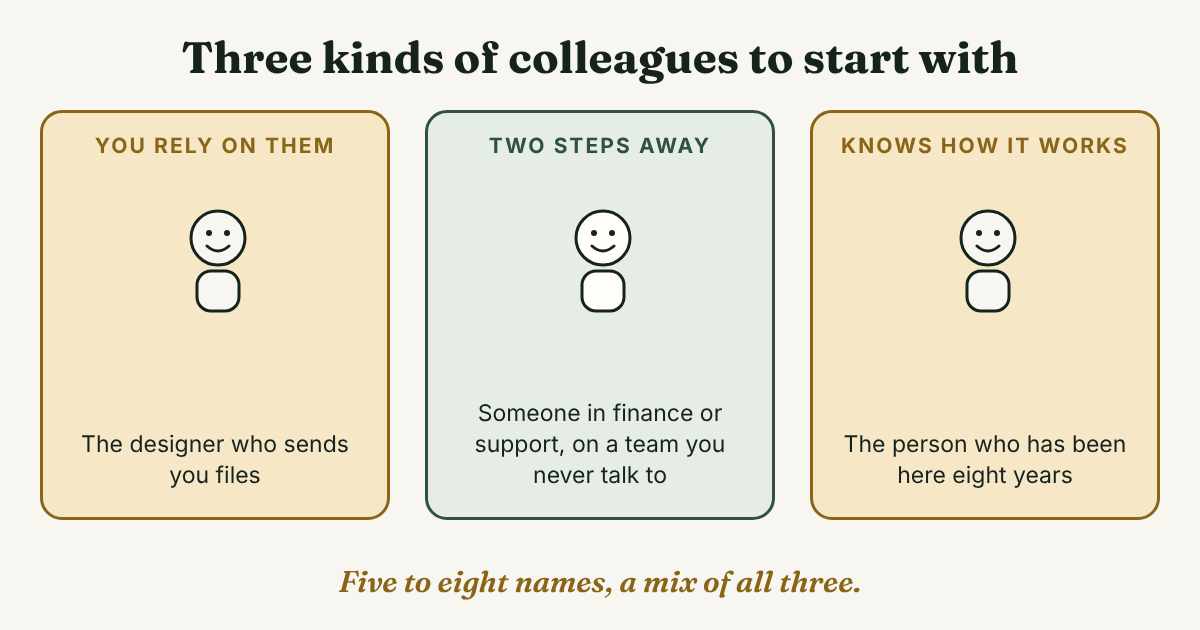
Write five to eight names. Mix three kinds of people:
- People you rely on. The designer who sends you files, or the analyst whose numbers you use.
- People two steps away. Someone in finance, support or legal, on a team you never talk to.
- People who know how things work. Someone who has been at the company for years and knows who owns what.
One line per person is enough: [Name], [team], I rely on them for [thing] or I could help with [thing], last talked [month]. Sam's first line was: Bianca, billing analyst in finance, two steps away, I could tell her which launch dates affect her reports, never talked.
If you want all your contacts on one page, not just colleagues, see our guide to mapping your professional network.
What does one small contact a week look like?
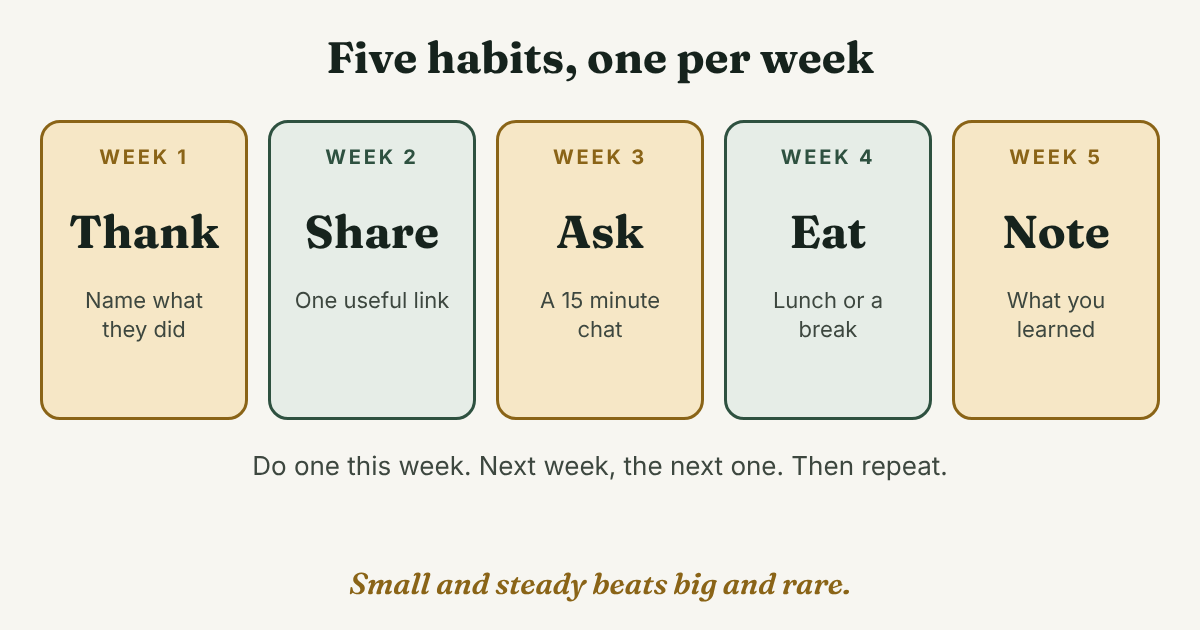
Here are five habits. Do one a week, in any order, then start again. Each takes 15 minutes or less.
Habit 1: Thank someone for something specific
"Thanks for your help" is easy to forget. A specific thank you shows what they did and what it let you do: Thanks for [what they did]. It saved me [time or work], and I used it to [result].
Habit 2: Share one useful thing
When you read something that fits a colleague's work, send it with one line: Saw this and thought of your work on [topic]: [link]. No need to reply. The last sentence matters. It gives them the link without giving them a chore.
Habit 3: Ask for a 15 minute talk about their work
This is the habit that reaches people two steps away. Name the reason and the length, and offer a way out: Hi [Name], I work on [team]. I keep running into [topic] and do not understand how your team handles it. Could I ask you three questions over 15 minutes, in person or on a call? A short written answer works too if that is easier. Then ask what they would like your team to know. That question turns a favor into an exchange. If this is your first job, our guide to networking tips for young professionals has more ways to start.
Habit 4: Eat or take a break together
A Washington State University researcher, Rebecca Portnoy, interviewed faculty members and custodians about sharing a family-style meal at work. They said the freedom to talk removed them from certain work constraints, and she described the meal as a space where hierarchy matters less. It was a small interview study, so it shows what people said, not a measured result.
A Rutgers-led study adds a caution. It surveyed 183 new hires at one university in 2016. Men who talked with coworkers and went to lunch or happy hour reported feeling more supported and integrated at 60 and 90 days. Women who made the same effort did not. The lead author suspects gender stereotypes, but the study did not test that.
What to do with that: do not judge a habit by one person's reaction, and do not rely on one setting. Lunch, coffee, a walk and a short call all count. Spread the effort across several people, and pick the setting that suits you and them. A happy hour is optional.
Habit 5: Follow up on what they said
People notice when you remember. Next time, bring it up: You mentioned [thing] last month. How did it go? This is also the easiest way to make a second talk feel natural, because you have a reason to start it.
How do you ask for help without being a burden?
The most helpful person at your company is probably tired. In a 2016 Harvard Business Review article on collaborative overload, Rob Cross, Reb Rebele and Adam Grant reported that, as Knowledge at Wharton summarizes it, up to a third of value-added collaborations come from only 3% to 5% of employees, and those people become bottlenecks. The summary does not say how "value-added" was measured, so read the numbers as a range.
The same summary suggests offering 30 minutes instead of an hour, with a clear end time. For a first ask, go smaller. Three things make an ask easy to answer: one question, a stated length, and a way to decline. The easiest ask is one a colleague can answer with a link. When you can, also ask a second or third person, not only the obvious expert.
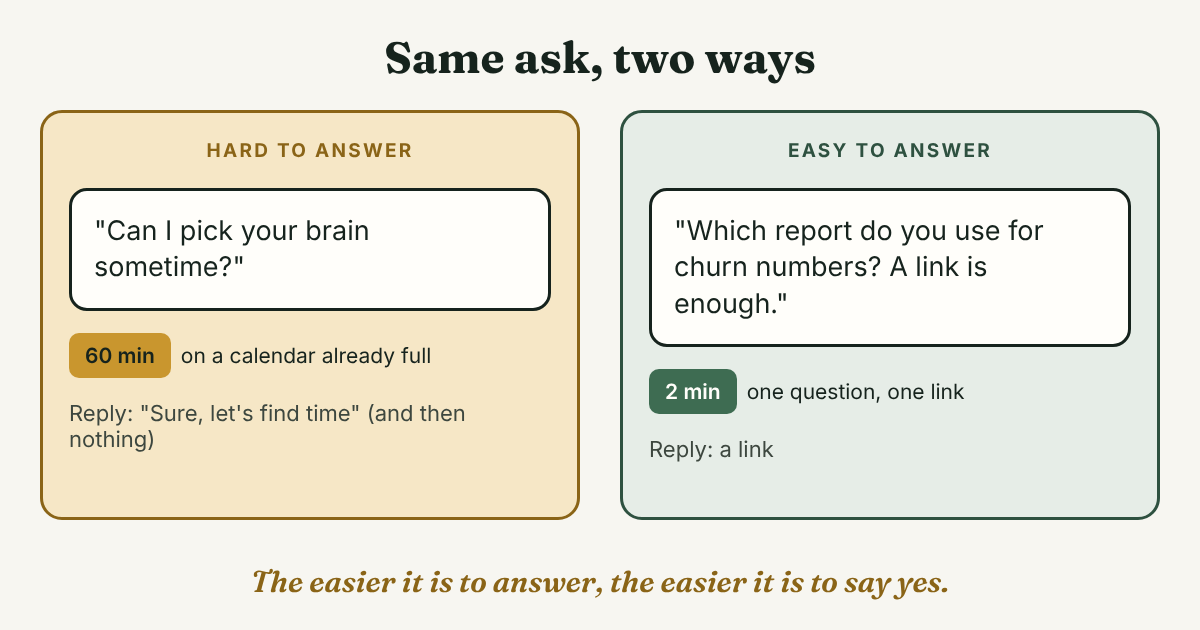
A quick test before you send: could they answer this on their phone, in two minutes, without a meeting? If not, shrink it.
How do you keep it from feeling political?
Here, office politics means working people for your own gain, at their cost. You can see the difference in what you do, not only in what you intend. Four rules help:
- Say why you are asking. "I am trying to understand how billing reports work" is honest. A vague "let's connect" invites guessing.
- Give credit where others can see it. Name the person who helped in the thread, the meeting or the update.
- Do not carry stories between people. What a colleague tells you about someone else stays there.
- Do not ask for a favor in a first talk. Learn first. Ask later.
Outside-work invitations need extra care. In a 2025 Harvard Business Review article, Kristie Rogers and Beth Schinoff write that connecting with colleagues outside work can create closer personal ties and stronger bonds, and that blurring work and personal boundaries carries real risks. We could open only the abstract. Our advice: keep invitations short, in daytime, and easy to decline, and let the other person choose how personal to get.
What about remote and hybrid colleagues?
Put it on the calendar, because nobody will bump into you. A 15 minute video call with three questions you sent in advance works as a coffee. Thank people in the shared channel by name. When a project ends, send a short note to the person two steps away who helped, with one line about the result.
How do you keep track of who you talked to?
After each talk, write one line: the date, one thing they said, and one small next step. A notes page is enough. Add a column for "last talked" so you can see who has gone quiet. Colleagues also move teams and companies. When one leaves, LinkedIn is often how you stay in touch, and our guide to LinkedIn follow-up messages shows how to write to someone you already know. For how these connections turn into roles and references, see networking for career advancement.
A notes page fits people you see every week. Full disclosure: we make GrowthSeeded, a simple follow-up tracker for LinkedIn. It fits better for the colleagues who move on: you write a note after each conversation, and a due-today view shows who is waiting for a follow-up. It does not find people or write messages for you.
FAQ
Is it okay to network with colleagues at my own company?
Yes. It means getting to know people and what they do, and being useful to them. It becomes a problem only when it is vague about why you are asking or it asks for favors too early.
How do I network with colleagues without office politics?
Say why you are asking, give credit in public, keep other people's stories to yourself, and save favors for later. If you would be uneasy about the person seeing what you said about them, change what you do.
How do I network with colleagues when I work remotely?
Schedule short calls, send your questions ahead, and thank people by name in shared channels. Remote work can make communication more siloed, so reaching across teams takes a deliberate step.
How often should I contact a colleague?
We found no research number. Our suggestion is one small contact a week across different people, and a light touch about once a month for any one person. Follow what they seem to welcome.
Should I invite a senior colleague for coffee?
You can. Ask a small question about their work, name the length, and make it easy to decline. Do not ask for a favor in the first talk. Learning how they got where they are is a good first topic.
Do this today
- Write five to eight colleagues, one line each, mixing people you rely on, people two steps away and someone who knows how things work.
- Pick one person and send a specific thank you, or one question they can answer with a link.
- Set a 10 minute reminder for Friday to write one line about what you learned from each talk this week.
Colleagues change teams and companies, and the follow-up is the part that slips. GrowthSeeded keeps a note for each person and a list of who is due for a message, so a thank you or a check-in does not depend on memory. You send every message yourself, and it never sends anything or touches LinkedIn. The Free plan is $0 for 5 active people at a time (checked October 2026, and plans change).
Sources
- The effects of remote work on collaboration, Berkeley Haas newsroom, summary of a study in Nature Human Behaviour, checked 2026
- How a Best Friend at Work Changes Engagement in Higher Ed, Stephanie Marken, Gallup, 2019
- New on the Job? Study Finds Men, Not Women, Are Rewarded for Getting to Know Their Coworkers, Rutgers University, 2024
- The Company That Eats Together, Washington State University Magazine, 2012
- Too Much Togetherness? The Downside of Workplace Collaboration, Knowledge at Wharton, 2017 (on a 2016 Harvard Business Review article by Rob Cross, Reb Rebele and Adam Grant)
- The Best Ways to Connect With Colleagues Outside of Work, Kristie Rogers and Beth Schinoff, Harvard Business Review, 2025 (abstract on Marquette University's repository)
About the author
Anisur Rahman Fagun is a marketing and content strategist with more than 9 years of experience in SEO, content, paid advertising and brand growth. He holds a master's degree in mass communication and journalism, and has led content and SEO strategy, built editorial teams and worked with product, design and sales teams. He also builds simple tools that turn marketing data into clear decisions. He writes the GrowthSeeded blog, which shares practical ways to follow up and stay in touch with people on LinkedIn.