Networking
Networking Events for Young Professionals: A First-Night Plan
11 min read
Key takeaways
- Pick a small event with some structure, such as a talk or a volunteer shift, for your first one. An open mixer is harder when you know no one.
- Set one goal you control: two real conversations. Two university guides we read use a target of about that size.
- Arrive early and start with someone who is standing alone. Rooms are easier to enter before the crowd builds, and people on their own are there to talk too.
- Plan your exit before you walk in: wait for a natural pause, say thank you, and move on.
- Write three lines about each person the same night, and send one short note within two days.
Short answer: A networking event for young professionals is easier when you plan the night. Pick a small event with some structure, aim for two real conversations, arrive early, start with someone standing alone, leave each talk at a natural pause, and send each person one short note within two days.
In this article
Which networking events for young professionals should you go to first?
What should you do before you go?
How do you start a conversation when you know no one?
How do you leave a conversation politely?
What do you do after the event?
What if the night feels awkward?
FAQ
Do this today
Which networking events for young professionals should you go to first?
Marcus (an example, not a real person) is 24 and three months into his first job. A coworker sent him a link to a young professionals mixer on Thursday evening. He bought a ticket, and then he spent two days wondering what he would say to a room of strangers.
If you are still deciding how to start networking at all, our seven ways for young professionals to start come first. This post is about the night itself: what to do before, during and after one event.
Events with this name come in a few kinds: open mixers and happy hours, talks and panels, volunteer days, and group activities such as trivia nights. Our guide to young professionals networking groups sorts them into social, career and giving back, and shows how to read an event list before you join.
Our rule of thumb for a first event is to choose a small one with a structure, such as a talk, a workshop or a volunteer shift. A structure gives you something to talk about when you know no one. Dorie Clark, quoted by the World Economic Forum in 2015, gives similar advice: if big events feel uncomfortable, "go to small events." We found no study that compares event types, so treat this as a starting point, not a finding. For help choosing by goal, see our guide to professional networking events.
What should you do before you go?
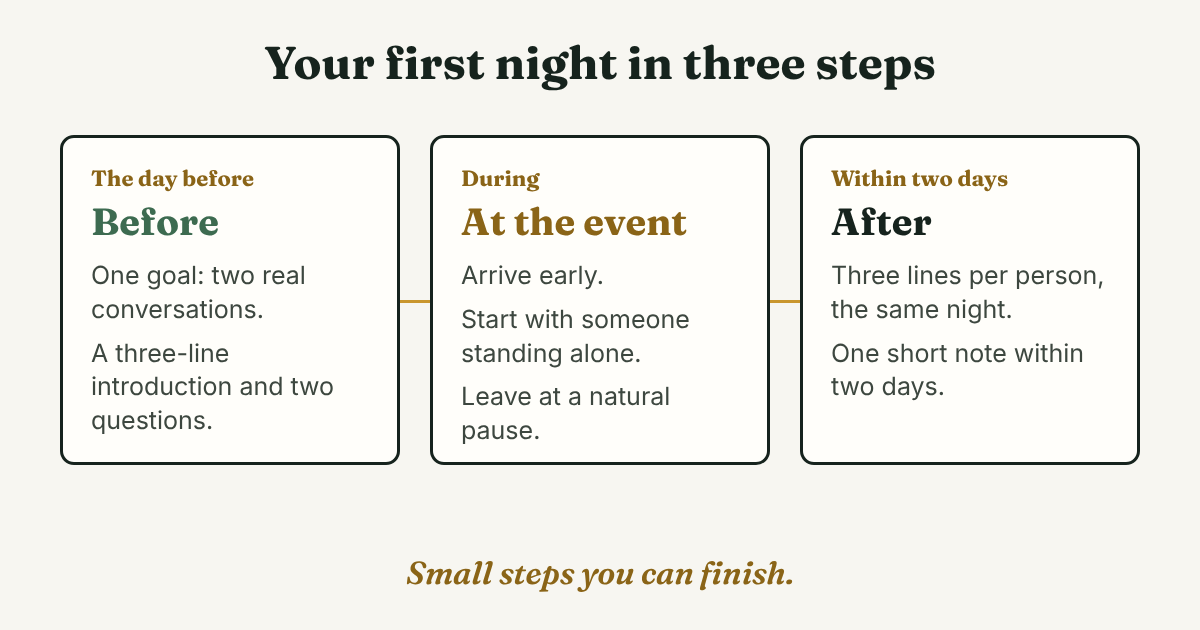
Give it ten minutes the day before. Three things are enough:
- One goal you control. A Georgetown Law guide for introverts suggests "having good conversations with 2 or 3 people that could lead to follow-up." An Oregon State career services post suggests the goal "I will have at least two successful conversations before I go." Two is a goal you can finish, and it keeps you from trying to talk to the whole room.
- Two names or two topics. Read the host's event page, and the guest list if there is one. The University of Twente advises picking out people you want to talk to and looking up their background. If there is no list, read the speaker's bio or the host group's last event page, and write down two things you could ask about.
- A three-line introduction. A University of Ottawa career blog suggests giving your name, your field and your purpose for being at the event. Twente adds a useful warning: do not only mention what you study. Add an interest or a goal.
Here is a version to edit:
Hi, I am [name]. I work in [field] at [company], and I started in [month]. I came because [one reason, such as a talk topic or a friend's invitation].
Then write two questions you want answered. For example: What brought you to this event? and What is the most useful thing you have learned in your first year? Keep your expectations small. Twente notes that you do not have to secure a job by the end of your first three conversations.
How do you start a conversation when you know no one?
Arrive early. The Georgetown guide notes that conversations are easier before many people have arrived, and suggests taking a small task, such as greeting guests at check-in, so you talk to people one at a time. You can ask for it in your reply to the organizer: Hi [Name], I am coming on Thursday. If you need a hand at check-in, I am happy to help. They may say no, and the question costs one line.
Then find someone who is alone. The Ottawa page says to look for another attendee on their own, "since they are also there to make connections." Ingrid Byerly, quoted in the World Economic Forum piece, goes further: "You go up to someone who looks the most nervous and you ask them about themselves." A person alone near the food or by the door is the easiest start. Say:
Hi, I am [name]. Is this your first one of these?
Then give your three-line introduction, ask one of your two questions and listen for something to ask about next. Byerly also says quiet moments are not a weakness. You do not have to fill every silence.
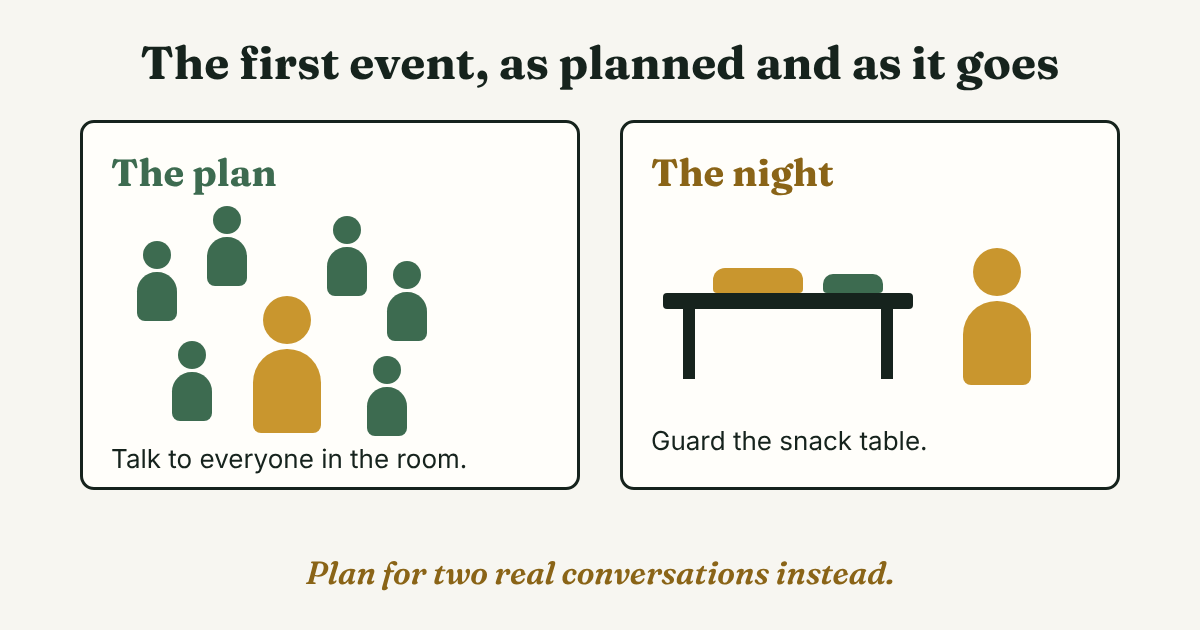
Do not stay in your own huddle. A career development handout from the University of Northwestern in St. Paul puts it as "Break out of the friend huddle!" If you came with a coworker, agree to split up for the first hour and compare notes after. That is our suggestion. For a group that is already talking, the same handout says to wait for a lull before you say your name.
How do you leave a conversation politely?
This is the step people skip, so plan it before you walk in. The Northwestern handout says to wait for "a natural pause in the conversation," thank the person or group, excuse yourself and move on, and it warns that hurried exits can be remembered badly. The Georgetown guide gives one example line: "I'll let you get to that, but I look forward to speaking with you again soon." Here are two more to edit:
- It was good to talk with you about [topic]. I am going to say hello to a few more people. Can we connect on LinkedIn?
- I do not want to keep you from [the speaker, the food, other guests]. Thank you for the tip about [topic].
One line and a name is enough. You do not need a reason.
What do you do after the event?
Several guides we read say little about this part. The Ottawa page has nothing on it, and Twente suggests talking the night over with friends. Georgetown says to contact people "shortly after the event," and Oregon State's page adds more: file each business card with notes about the person and your conversation, send a thank-you email that mentions specifics, ask to connect on LinkedIn, and later invite the person to coffee.
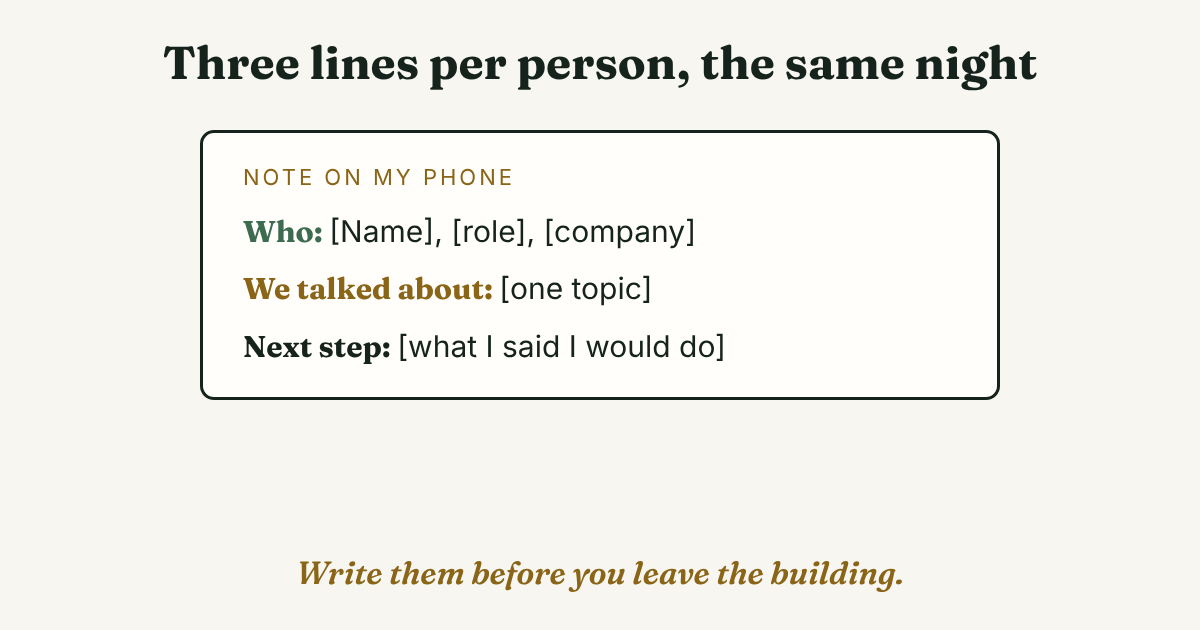
The same night, write three lines per person. Use your phone before you leave the building: who they are, what you talked about, and what you said you would do. If you said you would send a link, that is the next step.
Within two days, send one short note. The two days are our suggestion, based on the advice above to write shortly after the event. Write each note yourself, one person at a time:
Hi [Name], it was good to talk with you at [event] about [topic]. I found [one thing they said] useful, and I am going to try [action]. I would like to stay in touch.
If you also send a LinkedIn request, add a line to it: Hi [Name], we talked at [event] on [day] about [topic]. I would like to connect. Our guides to a follow-up message after a career fair and a message after you connect have more wording to edit.
A notes page is enough for four or five people. Full disclosure: we make GrowthSeeded, a simple follow-up tracker for LinkedIn. It fits when the people you talked to become LinkedIn connections and you want a note for each one and a list of who is due for a message. It does not find events for you, and it does not write the message.
What if the night feels awkward?
A 2018 paper in Psychological Science, summarized by the Association for Psychological Science, reported five studies of the "liking gap." On average, people who talked with a new partner liked that person more than they believed the partner liked them. In one study the gap lasted for months among roommates. The summary we read does not give sample sizes, and the authors' explanation, that people are more self-critical when another person is present, is a hypothesis. Still, it is a useful thing to remember on the way home: the other person probably liked the talk better than you think.
If you have one good conversation and want to go home, that is a result. Write the three lines, and try again at the next event.
FAQ
What are networking events for young professionals?
They are events for people early in their careers, run by hosts such as chambers of commerce, professional societies, employers and local groups. They range from open mixers to talks, workshops and volunteer days. Each host sets its own rules, so read the event page first. Our guide to young professionals groups lists the age limits we found.
What are social events for young professionals?
They are evenings with no program, such as happy hours, mixers and game nights. In our view they are a good place to make friends and a harder place to start a work conversation, because there is no shared topic. Try one after you have been to a talk or a volunteer day.
Should I go alone or with a friend?
Both can work. The University of Twente suggests going with friends to make the event less daunting, and the University of Ottawa suggests approaching someone who is on their own. A middle way is to arrive together and split up for the first hour.
How many people should I talk to?
Two real conversations is enough for a first night. Georgetown suggests 2 or 3, and Oregon State suggests at least two.
How soon should I follow up?
Georgetown's guide says shortly after the event. We suggest within two days, while both of you still remember the talk.
Do this today
- Find one small event with a talk or an activity in the next two weeks, and register.
- Write your three-line introduction and two questions in a note on your phone.
- Reply to the host and ask whether they need a hand at check-in.
If you leave the night with four new names, GrowthSeeded can hold them. Add each person you connect with on LinkedIn, write one note about what you talked about, and the due-today view shows who to write to next, based on what happened. You send every message yourself, and it never sends anything or touches LinkedIn. The Free plan is $0 for up to 5 active people at once (checked October 2026, and plans change).
Sources
- Tips for attending your first networking event alone, Telfer School of Management Career Centre, University of Ottawa, 2019
- How to prepare for a network event, University of Twente, 2025
- How to prepare for a networking event, Oregon State University Career Services, no date shown, checked 2026
- Networking Tips for Introverts, Georgetown University Law Center, 2020
- 10 Tips for Networking Events, University of Northwestern, St. Paul, no date shown, checked 2026
- 5 strategies to master small talk, April Dudash, World Economic Forum, 2015
- You Probably Made a Better First Impression Than You Think, Association for Psychological Science, 2018
About the author
Anisur Rahman Fagun is a marketing and content strategist with more than 9 years of experience in SEO, content, paid advertising and brand growth. He holds a master's degree in mass communication and journalism, and has led content and SEO strategy, built editorial teams and worked with product, design and sales teams. He also builds simple tools that turn marketing data into clear decisions. He writes the GrowthSeeded blog, which shares practical ways to follow up and stay in touch with people on LinkedIn.