Networking
Networking Activities for Professional Development: Pick by Goal
11 min read
Key takeaways
- Choose the goal first, then the activity. A mixer with no goal gives you cards and no next step.
- Five small activities cover most goals: an informational chat, one question to a possible mentor, a note to an old contact, a short skill share, and one small job in a professional group.
- Keep each ask small and clear: 15 to 30 minutes, one question, one topic.
- About an hour a week is enough to start. That number is our estimate, not a study's.
- One meeting is not enough. Write one line about each person and the day to write next.
Short answer: Pick one growth goal, then one activity that fits it. To learn a field, ask for a 15 to 30 minute chat. To get advice, ask a possible mentor one small question. To find fresh ideas, write to an old contact. To be seen, share a skill in a short session. An hour a week is enough.
In this article
Why do so many networking activities lead nowhere?
Which activity fits which goal?
How do you ask for an informational chat?
How do you ask a possible mentor for advice?
Who should you write to first, a new person or an old one?
How can you share a skill without feeling like a speaker?
What about joining a professional group?
How much time does this take?
How do you keep track of who you talked to?
What should you skip?
What do we not know?
FAQ
Do this today
Why do so many networking activities lead nowhere?
Marcus (an example, not a real person) goes to a networking mixer every month. He brings cards, talks to six people and goes home with a pile of names. Six months later, nothing has changed in his work. He never decided what he wanted from any of it.
That is the common mistake: the activity comes first and the goal comes later. The University of Kansas School of Business says to enter conversations knowing what you hope to get out of them, and that one meeting is not enough. Its list names activities, such as joining a professional organization and scheduling informational interviews, but gives no time for any of them. Here, each activity has a goal and a number of minutes.
If your network is still small, start with our guide to building a professional network from zero, then come back to pick your activities.
Which activity fits which goal?
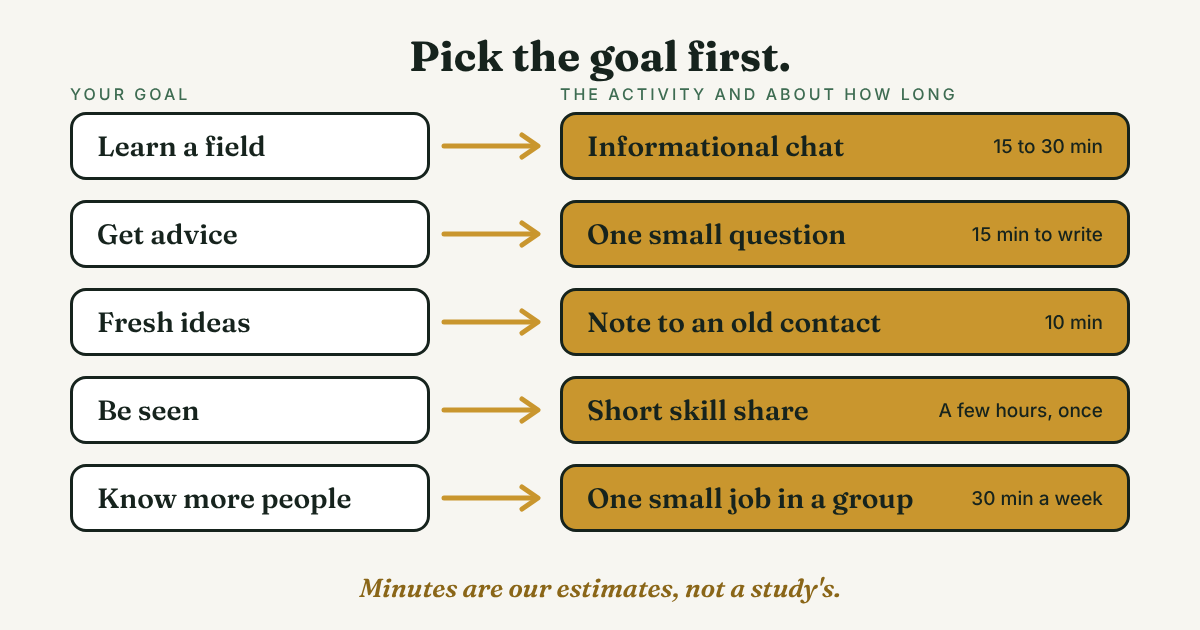
Choose one goal for the next month, then pick from this list. The pairing is our suggestion, and the minutes are our estimates.
- Learn a field or a role. Ask for an informational chat. About 15 to 30 minutes on the call.
- Get advice on a decision. Ask a possible mentor one small question. About 15 minutes to write it.
- Find fresh ideas, or a way back into a field. Write to someone you lost touch with. About 10 minutes.
- Be seen for your work. Share one skill in a short session. A few hours once.
- Know more people in your field. Join one professional group and take one small job. About 30 minutes a week.
Pick one or two, not all five.
How do you ask for an informational chat?
An informational chat is a short talk where you ask someone about their work. It is not a request for a job. The career office at the Harvard Graduate School of Education says most run 15 to 30 minutes, that 5 to 7 questions are enough for 30 minutes, and to email first with a short introduction and your reason. Boise State says to follow up with thanks and the key takeaways.
A request you can edit:
Hi [Name], I'm a [your role], and I'm curious how you moved into [their area]. I read [one specific thing they wrote or did]. Could I ask you five questions in a 20-minute call? I can do [day] or [day]. If this is a busy month, no problem.
Choose questions that serve your goal. Two good ones: "What does a normal week look like?" and "What do people new to this get wrong?" Then thank them within a day:
Thank you for the 20 minutes, [Name]. Your point about [one thing] changed what I will do this week: [one step]. I'll write again when I have news.
How do you ask a possible mentor for advice?
Do not ask "Will you be my mentor?" A slide deck from the mentorship program at Oregon Health & Science University (Brenda G. Campbell) advises against it. It says to ask for something bounded: one question, a review of one document, or a 20-minute talk on one topic. Include who you are, what you want, why you picked this person, a thank-you, and how they can learn more about you.
A note in that shape:
Hi [Name], I'm a [role] with [length of time] in [field]. I'm choosing between [option A] and [option B], and you made a similar move in [year]. Could I ask you one question about it, by email or in 20 minutes on a call? Thank you for considering it. My LinkedIn profile is [link], in case it helps.
If it goes well, write again after you try their advice and tell them what happened.
Who should you write to first, a new person or an old one?
Do one of each in the same month. They help in different ways.
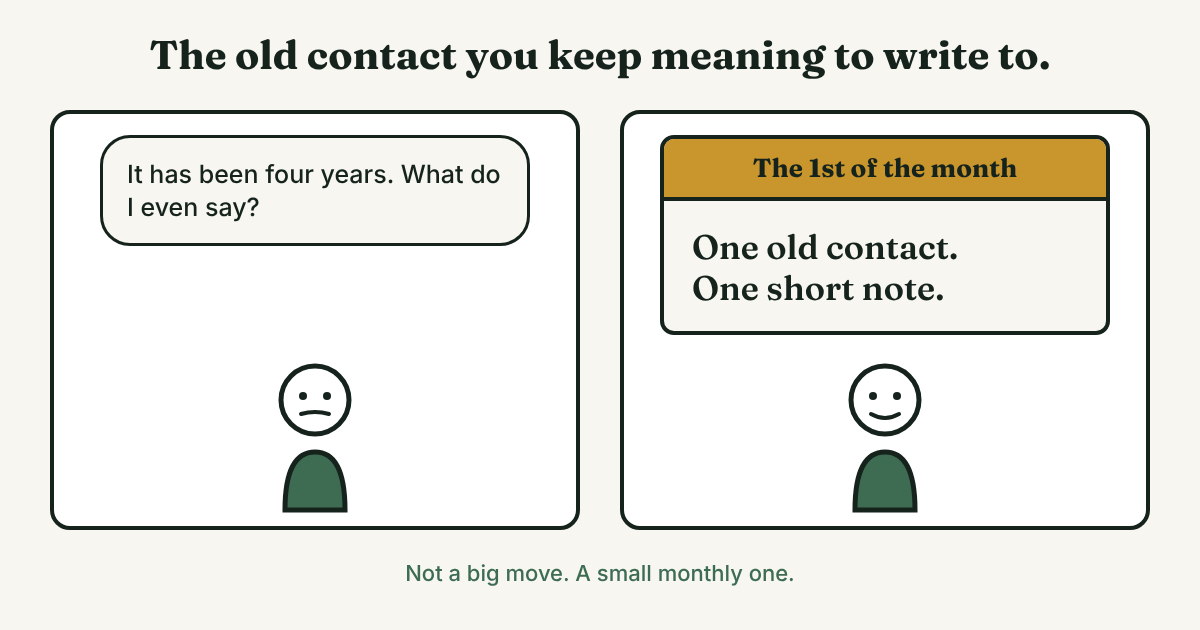
Old contacts are the easier ask. A Wharton Leadership Center summary of research by Daniel Levin, Jorge Walter and Keith Murnighan says "dormant ties", people you have not talked to for three or more years, can be easier and faster to ask for advice than weak ties, because of "a residue of trust built up from past interactions." They also have new experiences since you last talked. The summary names no study years, and it is not the papers. Its tip: set a monthly calendar reminder to reconnect with one person.
New people matter too. In a five-year LinkedIn experiment with about 20 million users, MIT News (2022) reports that weak ties were, on average, more useful for job mobility than strong ties. It measured job changes on LinkedIn only, and several authors worked at LinkedIn.
A note to someone from your past:
Hi [Name], it has been a few years. I was thinking about [the project or team you shared], and wondered how things are going with [what they do now]. I'm working on [one thing] these days. Could we trade a few updates, by message or in a short call?
How can you share a skill without feeling like a speaker?
Being known for one useful thing makes it easier for people to write to you. At the MIT Press, colleagues teach a skill they already have in a 45-minute session with Q&A, about four to six times a year, as Gabe Harp describes in The Scholarly Kitchen (2021). He says the hardest part is convincing colleagues they have something worth sharing. His account is anecdotal, with no metrics.
Our smaller version is 15 minutes, at a team meeting or a group's online call. Pick one thing people ask you about, such as how you set up a weekly report. Show it once, take questions, and share a one-page note. The people who asked questions are the next people to write to. For small habits at work, see networking with colleagues.
What about joining a professional group?
The University of Kansas list includes joining a professional organization and volunteering. We found no study that shows which works best. One small job beats paying dues and staying quiet: ask the organizer for one task, such as welcoming new members. It gives you a reason to talk to the same people next month. Our guide to professional networking events shows how to pick and follow up.
How much time does this take?
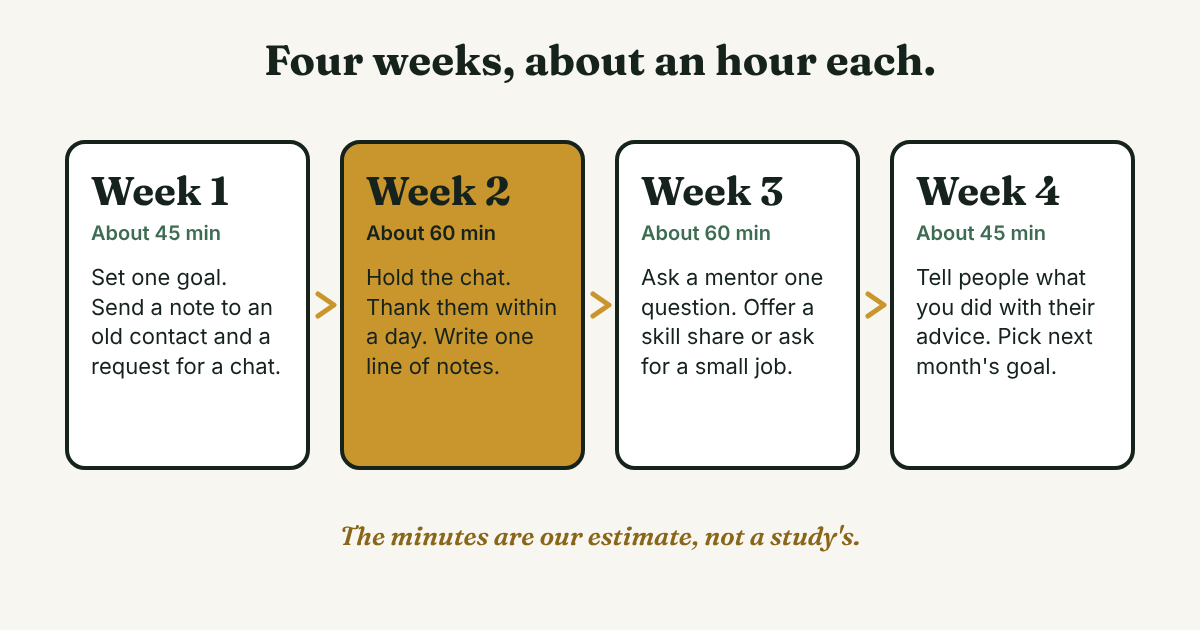
About an hour a week. This plan is our suggestion, not a study's.
- Week 1, about 45 minutes. Write your goal in one sentence. Send one note to an old contact and one request for a chat.
- Week 2, about 60 minutes. Hold the chat, thank them within a day, and write one line of notes.
- Week 3, about 60 minutes. Send one question to a possible mentor. Offer a 15-minute skill share, or ask a group for one small job.
- Week 4, about 45 minutes. Write to the people who replied and tell them what you did with their advice. Pick next month's goal.
For a plan that ties networking to a career move, see networking for career advancement.
How do you keep track of who you talked to?
After four weeks you may have five or six names and a few open loops. The University of Kansas page says to save each contact's information and what they offer, and to revisit them. One line per person is enough: where you talked, what they said, what you promised, and the day to write next. Three examples (not real people):
- Rana, former teammate. Wrote November 3. She is on a new pricing project. Next: ask how it went, December 3.
- Tom, informational chat on October 28. Said new analysts should learn SQL first. I promised to tell him which course I picked. Next: November 20.
- Elif, one question about a job offer. Said to ask about team size. Next: tell her what I decided.
Full disclosure: we make GrowthSeeded, a simple follow-up tracker for LinkedIn. You add a person and a note after each talk, a due-today view shows who to message, and the next step follows what happened, such as a reply. You send every message yourself. For a handful of people, a plain spreadsheet works too.
What should you skip?
- Activities with no goal.
- One big ask. "Will you be my mentor?" is the example the OHSU deck warns against.
- One note pasted to many people. Write each one for the person who will read it. We do not recommend mass messages or tools that send for you.
- Going quiet after a good talk. A missed follow-up is how most of these chats go nowhere.
What do we not know?
We found no study that compares these activities or says how many minutes a week works best, so the weekly plan is ours. The Wharton piece is a summary, and the weak ties study covers LinkedIn job changes only. The mentor deck is written for trainees. Check group fees and event times yourself.
FAQ
What are good networking activities for professional development?
Five that need little time: an informational chat, one question to a possible mentor, a note to an old contact, a short skill share, and one small job in a professional group. Pick by your goal.
How often should you do networking activities?
We suggest about an hour a week. The Wharton summary suggests a monthly reminder to reconnect with one person. We found no study that sets a number.
What if nobody replies?
We suggest one polite nudge after about a week, then ask someone else. That is a rule of thumb, not a study's finding.
Do this today
- Write one goal for this month in a single sentence.
- Pick one activity from the list and one person. Send the note.
- Write one line about that person: why you wrote, what you asked, and the day to write next.
Small asks add up to a lot of names fast. Add each person to GrowthSeeded with a line about what they said, and it tells you who to message each day, so you don't forget to follow up. Free is $0 for up to 5 active people at a time (checked October 2026, and plans change). You send every message yourself, and it never sends anything or touches LinkedIn.
Sources
- Nano Tools: Finding New Ideas: The Value of Connecting and Reconnecting, Wharton Leadership Center, 2015
- The power of weak ties in gaining new employment, Peter Dizikes, MIT News, 2022
- Informational Interviewing, Career Services Office, Harvard Graduate School of Education, checked 2026 (page shows no date)
- Informational Interviewing, Boise State University Career Center, page last modified December 2025
- Finding a Mentor That Fits, Brenda G. Campbell, Oregon Health & Science University, slides dated September 2024 and March 2026
- Guest Post: A Model for Peer-to-Peer Workplace Learning, Gabe Harp, The Scholarly Kitchen, 2021
- Networking, University of Kansas School of Business, checked 2026 (page shows no date)
About the author
Anisur Rahman Fagun is a marketing and content strategist with more than 9 years of experience in SEO, content, paid advertising and brand growth. He holds a master's degree in mass communication and journalism, and has led content and SEO strategy, built editorial teams and worked with product, design and sales teams. He also builds simple tools that turn marketing data into clear decisions. He writes the GrowthSeeded blog, which shares practical ways to follow up and stay in touch with people on LinkedIn.