Networking
Thank-You Email After an Interview: 3 Examples
10 min read
Key takeaways
- Send the thank-you email within 24 hours if you can. Most sources we read treat 48 hours as the upper limit.
- Keep the subject line short and plain: a word of thanks, the role, and the date or your name.
- Write three or four sentences with one specific thing you talked about, and send a separate note to each interviewer.
- A LinkedIn link in your email signature is enough for most people. A short LinkedIn note adds something only in a few cases.
Short answer: Send a short thank-you email within 24 hours of the interview. Use a plain subject line such as "Thank you: [Role] interview on [Date]". Write three or four sentences with one specific detail, send one note to each interviewer, and put your LinkedIn link in your signature instead of sending a second message.
In this article
What does a thank-you email after an interview need to do?
What subject line should you use?
When should you send it?
What goes in the email?
What are three examples you can edit?
Does LinkedIn add anything after the email?
What should you skip?
Where does a tracker fit?
FAQ
Do this today
What does a thank-you email after an interview need to do?
The interview is over, and now there is an empty email and a few small choices. What goes in the subject line? How long should you wait? What if three people interviewed you?
A thank-you email has one job: to thank the person for their time and remind them who you are. Northeastern's career office calls email "standard and expected" and says to send a note to each person who interviewed you. Northeastern also says to avoid re-interviewing yourself or adding work for the interviewer.
This post covers the email. For the channel question, see our guide to the follow-up message after an interview on LinkedIn. For the whole picture across email and LinkedIn, start with our guide to follow-up messages and when to send each one.
What subject line should you use?
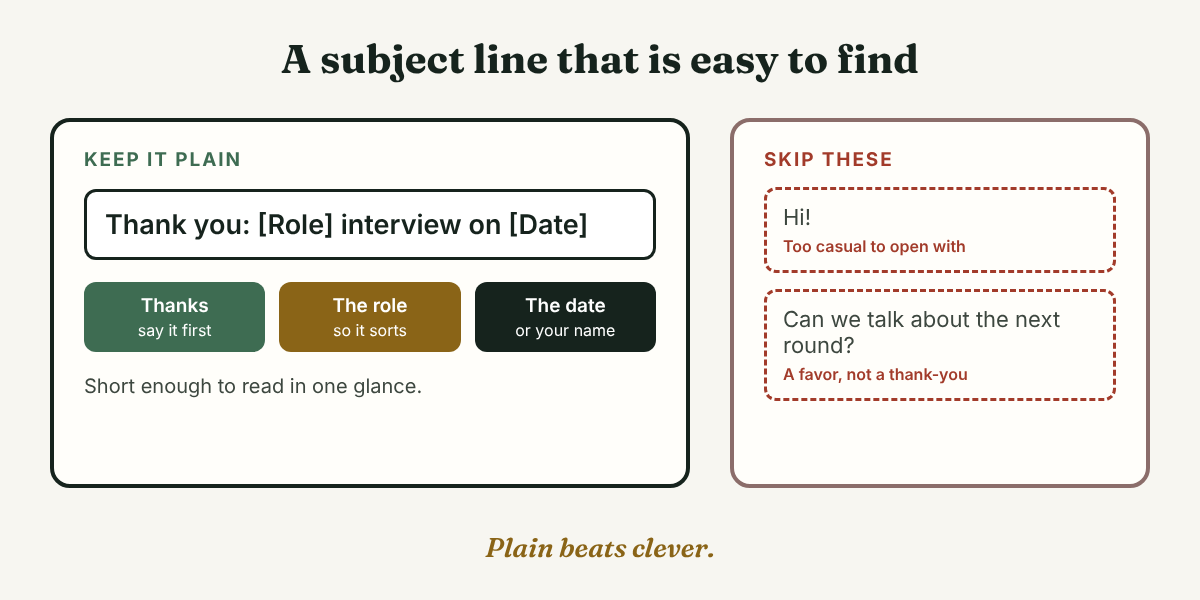
The subject line is the first thing the interviewer reads, and the sources we opened agree on one idea: keep it short and plain. Built In quotes career coach Wendy Saccuzzo: simple, streamlined subject lines work best. Northeastern suggests a pattern with three parts: thank you, the role, and the date.
Here are subject lines that fit what the sources describe:
- After a first interview, Built In lists "Thank You for the Interview" and "Interview Follow-Up - Thank You."
- For later rounds, Built In lists "Thanks for the Conversation" and "Appreciated Your Time Yesterday," and warns not to let casual become too casual.
- Mississippi State, republishing The Muse, lists "Thank you for your time" for a same-day note and "Thank you for the opportunity" for a next-day note.
Rutgers-Newark adds two warnings: skip an opening such as "Hi," which it says feels informal, and do not ask for a favor in the subject line. Our reading: put the role or the date in the line so the email is easy to find later, and keep your name in the sender field.
When should you send it?
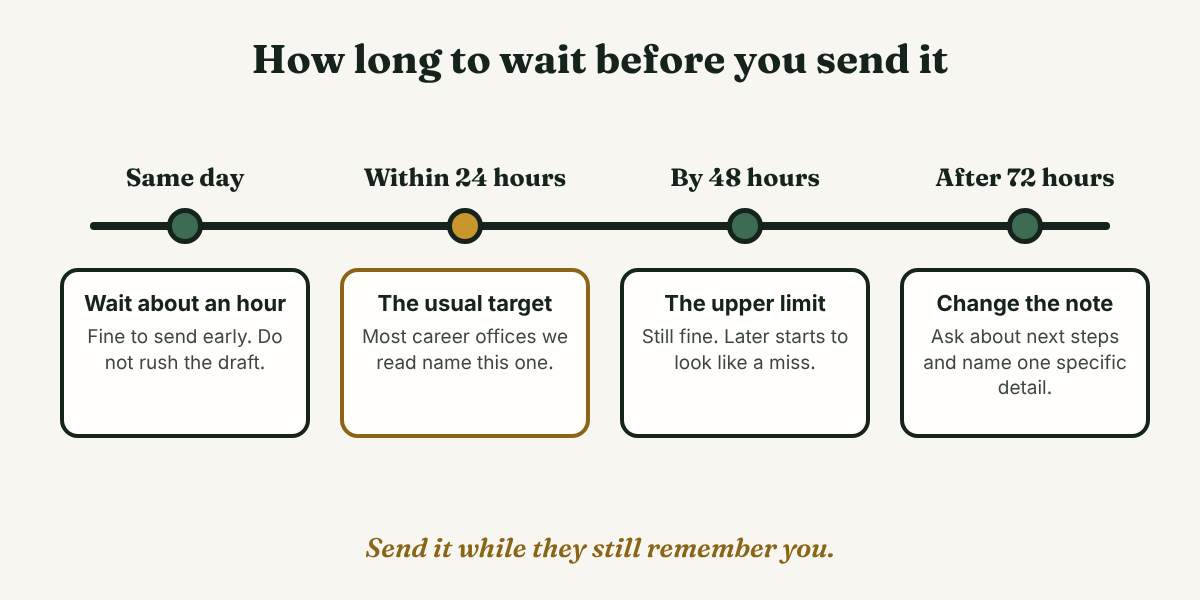
- Within 24 hours. Northeastern, Emory and Built In all point to this window.
- Right after the interview. Mississippi State says same-day is fine, but suggests waiting at least an hour so you do not rush the draft.
- By 48 hours. Rutgers-Newark says 24 to 48 hours, and adds that within 24 hours is usually better. Mississippi State calls 48 hours the limit before it can look like you forgot to hit send.
- After 72 hours. Mississippi State says the note loses its meaning, and suggests asking about next steps instead.
What goes in the email?
Northeastern says three or four sentences. Emory says no more than one or two short paragraphs. Build the note in four steps.
Step 1: Open with thanks and the role
Thank the interviewer and name the position. Northeastern says to match the formality of their earlier messages.
Step 2: Name one specific thing you talked about
This is the part that shows you were listening. Northeastern asks for two or three sentences on something specific from the conversation, tied to your background or interest. Built In says to link your experience to the role in one sentence at most.
Step 3: Close with a short offer and a clean signature
Offer to answer any remaining questions, as Northeastern and Built In suggest. Emory says to end with a professional signature, including your full name, email, phone number and a LinkedIn link.
Step 4: Read it aloud, then send it to one person
Northeastern says to read the note aloud, because a typo is hard to miss and hard to forget. We never recommend automation or mass messaging. Write each note yourself.
What are three examples you can edit?
Change every part in [brackets] and send each email to one person.
1. The next-day note to one interviewer
Subject: Thank you: [Role] interview on [Date]
Dear [Name], thank you for the time you gave me on [day]. What stayed with me was [one specific thing you discussed]. It made the [role] position more appealing, because [one line that links it to your work]. I am glad to answer any further questions. Sincerely, [Your name] | [Phone] | [LinkedIn URL]
2. A panel: one note for each person
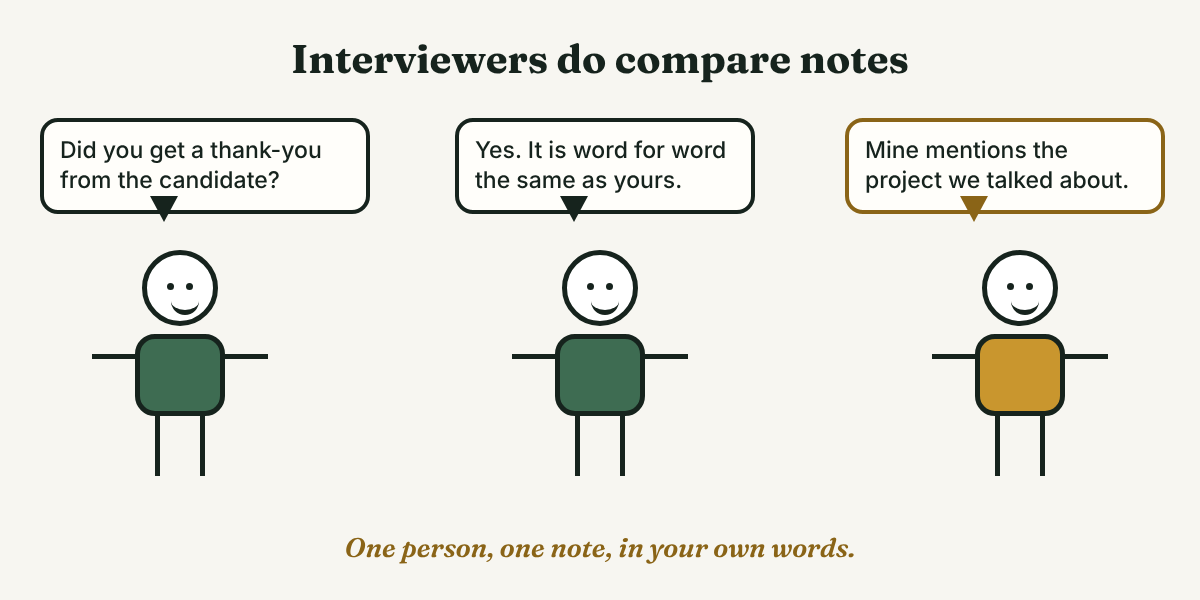
Northeastern warns that interviewers often compare notes, so identical text can stand out. Mississippi State says to send a tailored note to each person who played a key role, and Emory says to thank each interviewer individually. If you lost a name, York University says to contact reception for help. Here are two notes from one interview.
To the hiring manager: Dear [Name], thank you for walking me through how the [team] handles [topic]. I would be glad to help with [the task you described]. If a work sample would help, I can send [link]. Sincerely, [Your name]
To a teammate: Dear [Name], thank you for answering my questions about [day-to-day topic]. Hearing how you [specific detail] helped me picture the work. I appreciate your time. Best, [Your name]
3. A late note, three days after
Mississippi State says a note after three days can still help if it points to a specific part of the conversation, and that skipping is better than sending an awkward one.
Subject: Thank you: [Role] interview
Dear [Name], thank you for speaking with me on [date] about the [role] position. I have kept thinking about [one thing you discussed], and it made me more interested in the work. I am happy to send [a sample or link] if it would help. Sincerely, [Your name]
Does LinkedIn add anything after the email?
Mostly, it adds your profile, not another message. Emory says to put a LinkedIn link in your email signature. Rutgers-Newark lists linking your LinkedIn page or personal website as a benefit of the thank-you email. None of the pages we read asked you to send the thank-you itself through LinkedIn.
Our reading: the link in your signature is enough for most people. A short LinkedIn note can add something in two cases: you are already connected with the interviewer and have no email address, or the decision is made and you want to stay in touch. We cover both in our interview guide. If you met the person through LinkedIn first, see how to write a follow-up email after a LinkedIn connection, or use our guide to choosing between email and LinkedIn.
What should you skip?
- Questions about salary or benefits. Built In says not to ask before an offer is made.
- A reminder of a weak answer. Built In says not to remind the interviewer of negative parts of the interview.
- Identical notes. Write to each person separately.
- A note when the company said no follow-up. Mississippi State says to skip it if the employer asks candidates not to follow up.
- Automation and copy-paste. Skip any tool that sends or repeats messages for you.
Where does a tracker fit?
Full disclosure: we make GrowthSeeded, a simple follow-up tracker for LinkedIn. It does not write your email, send it, or touch LinkedIn. It helps with the part around the note: who interviewed you, what each person said, and who is still waiting to hear from you. You add each person, write a note after each conversation, and a due-today view shows who to follow up with. The next step comes from what happened, such as a reply, not from a fixed date.
Prices, checked October 26, 2026: Free is $0 for 5 active people at a time (up to 20 when friends join through invites), Pro is $15 a month or $150 a year, and Max is $29 a month. They change. For one interview, a notes file and a reminder do the job.
FAQ
What should the subject line of a thank-you email say?
Keep it short: a word of thanks, the role, and the date, as in "Thank you: [Role] interview on [Date]". Skip "Hi" and skip any request.
How soon should you send a thank-you email after an interview?
Within 24 hours if you can. Northeastern, Emory and Built In point to this window, and Mississippi State calls 48 hours the limit.
Should you send the thank-you on LinkedIn instead of email?
The sources we read favor email, with your LinkedIn link in the signature. A short LinkedIn note makes sense if you are already connected and have no email address, or after the decision.
Should you email each interviewer separately?
Yes. Northeastern, Emory and Mississippi State all say to write to each person, and Northeastern notes that interviewers often compare.
What if you waited too long to send it?
After about three days, send a short note only if you can point to a specific detail. After that, Mississippi State suggests asking about next steps instead of sending a thank-you.
Do this today
- While the interview is fresh, write down one specific thing you discussed with each person.
- Draft a subject line and a short email for each interviewer, then read each aloud.
- Add your LinkedIn link to your signature and send each note within 24 hours.
A thank-you email is the first of several small messages after an interview. In GrowthSeeded you can add each interviewer, save the detail you plan to mention, and use the due-today view to see who is still waiting on a note. You write every email yourself. It never sends anything or touches LinkedIn, so your account stays safe. The Free plan covers 5 active people at a time.
Sources
- Thank You Notes, Northeastern University Experiential Education and Career Development, 2026
- Writing Thank You Letters, Emory University Career and Professional Development, 2021, updated 2025
- How to Write a Thank You Email After an Interview, Built In, 2024
- Thank you email after interview subject line, Rutgers University-Newark Career Resources and Exploration, 2023
- When to Send a Thank-you Email After an Interview, Mississippi State University Career Center, 2026
- Follow up after an interview, York University Co-op and Career Centre, 2026
About the author
Anisur Rahman Fagun is a marketing and content strategist with more than 9 years of experience in SEO, content, paid advertising and brand growth. He holds a master's degree in mass communication and journalism, and has led content and SEO strategy, built editorial teams and worked with product, design and sales teams. He also builds simple tools that turn marketing data into clear decisions. He writes the GrowthSeeded blog, which shares practical ways to follow up and stay in touch with people on LinkedIn.