Networking
LinkedIn Follow-Up Message After an Interview: 4 Examples
10 min read
Key takeaways
- Send the thank-you as an email within 24 to 48 hours. Most career pages we read name email as the main channel.
- LinkedIn fits in two cases: you are already connected with the interviewer, or the interview is over and the decision is made.
- If you hear nothing after 7 to 10 business days and no timeline was given, send one short check-in. Then stop.
- Write each message to one person, in your own words.
Short answer: Send a thank-you email within 24 to 48 hours of the interview. Use LinkedIn if you are already connected with the interviewer. Send a connection request with a short note only after the decision, because several career offices say a request right after an interview can feel too forward. Keep each message to a few sentences.
In this article
Why is a LinkedIn message after an interview tricky?
Should you use email or LinkedIn after an interview?
When should you send each message?
What should the message include?
What are four examples you can edit?
What should you skip?
Where does a tracker fit?
FAQ
Do this today
Why is a LinkedIn message after an interview tricky?
The interview is over, and you want to leave a good impression. It is easy to overthink it. Which app? How long? Is it too soon?
The tricky part is that LinkedIn sits between two moments. During the hiring process, the interviewer is deciding about you. After the decision, you are two professionals who spoke once. A message that fits the second moment can feel pushy in the first.
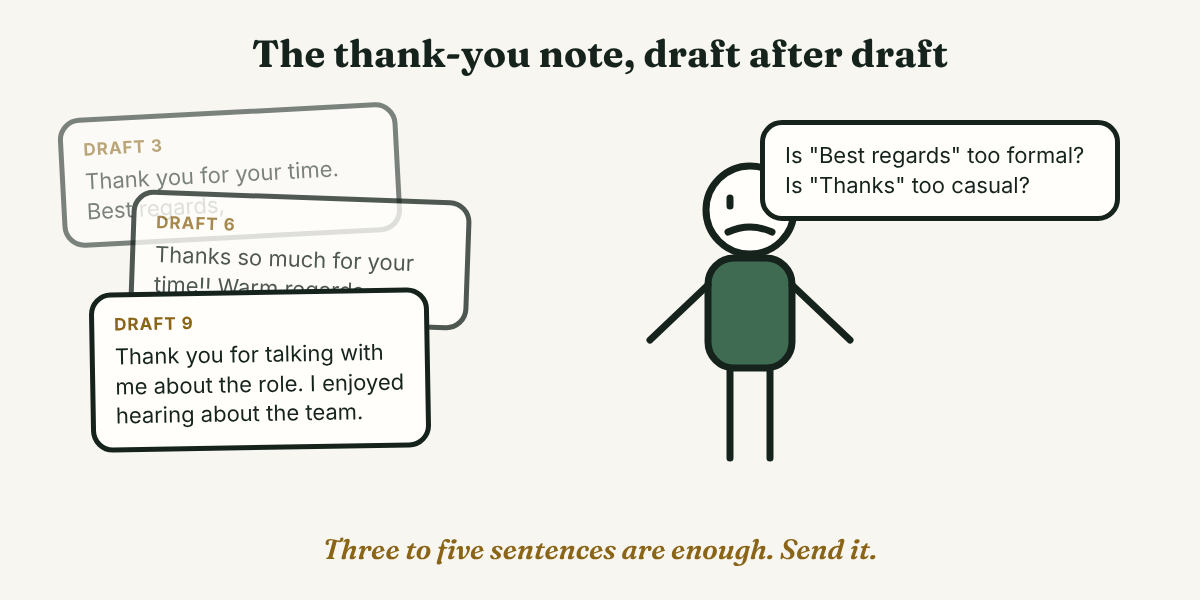
So the question is which channel to use, and when. If your moment is different, see our guides to the follow-up after you apply and the follow-up message to a recruiter may fit better.
Should you use email or LinkedIn after an interview?
Email is the main channel in the sources we read, and they split on LinkedIn.
- UNLV Career Services: email is "the most common follow-up method." LinkedIn works if you connected with the interviewer, through "a brief, courteous message."
- USC Career Center: the thank-you should be emailed. The page does not mention LinkedIn.
- Bentley University: use a personalized email. The page says "Connecting on LinkedIn is not appropriate right after an interview," because an offer is not guaranteed and the request could put the interviewer in an awkward position.
- Northeastern University: send thank-you notes by email. An invite right after the interview is considered inappropriate, and connecting after you formally accept an offer is fine.
- Rutgers University-Newark (an Ivy Exec article): wait until a hiring decision is made. Until then, send a thank-you email instead of a LinkedIn request.
- A Western Michigan University textbook page and a BYU career page: both are more open. The first says an email or LinkedIn message the day after is appropriate. The second says to connect with your interviewers after the interview. Neither shows a year.
Our reading: the weight of the sources points to email first. If you are already connected, a LinkedIn message is fine. If you are not, a new connection request can wait until you know the result. If you are weighing the two channels, our guide on choosing between a follow-up email and a LinkedIn message walks through the choice.
When should you send each message?
Three moments matter.
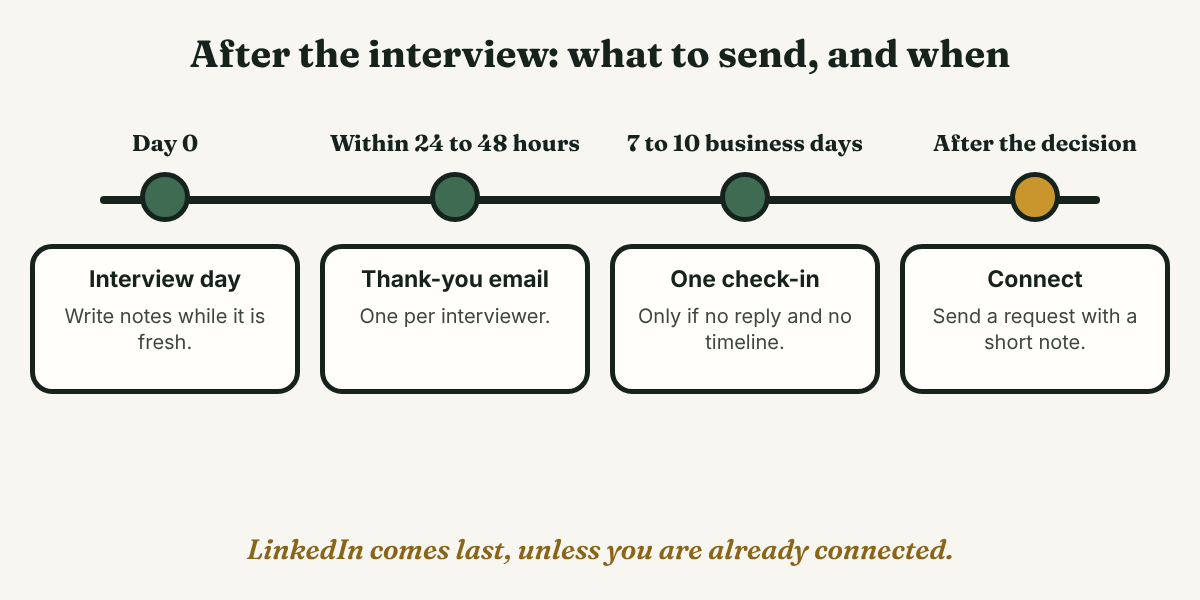
Within 24 to 48 hours: the thank-you. UNLV and USC say within 24 hours. Bentley says within 48 hours. Fidelity says within a day. The day after the interview is inside every window.
After 7 to 10 business days: one check-in. UNLV says to send a polite follow-up if you have not heard anything after 7 to 10 business days. Northeastern gives the same range and says to restate your interest and ask if the hiring manager needs anything more from you. If the employer gave you a timeline, UNLV says to respect it.
After the decision: the connection. Rutgers calls waiting for the decision "the most measured strategy," and says an early request can seem overconfident. Northeastern says a request after you accept an offer is fine.
One hiring manager in the Rutgers article said an early request could sway them the wrong way if they were undecided. We do not know how common that is, but you can avoid the risk by waiting.
What should the message include?
Keep every message short. USC says three to five sentences should be enough, and Northeastern says six or fewer. Use these four parts.
Step 1: Thank them for one specific thing
Thank them for their time, and name one thing you talked about. UNLV says to mention something discussed, and USC says to use a key takeaway from the conversation.
Step 2: Add one line about fit
UNLV says to reaffirm your interest. Say why the role still interests you, in one line. Do not retell your résumé.
Step 3: Make one small offer or one small ask
Offer a link or a work sample if it helps, as Fidelity suggests. In a check-in, ask about the timeline instead. Do not ask for more than one thing.
Step 4: Write to each person separately
USC says to send each interviewer a separate, personalized message, and Fidelity says not to send identical copies. If three people interviewed you, write three short messages.
What are four examples you can edit?
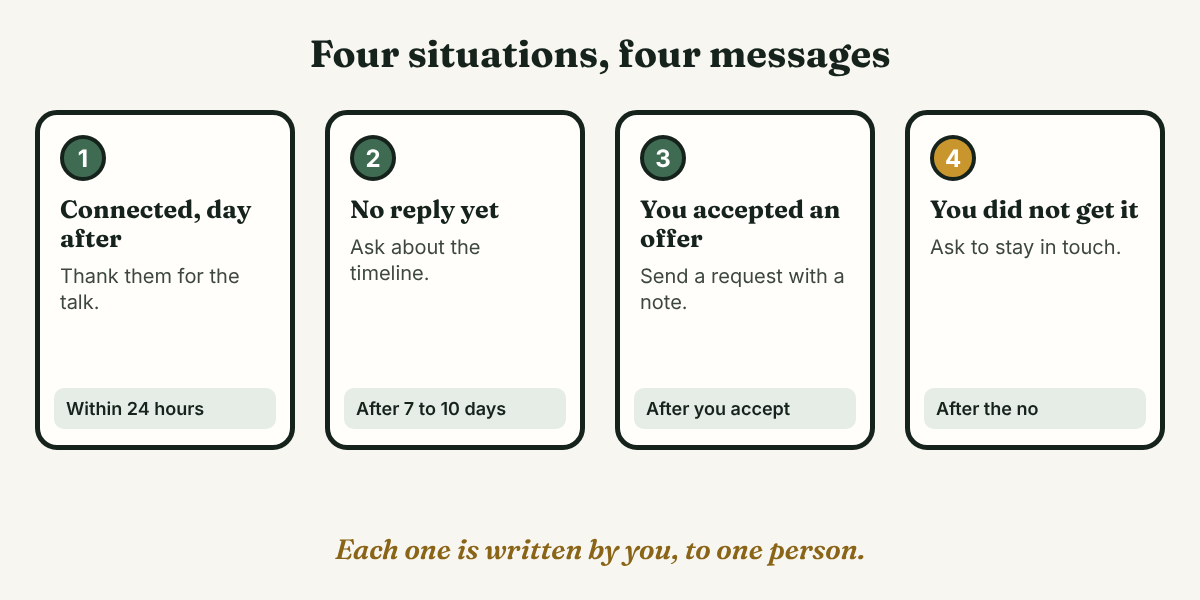
Pick the one that matches your situation, change every part in [brackets], and send it to one person. A connection note box is small, so check what your screen allows.
1. You are already connected, and it is the day after
Use this when you are connected with the interviewer and have no email address. If you already sent an email, do not send the same thank-you here.
Hi [Name], thank you for talking with me yesterday about the [role] position. I enjoyed hearing how your team handles [one thing you discussed]. It made me more interested in [one part of the role]. If it would help, I can send [a link or a work sample]. Thank you, [Your name]
2. You heard nothing after 7 to 10 business days
Send this by email, or on LinkedIn if you are connected. Send it once.
Hi [Name], I wanted to check in on the [role] position after our conversation on [date]. I am still very interested in [one part of the role]. Is there anything else you need from me, or an update on the timeline? Thank you, [Your name]
3. You accepted an offer
Rutgers says you can connect after an offer. Northeastern says to wait until you formally accept.
Hi [Name], I accepted the [role] offer and I look forward to working with you and the team. Thank you for the time you gave me during the interviews. I would like to connect here.
4. You did not get the job
Rutgers says you can still connect after a no, and suggests saying you enjoyed getting to know the person and want to be considered for future openings.
Hi [Name], thank you for the time you gave me during the interview for the [role] position. I enjoyed getting to know you and learning about [one thing]. I would like to stay connected and be considered for future openings. Thank you, [Your name]
What should you skip?
Skip these:
- A connection request right after the interview. Bentley and Northeastern call it inappropriate right after the interview, and Rutgers says to wait for the decision.
- More than one check-in. UNLV says one follow-up is usually enough.
- Copy and paste. We never recommend automation, bots or mass messaging. Write each note yourself.
- Typos. USC says the thank-you may be your last writing sample, so proofread it.
Where does a tracker fit?
Full disclosure: we make GrowthSeeded, a simple follow-up tracker for LinkedIn. It does not write your message, send it, or touch LinkedIn. It helps with the part around the message: who interviewed you, what you talked about, and who is waiting for a note. You add each person, write a note after each conversation, and a due-today view shows who to follow up with. The next step comes from what happened, such as a reply, not from a fixed date.
Prices, checked October 25, 2026: Free is $0 for 5 active people at a time (up to 20 when friends join through invites), Pro is $15 a month or $150 a year, and Max is $29 a month. They change.
If you have one interview this month, a notes app is enough. A tracker helps when several rounds and interviewers overlap.
FAQ
Should you send a LinkedIn message after an interview?
Yes, if you are already connected with the interviewer, according to UNLV. If not, the sources lean toward a thank-you email first and a connection request after the decision.
How soon should you send a thank-you after an interview?
Within 24 to 48 hours. UNLV and USC say within 24 hours, and Bentley says within 48 hours.
Should you connect with an interviewer on LinkedIn before you hear back?
The sources do not agree. Bentley, Northeastern and Rutgers say to wait, and BYU says to connect after the interview. Waiting is the lower risk choice.
How long should you wait before you follow up?
About 7 to 10 business days, if the employer gave no timeline. UNLV and Northeastern give this range. If the employer named a date, wait until it passes.
How many follow-up messages are too many?
One is usually enough, according to UNLV. After that, keep applying.
Do this today
- Open your interview notes and write one thing you discussed with each person.
- Write a three to five sentence thank-you email to each interviewer.
- Set a reminder for 7 to 10 business days out, and pick the one question for a check-in.
After an interview you have a few people to remember and one thing to say to each. In GrowthSeeded you can add each interviewer, write down what you talked about while it is fresh, and see on the due-today view who to follow up with. You send every message yourself. It never sends anything or touches LinkedIn, so your account stays safe. If you have only a few interviews lined up, the Free plan covers 5 active people at a time.
Sources
- Following Up, UNLV Career Services, 2026
- Thank-you emails and why they matter, USC Career Center, 2022
- How to follow up after an interview, Fidelity, checked 2026
- When & How to Follow Up, Bentley University, 2020
- How to correspond with a potential employer, Northeastern Global News, 2016
- Should You Connect on LinkedIn with Your Interviewer?, Rutgers University-Newark Career Resources and Exploration, via Ivy Exec, 2024
- Open textbook page on a professional job search, Western Michigan University, checked 2026
- Connecting with interviewers, BYU career page, checked 2026
About the author
Anisur Rahman Fagun is a marketing and content strategist with more than 9 years of experience in SEO, content, paid advertising and brand growth. He holds a master's degree in mass communication and journalism, and has led content and SEO strategy, built editorial teams and worked with product, design and sales teams. He also builds simple tools that turn marketing data into clear decisions. He writes the GrowthSeeded blog, which shares practical ways to follow up and stay in touch with people on LinkedIn.